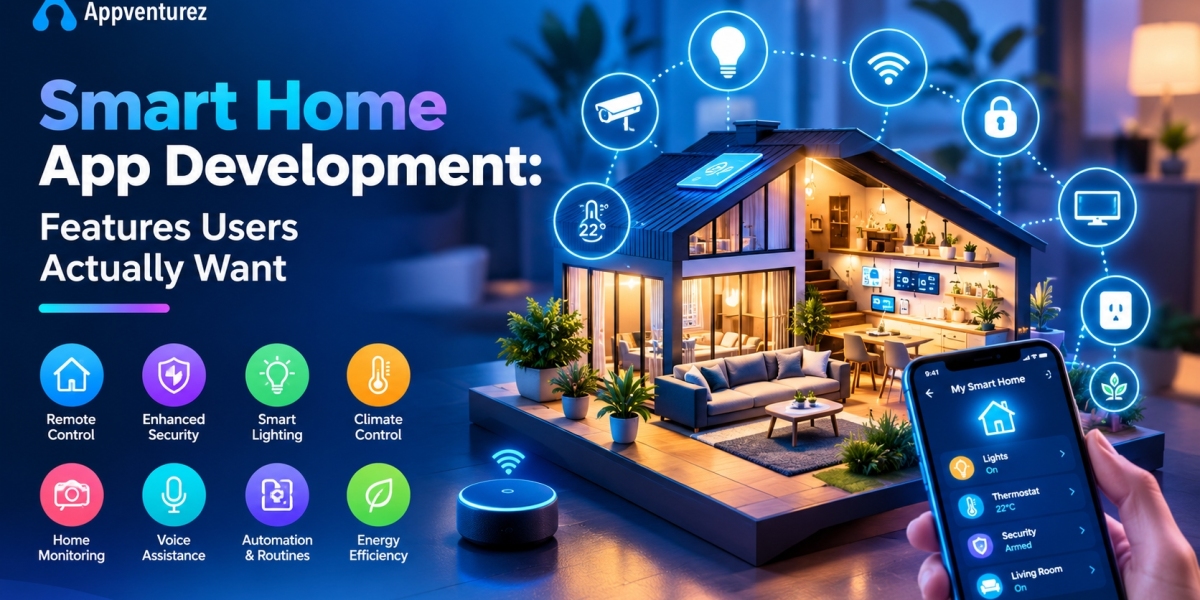

A smart home is only as smart as the app that controls it. You can fill a house with connected lights, locks, thermostats, cameras, speakers, and appliances, but if the app is confusing, slow, or unreliable, people stop using it. Many smart home products fail not because the hardware is bad, but because the software experience falls short of what users expect.
Today's homeowners and renters want more than a remote control on their phone. They want devices that connect in minutes, respond instantly, work together without effort, keep their family safe, save money on energy, and protect their privacy. They want a home that adapts to them, not one that demands constant attention.
If you're a startup building a connected device, a manufacturer adding an app to your product line, or a real estate and property business creating smart living experiences, knowing which features truly matter is the key to adoption and retention. Companies like Appventurez help businesses design and build scalable, secure, and user-friendly smart home solutions that people love to use.
In this comprehensive guide, we'll explore the features users actually want in smart home apps, the technologies behind them, the development process, cost factors, challenges, and why India has become a preferred destination for smart home app development.
Why Smart Home Apps Matter
The app is the face of your smart home product. For most users, it is the main way they experience the technology every single day.
A great smart home app:
Makes setup simple, even for non-technical users
Gives one place to control devices from different rooms and, ideally, different brands
Saves time, energy, and money
Improves comfort, convenience, and safety
Builds trust through reliability and privacy
Keeps users engaged long after the first week
A poor app does the opposite. It frustrates users, generates support tickets, damages brand reputation, and leads to returns and bad reviews.
What Users Actually Want: Top Features in a Smart Home App
Here are the features that matter most to real users, ordered roughly from the basics to the differentiators.
1. Fast, Frictionless Device Setup
Setup is the first impression, and many apps lose users right here. People want to add a device in a few taps, using QR code scanning, Bluetooth pairing, or guided Wi-Fi onboarding. Clear instructions, helpful error messages, and automatic device discovery make a major difference. If setup takes more than a few minutes or requires technical knowledge, users give up.
2. A Simple, Intuitive Interface
The best smart home apps feel obvious. Users should be able to find and control their most-used devices within a couple of taps. A clean home screen with favorite devices, room-based organization, clear on/off states, and large touch targets works better than a cluttered dashboard.
3. Reliable, Real-Time Control
When a user taps a button, the light should respond right away, and the app should show the true state of the device. Delays, incorrect statuses, and failed commands destroy trust faster than almost anything else. Users want control that simply works.
4. Room and Zone Organization
People think in terms of rooms and areas such as the living room, bedroom, kitchen, and garden. Letting users group devices by room, control a whole room at once, and create custom zones makes large setups manageable.
5. Scenes and Routines
Scenes let users trigger multiple actions with a single tap, such as a "Movie Night" scene that dims the lights, lowers the blinds, and turns on the TV. Routines add scheduling and triggers, such as turning on porch lights at sunset or starting a "Good Morning" routine on weekdays. These save time and make the home feel truly smart.
6. Smart Automation and Rules
Beyond schedules, users want automations that react to conditions: turn on the hallway light when motion is detected after dark, switch off the air conditioner when a window opens, or start the robot vacuum when everyone leaves. An easy rule builder with clear "if this, then that" logic, designed for non-programmers, is a major differentiator.
7. Voice Assistant Integration
Many users already rely on voice assistants such as Amazon Alexa, Google Assistant, and Apple's Siri. Supporting these ecosystems lets people control devices hands-free and fits into the habits they already have. Offering voice control in multiple languages broadens your audience further.
8. Remote Access and Notifications
Users want to check and control their home from anywhere. Timely, relevant notifications, such as a door left unlocked, a package delivery, a water leak, or unusual activity, are among the most valued features. The key is to make notifications useful and customizable, not noisy.
9. Security and Safety Features
Safety is a top reason people buy smart home products. Popular features include:
Live camera viewing and recorded clips
Motion and person detection alerts
Smart lock control with temporary guest access codes
Door and window sensor status
Smoke, carbon monoxide, and water leak alerts
Video doorbell integration
Alarm arming and disarming
These features need especially strong reliability and security.
10. Energy Monitoring and Savings
Energy costs matter to most households. Users appreciate apps that show real-time and historical energy usage by device or room, offer smart thermostat scheduling, suggest savings, and automate energy-saving behaviors. Clear, simple charts are more helpful than raw numbers.
11. Multi-User and Family Sharing
Homes have more than one person. Users expect to invite family members, roommates, or guests, assign different permission levels, and manage who can control which devices. Temporary access for guests, cleaners, or service providers is increasingly popular.
12. Cross-Brand Compatibility
People rarely buy every device from one manufacturer. Users want one app, or at least one smooth experience, that works with lights from one brand, a thermostat from another, and a speaker from a third. Support for open standards such as Matter helps devices from different manufacturers work together more reliably.
13. Offline and Local Control
When the internet goes down, a light switch should still work. Local control, where devices communicate directly on the home network without needing the cloud, improves speed, reliability, and privacy. Users value apps that keep core functions working during outages.
14. Privacy Controls and Transparency
Microphones, cameras, and presence sensors inside the home make privacy a real concern. Users want clear information about what data is collected, simple controls to turn off recording, easy ways to delete history, and strong account security. Apps that treat privacy as a feature, not a footnote, earn trust.
15. Personalization and Learning
A smart home should adapt over time. Learning thermostats, lighting that adjusts to daily patterns, and suggestions based on habits make the experience feel intelligent. Personalization works best when users can see and override what the system is doing.
16. AI Assistant and Natural Language Control
The next big step is conversational control. With NLP and an AI chatbot, users can type or say "make the living room cozy" or "why is my bedroom so warm?" and get helpful responses and actions. An AI assistant can also explain alerts, recommend automations, and help troubleshoot problems, reducing frustration and support requests.
17. Device Health and Troubleshooting
Batteries die, Wi-Fi drops, and firmware needs updates. Users appreciate clear device status, battery level warnings, simple troubleshooting guidance, and one-tap fixes. Automatic firmware updates with clear communication keep devices secure without manual effort.
18. Activity History and Insights
A readable history of events, such as when the front door was unlocked or when the heating ran, helps users understand what is happening in their home. Weekly summaries and insights add value without requiring effort.
19. Accessibility and Inclusive Design
Smart homes can be life-changing for older adults and people with disabilities. Support for screen readers, voice control, large text, high contrast, and simple layouts makes your app usable by more people and often improves the experience for everyone.
20. Widgets, Wearables, and Quick Controls
People don't want to open an app for every small action. Home screen widgets, notification shortcuts, smartwatch controls, and lock-screen actions provide faster access to the most common tasks.
Features That Look Impressive but Rarely Matter
Not every feature earns its place. Be careful with:
Overly complex dashboards with too many graphs and toggles
Gimmicky animations that slow the app down
Too many notifications, which train users to ignore alerts
Forced account creation before users can try basic features
Features that require constant manual tuning
Advanced automation tools that only engineers can understand
The best approach is to nail the essentials first, then add advanced features based on real user feedback.
Technologies Behind Smart Home Apps
Connectivity Technologies
Smart home devices connect through Wi-Fi, Bluetooth Low Energy, Zigbee, Z-Wave, and Thread. Each has trade-offs in range, power use, speed, and reliability, and many homes use a mix.
Matter
Matter is an industry standard designed to help smart home devices from different manufacturers work together across major ecosystems. Supporting it can reduce compatibility headaches for users and expand your product's reach.
Messaging and Communication Protocols
Protocols such as MQTT, HTTP, and CoAP carry data between devices, hubs, apps, and the cloud, depending on device capabilities and architecture.
Cloud Platforms
Cloud services handle device registration, remote access, data storage, user accounts, and analytics. Major providers such as AWS, Microsoft Azure, and Google Cloud offer tools that can support smart home backends.
Mobile App Development
Apps are commonly built natively for Android with Kotlin and for iOS with Swift, or with cross-platform frameworks such as Flutter and React Native, depending on budget and performance needs.
Voice Assistant SDKs and APIs
Integrations with Alexa, Google Home, and Apple Home let your devices work within the ecosystems users already know.
AI and Machine Learning
AI powers voice and chat understanding, behavior learning, anomaly detection, and smart recommendations. Edge AI can run on devices or hubs for faster responses and better privacy.
Security Technologies
Encryption, secure device identity, signed firmware updates, multi-factor authentication, and secure key storage help protect homes and families.
Smart Home App Development Process
Step 1: Research Users and the Market
Start by understanding who your users are, what frustrates them about existing products, and what they would pay for. Study competitors and read their reviews carefully, because complaints reveal opportunities.
Step 2: Define Scope and Priorities
Decide which devices and ecosystems you will support and which features belong in the first release. Focus on solving a few core problems well.
Step 3: Design the Architecture
Choose connectivity technologies, communication protocols, cloud platform, and the balance between local and cloud control.
Step 4: Design the User Experience
Create wireframes and prototypes for onboarding, device control, automations, and notifications. Test them with real users, including non-technical ones, before development begins.
Step 5: Build the MVP
Develop a Minimum Viable Product with core features such as setup, control, scenes, and notifications. This lets you launch sooner and learn from real usage.
Step 6: Integrate Devices and Ecosystems
Connect with device firmware, voice assistants, and third-party platforms, and test compatibility carefully.
Step 7: Test in Real Homes
Homes are messy environments with weak Wi-Fi, thick walls, and dozens of competing devices. Test in realistic conditions, across many phones and operating system versions, and include scenarios such as power cuts and network outages.
Step 8: Prioritize Security and Privacy
Build security into the design from day one, including secure onboarding, encrypted communication, and strict access control.
Step 9: Launch and Gather Feedback
Release in phases, watch usage data, and listen closely to reviews and support tickets.
Step 10: Improve Continuously
Release updates, add features, support new devices, and keep firmware and apps secure over time.
Challenges in Smart Home App Development
Device Fragmentation and Compatibility
The market includes countless brands, protocols, and standards. Ensuring devices work together reliably takes careful engineering and testing.
Unreliable Home Networks
Weak Wi-Fi, router quirks, and interference cause many support issues. Smart retry logic, clear error messages, and local control help.
Security and Privacy Risks
Smart homes handle intimate data and control physical access. Weak security can lead to serious harm, so protection and transparency are essential.
Onboarding Complexity
Pairing devices across different networks and ecosystems is one of the hardest user experience challenges.
Latency and Real-Time Performance
Users notice delays of even a second or two. Architecture choices, such as local control and efficient messaging, directly affect responsiveness.
Long-Term Maintenance
Devices may stay in homes for many years. Firmware updates, operating system changes, and cloud costs must be planned for the long term.
Balancing Simplicity and Power
Beginners want simplicity, while enthusiasts want deep customization. Good apps offer a simple default experience with advanced options available for those who want them.
Cost Factors in Smart Home App Development
The cost depends on many variables. Exact figures vary widely, so request a detailed estimate based on your specific scope.
Number of supported devices and ecosystems
Feature set, including automation, voice control, video, and AI
Platform choice: Android, iOS, or both
Custom hardware and firmware work versus off-the-shelf devices
Cloud infrastructure and ongoing usage fees
UI/UX design depth
Security and compliance requirements
Third-party integrations and certifications
Team size and location
Maintenance, support, and updates after launch
Starting with an MVP and expanding based on user feedback is one of the most effective ways to control cost and reduce risk.
Why India is a Preferred Destination for Smart Home App Development
India has become a global hub for IoT and mobile app development, and many businesses choose Indian partners for good reasons.
Skilled Engineering Talent
India produces thousands of engineers every year with expertise in mobile development, embedded systems, cloud platforms, and AI.
Cost-Effective Development
Compared to North America and Europe, businesses can significantly reduce development costs while maintaining high-quality standards.
Strong Technology Ecosystem
India hosts thousands of technology companies offering IoT consulting, mobile app development, cloud services, and UI/UX design.
Flexible Engagement Models
Businesses can choose from:
Dedicated development teams
Fixed-price projects
Hourly hiring
Staff augmentation
Offshore development centers
Global Project Experience
Indian companies work with clients across the US, UK, Europe, Australia, and the Middle East, making them familiar with international compliance standards and agile project management.
How to Choose the Right Smart Home App Development Partner
The right partner shapes both the quality of your product and the speed of your launch. When evaluating an IoT app development company, look for:
Proven experience with IoT and smart home projects
Strong mobile app and UI/UX design capabilities
Expertise in device connectivity, firmware integration, and cloud architecture
Experience integrating voice assistants and standards such as Matter
A documented secure development process
Transparent pricing and realistic timelines
Agile development methodology
Post-launch maintenance and support
Relevant case studies and client testimonials
A reliable technology partner builds around how real people use their homes, not just around technical specifications.
Why Choose Appventurez for Smart Home App Development?
When businesses plan to build connected home products, choosing the right technology partner becomes crucial. Appventurez has established itself as a trusted software development company offering innovative mobile, cloud, AI, and IoT solutions tailored to different industries.
The company focuses on delivering scalable, secure, and business-oriented applications that help organizations connect devices, simplify user experiences, and make smarter decisions. From designing intuitive mobile apps and device onboarding flows to building cloud backends, voice integrations, and AI-powered assistants with NLP and chatbot capabilities, Appventurez combines technical expertise with a deep understanding of business needs.
By leveraging modern frameworks, cloud technologies, AI capabilities, and agile methodologies, Appventurez ensures every smart home solution is designed for long-term scalability, seamless integration, strong security, and measurable business outcomes.
Future Trends in Smart Home Apps
The smart home landscape continues to evolve quickly, and these trends are worth watching.
Key trends include:
Wider adoption of Matter and greater cross-brand compatibility
Generative AI assistants that understand natural requests and explain what is happening at home
Proactive homes that anticipate needs instead of waiting for commands
More on-device and local AI for speed and privacy
Deeper energy management, including solar, batteries, and electric vehicle charging
Smart home features in rental properties, hotels, and senior living
Health and wellness integrations through wearables and ambient sensors
Stronger privacy expectations and regulation for connected devices
Presence-aware and context-aware automation
Simpler setup experiences that reduce the need for hubs and manual configuration
Businesses that build flexible, standards-friendly foundations today will adapt more easily as these trends mature.
Conclusion
The most successful smart home apps are not the ones with the most features. They are the ones that make everyday life easier: setup that takes minutes, control that responds instantly, automations that quietly save time, security that people can trust, energy insights that save money, and privacy that is respected. Add accessibility, cross-brand compatibility, and an AI assistant that understands natural language, and you have an app people will keep using for years.
Success depends on understanding real users, focusing on a strong MVP, designing for reliability and security, and choosing a partner with deep experience in IoT and mobile development. India continues to stand out as a preferred destination for smart home app development thanks to its exceptional engineering talent, cost-effective delivery models, and growing expertise in AI, cloud, and embedded technologies. By partnering with an experienced IoT app development company like Appventurez, businesses can build scalable, secure, and future-ready smart home solutions tailored to their specific goals.
Whether you're launching a smart-device startup, expanding a connected product line, or creating intelligent living experiences, building the features users actually want is the surest path to a smart home app that people love and rely on.










