
More Than Just Placing Objects
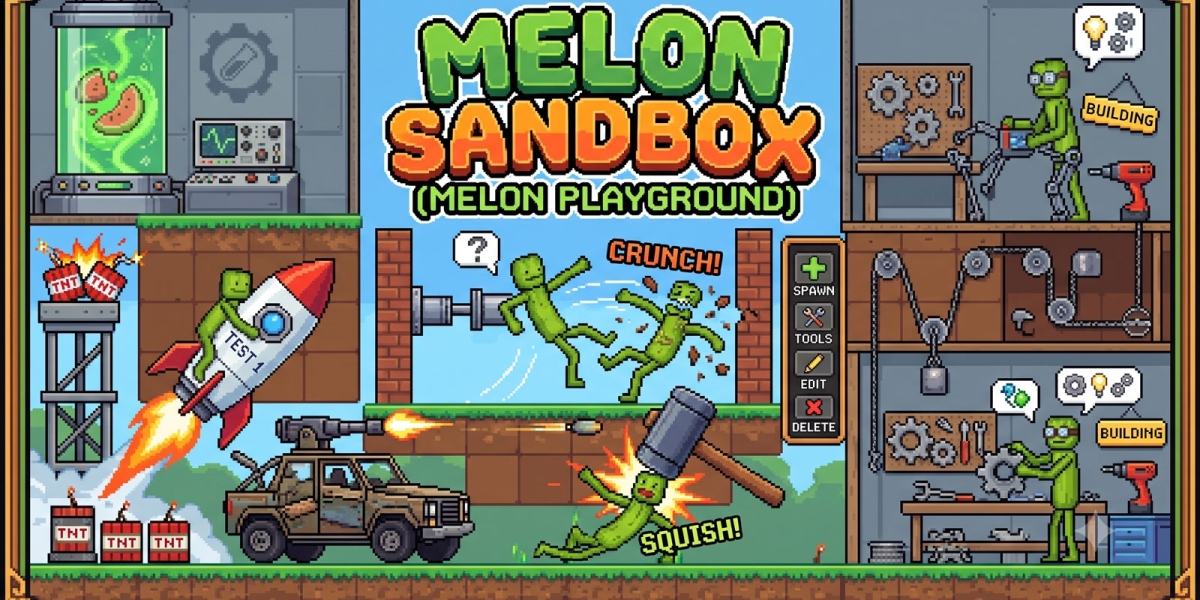
A sandbox game becomes interesting when simple actions can lead to different outcomes. Melon Sandbox gives players an interactive environment filled with characters, tools, vehicles, and other objects that can be arranged into custom scenes. Rather than sending you through a series of missions, it lets you decide what to explore and how to approach each situation.
You can start with a rough idea and build around it, or begin with a few random objects and see what develops. Either way, the experience is shaped by your own choices.
See What Happens When Things Interact
One of the main attractions of Melon Sandbox is the way objects respond to their surroundings. Movement, gravity, and collisions can influence a scene, making object placement an important part of your setup.
Try putting two objects in different positions and observing how their interactions change. You could also introduce another item to see whether it affects the result. These small tests help you understand the environment while giving you ideas for more elaborate creations.
Not every attempt will produce the outcome you expected. That is part of the appeal: you can change the arrangement, repeat the action, and see whether a different approach works better.
Build Around Your Own Goals
Without a fixed mission to complete, you can create personal objectives to give each session direction. Perhaps you want to arrange a scene with several moving parts, reproduce a situation you imagined, or find a particular way to combine objects.
You can keep these goals simple. For instance, choose three objects and find an interesting way to use them together. Once you finish, replace one item or rearrange the scene to create a new challenge.
This style of play makes the game accessible to different types of players. Those who enjoy planning can spend time refining their designs, while those who prefer improvisation can make quick changes and react to the results.
Tips for Exploring More Effectively
A little structure can help you get more from your experiments without making the game feel restrictive.
Begin with a small setup. Fewer objects make individual interactions easier to observe.
Learn each control. Understanding how to select and move items helps you work more efficiently.
Change one variable at a time. This makes it easier to notice why the result has changed.
Reuse interesting arrangements. Repeating a scene allows you to compare different approaches.
Keep experimenting. If an idea does not work, treat it as a reason to try another configuration.
You can also take a break from building and focus on observing what is already happening in your scene. Sometimes, paying attention to a small detail can suggest a completely new idea.
A Flexible Game for Different Moods
Some days, you may want to spend time creating a detailed arrangement. On other days, a quick experiment may be enough. Melon Sandbox accommodates both because you decide when to start a new idea, change direction, or finish a session.
The experience can also develop as you become more familiar with the available objects. What begins as a basic scene may gradually turn into a more involved construction as you discover new combinations and interactions.
Getting Started in Your Browser
Depending on the version offered by a gaming platform, you may be able to play through your web browser. Open a compatible game page, check the available controls, and begin with a simple setup. If the game feels unfamiliar, learning the basic interactions first can make later experiments easier to manage.
Final Thoughts
Melon Sandbox turns curiosity into a central part of gameplay. You can create your own scenes, observe how objects behave, and refine your ideas through repeated attempts. There is no need to rush toward an ending or follow someone else's strategy. Choose a starting point, test a possibility, and let the results guide your next move.










