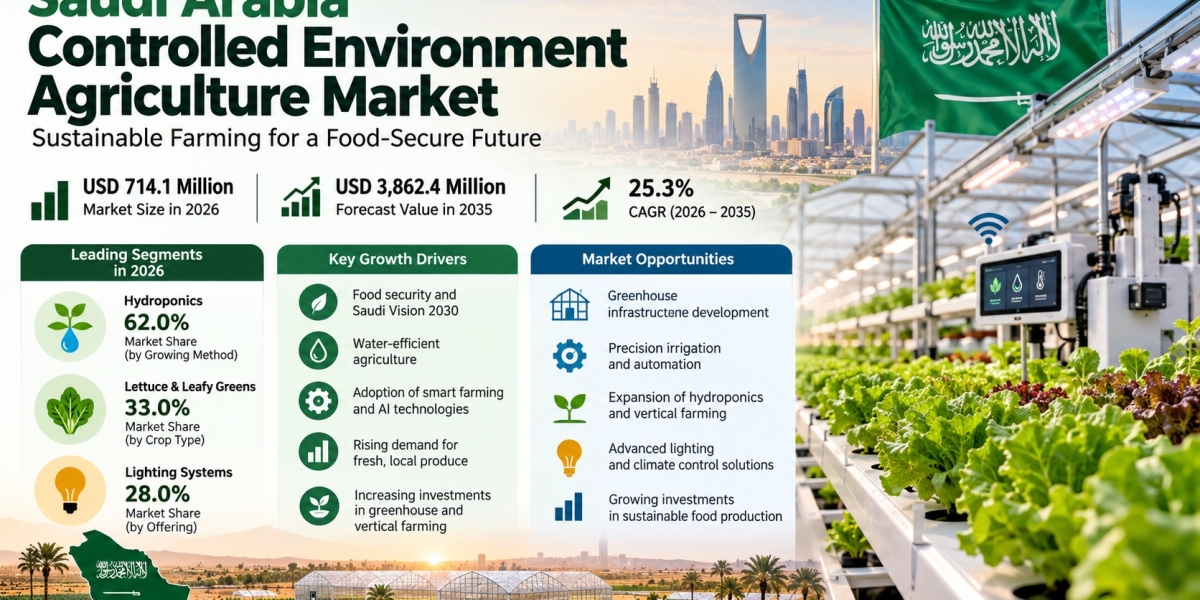

Saudi Arabia is accelerating its transition toward sustainable, technology-enabled farming as food security, water conservation, and agricultural self-sufficiency become national priorities. The Saudi Arabia Controlled Environment Agriculture Market is emerging as an important investment opportunity, supported by greenhouse modernization, hydroponic cultivation, vertical farming, and advanced agricultural automation.
According to Dimension Market Research, the market is projected to reach USD 714.1 million in 2026, expanding to USD 3,862.4 million by 2035, at a compound annual growth rate (CAGR) of 25.3% during 2026 to 2035. This growth reflects increasing investments in water-efficient agriculture, fresh produce cultivation, and smart farming infrastructure aligned with Saudi Vision 2030.
The country's challenging agricultural climate, limited arable land, and growing requirements for reliable food supplies are accelerating interest in climate-controlled cultivation. For agricultural technology companies, greenhouse developers, and investors, this transformation creates opportunities across precision irrigation, automated environmental controls, LED lighting, and soilless farming systems.
What Is the Saudi Arabia Controlled Environment Agriculture Market?
Controlled environment agriculture (CEA) refers to agricultural production systems that regulate growing conditions such as temperature, humidity, lighting, irrigation, and nutrient delivery to improve crop consistency and resource efficiency.
In Saudi Arabia, CEA encompasses greenhouse farming, hydroponics, aeroponics, aquaponics, and indoor vertical farming. These approaches support vegetable and fruit production in environments where conventional agriculture faces significant climatic limitations.
Unlike traditional open-field farming, controlled cultivation allows growers to manage production conditions throughout the year. It also supports more precise water and nutrient management, helping agricultural businesses develop productive farming operations despite environmental constraints.
Why Is Controlled Environment Agriculture Growing in Saudi Arabia?
Food security remains one of the most important forces shaping agricultural investment in the Kingdom. Saudi Vision 2030 encourages sustainable food production, agricultural modernization, and technologies that can improve domestic supply reliability.
The market also benefits from rising demand for fresh vegetables, leafy greens, and locally produced food. Greenhouse operators are adopting climate-control equipment, fertigation systems, and hydroponic technologies to deliver consistent crop quality.
Agricultural production figures illustrate this transition. Saudi greenhouse vegetable production increased from approximately 721,000 tons in 2023 to 797,000 tons in 2024, as cited in the DMR report from the General Authority for Statistics.
Meanwhile, agricultural imports increased from 16.9 million tons in 2023 to 18.7 million tons in 2024. This reinforces the importance of expanding efficient domestic production alongside broader food supply strategies.
Get a Free Sample of the Saudi Arabia Controlled Environment Agriculture Market Report
Evaluating investment opportunities in Saudi Arabia's agricultural technology industry? Explore the report sample to understand the research scope, covered segments, competitive landscape, and market outlook.
Saudi Arabia Controlled Environment Agriculture Market: Key Statistics
● 2026 Market Size: USD 714.1 Million
● 2035 Forecast Revenue: USD 3,862.4 Million
● Forecast CAGR: 25.3% (2026 to 2035)
● Leading Growing Method: Hydroponics, 62.0% share in 2026
● Leading Crop Segment: Lettuce and Leafy Greens, 33.0% share in 2026
● Leading Offering Segment: Lighting Systems, 28.0% share in 2026
These estimates indicate strong demand for efficient cultivation technologies, particularly systems designed to address water scarcity and support commercial-scale crop production.
Hydroponics Leads Saudi Arabia's Controlled Farming Transformation
Hydroponics is projected to account for approximately 62.0% of the market by growing method in 2026, making it the dominant cultivation approach.
Its popularity reflects the ability to grow crops through nutrient-rich water solutions instead of conventional soil. This method enables controlled nutrient delivery, efficient irrigation, and faster cultivation cycles.
For Saudi growers, hydroponic farming is particularly relevant to leafy greens, vegetables, and greenhouse production. The technology also provides opportunities for suppliers of irrigation controls, growing systems, nutrient solutions, and automated monitoring platforms.
Aeroponics is another emerging cultivation method. Although its operational complexity and capital requirements can restrict adoption, its precision nutrient-delivery approach offers additional opportunities for advanced agricultural facilities.
Lighting Systems and Leafy Greens Shape Market Demand
Lighting systems are expected to account for 28.0% of the offering segment in 2026, supported by the adoption of LED grow lights in greenhouses and indoor farming facilities.
LED technology helps growers manage plant development through controlled lighting conditions. As vertical farming and enclosed cultivation expand, reliable lighting solutions become increasingly important to farm productivity and energy management.
Within the crop category, lettuce and leafy greens are projected to represent approximately 33.0% of the market in 2026.
These crops benefit from shorter growing cycles, efficient water consumption, and compatibility with hydroponic systems. Tomatoes also represent an important application for controlled greenhouse cultivation, supported by precision irrigation and climate management.
How AI and Smart Farming Technologies Are Transforming Agriculture
Artificial intelligence, Internet of Things sensors, and automated agricultural systems are becoming important components of Saudi Arabia's controlled farming infrastructure.
These technologies enable continuous monitoring of crop conditions, including temperature, humidity, lighting, and nutrient concentrations. Automated systems can subsequently adjust irrigation and environmental controls to improve consistency and resource utilization.
AI-enabled agricultural platforms also support early disease identification, crop health monitoring, and production planning.
For technology providers, this creates opportunities beyond physical greenhouse infrastructure. Integrated software, connected sensors, climate automation, and farm management platforms can provide additional value to commercial growers.
Investment Opportunities and Market Challenges
Controlled environment agriculture creates opportunities for greenhouse developers, hydroponic equipment manufacturers, precision irrigation companies, and agricultural automation providers.
Demand for water-efficient farming technologies is particularly relevant because agriculture consumes substantial water resources in Saudi Arabia. The DMR report cites agricultural water consumption of 12,298 million cubic meters in 2023.
However, large initial investments remain a significant barrier. Greenhouse construction, lighting equipment, climate-control infrastructure, and system maintenance can increase project costs.
Technical workforce shortages also create operational difficulties, particularly for farms requiring advanced automation and specialized environmental management.
For investors and technology suppliers, this suggests that project economics, resource efficiency, operator training, and long-term maintenance capabilities will influence purchasing decisions.
Competitive Landscape and Strategic Positioning
Saudi Arabia's CEA industry includes domestic agricultural businesses, greenhouse developers, and international agricultural technology providers.
Companies identified in the report include Red Sea Farms, Pure Harvest Smart Farms, DAVA Agricultural Company, NADEC, Saudi Arabian Hydroponic Co., Hydro Farm, ARASCO, AeroFarms, and SABIC Agri-Nutrients Co.
Competition centers on farming productivity, environmental control, water efficiency, and technology integration.
Businesses that combine suitable cultivation infrastructure with dependable technical services and efficient resource management may be better positioned to address the Kingdom's evolving agricultural requirements.
Future Outlook: Sustainable Agriculture Through 2035
The market's projected expansion highlights the increasing role of controlled farming technologies in Saudi Arabia's food production strategy.
Hydroponics, smart greenhouses, and automated indoor farming are expected to remain important areas of investment as agricultural operators seek consistent production and improved resource efficiency.
For industry stakeholders, opportunities extend across greenhouse infrastructure, irrigation systems, crop management technologies, and integrated agricultural solutions.
Successfully addressing capital costs, energy demand, and technical expertise requirements will remain essential for sustainable market development.
View the Saudi Arabia Controlled Environment Agriculture Market Report and Purchase Options
Explore the complete report to assess market revenue forecasts, growing-method opportunities, crop segmentation, competitive positioning, and investment considerations. The report provides insights to support agricultural technology planning, market entry, and strategic business decisions.
https://dimensionmarketresearch.com/checkout/saudi-arabia-controlled-environment-agriculture-market/
Frequently Asked Questions (FAQs)
1. What is the size of the Saudi Arabia Controlled Environment Agriculture Market?
The market is projected to reach USD 714.1 million in 2026 and expand to USD 3,862.4 million by 2035.
2. What is the expected CAGR of the Saudi Arabia Controlled Environment Agriculture Market?
The market is forecast to grow at a CAGR of 25.3% during 2026 to 2035.
3. Which growing method dominates the Saudi Arabia Controlled Environment Agriculture Market?
Hydroponics leads the market by growing method, accounting for approximately 62.0% of the projected 2026 market, supported by efficient water utilization and suitability for arid climates.
4. Which crop segment holds the largest market share?
Lettuce and leafy greens are expected to dominate the crop segment with approximately 33.0% share in 2026, driven by demand for fresh produce and compatibility with hydroponic cultivation.
5. What factors are driving market growth in Saudi Arabia?
Major drivers include Vision 2030 food security initiatives, increasing greenhouse investments, water conservation requirements, rising demand for fresh produce, and adoption of AI-enabled smart farming technologies.
Conclusion
The Saudi Arabia Controlled Environment Agriculture Market is entering a significant expansion phase as sustainable agriculture becomes increasingly important to national food security.
With strong growth anticipated through 2035, hydroponic systems, advanced greenhouse technologies, precision irrigation, and agricultural automation will play important roles in shaping the industry's development.
For investors, agricultural businesses, and technology providers, the market offers opportunities to support more resource-efficient and resilient domestic food production.
Related Controlled Environment Agriculture Market Insights
Global Controlled Environment Agriculture Market
The global industry provides a broader perspective on the adoption of climate-controlled cultivation technologies. The Controlled Environment Agriculture Market Size was projected at USD 27,138.1 million in 2024 and is forecast to reach USD 125,617.3 million by 2033, with a CAGR of 19.2%. Growth reflects increasing demand for fresh produce, vertical farming systems, hydroponics, and efficient agricultural technologies.
US Controlled Environment Agriculture Market
The United States represents an important market for automated indoor agriculture, sustainable crop production, and urban vertical farming. The US Controlled Environment Agriculture Market Share analysis highlights a projected market value of USD 10.8 billion in 2025, expanding to USD 52.3 billion by 2034 at a CAGR of 19.2%. Developments in LED lighting, precision farming, and smart environmental controls are supporting market expansion.
Japan Controlled Environment Agriculture Market
Japan is advancing technologically integrated farming solutions to address agricultural land constraints and workforce challenges. The Japan Controlled Environment Agriculture Market Growth outlook projects expansion from USD 3.4 billion in 2026 to USD 18.2 billion by 2035, at a CAGR of 20.4%. Hydroponics accounts for an estimated 55.0% share in 2026, reflecting the importance of automated plant factories and resource-efficient cultivation.










