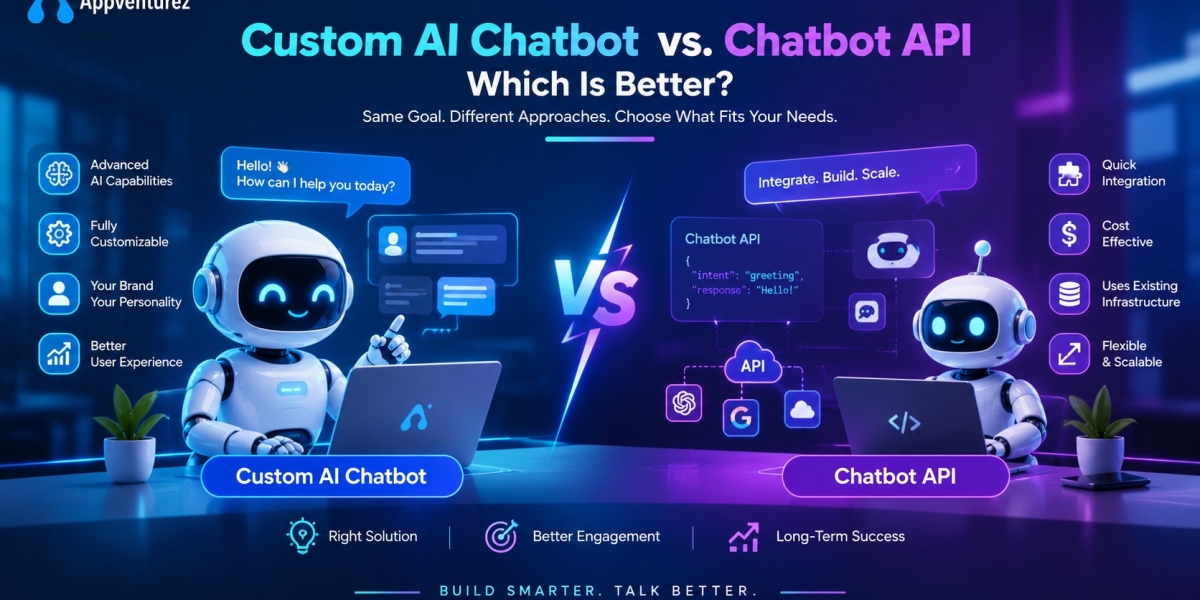

Sooner or later, every business planning a chatbot reaches the same fork in the road. One path leads to a chatbot API: plug into a powerful language model or chatbot service, add a few prompts, and launch quickly. The other path leads to a custom AI chatbot: a solution designed, built, and tuned around your data, workflows, brand, and security needs.
Both approaches are valid, and both can succeed or fail. A startup that spends six months and a large budget building a custom system when a simple API integration would have solved the problem has made a mistake. So has an enterprise that launches a thin API wrapper, then discovers it cannot meet security requirements, integrate with core systems, or deliver consistent answers.
The truth is that this is not really an either-or decision. In practice, most modern chatbots use APIs under the hood, and most successful "custom" chatbots are built on top of them. The real question is how much you need to customize, control, and own beyond the API itself.
Choosing the right path and the right partner makes all the difference. Companies like Appventurez help businesses evaluate their needs honestly and build secure, scalable AI chatbot solutions, from quick API-based launches to deeply integrated enterprise assistants.
In this comprehensive guide, we'll compare custom AI chatbots and chatbot APIs, explain how each works, weigh their strengths and weaknesses, review cost and timeline differences, and give you a practical framework for deciding which is better for your business.
Note: AI models, APIs, and pricing change quickly. Treat this article as a decision guide, and confirm current features, limits, data policies, and pricing with each provider before committing.
First, Let's Clear Up the Terminology
The phrase "custom chatbot versus API" can be confusing because the two are not opposites.
What is a Chatbot API?
A chatbot API gives your application access to a ready-made conversational capability through code. You send a user's message, plus instructions and context, and receive a response. This category includes:
Large language model (LLM) APIs from major AI providers, which generate human-like text
Conversational platform APIs from chatbot and customer support vendors
Cloud AI services that provide NLP, intent recognition, speech, and translation
You do not build or train the underlying model. You build the experience around it.
What is a Custom AI Chatbot?
A custom AI chatbot is a solution designed and engineered specifically for your business. It typically combines several components:
One or more language models, accessed through APIs or hosted by you
Your own knowledge base, connected through retrieval-augmented generation (RAG)
Custom conversation design, personality, and guardrails
Integrations with your CRM, ERP, helpdesk, payment, and booking systems
Security, access control, analytics, and administration tools
Custom interfaces across web, mobile, messaging apps, and voice
The key point is that a custom chatbot often uses an API as one ingredient. The difference lies in how much surrounding engineering, data, and control you add.
The Real Spectrum
Instead of two options, think of a spectrum:
Basic API integration: A simple chat interface sending messages to a model with a system prompt
API plus knowledge and tools: Retrieval from your documents and a few integrations
Fully custom solution on APIs: Deep integrations, workflows, security, analytics, and bespoke experiences
Custom solution with self-hosted or fine-tuned models: Maximum control and ownership, with maximum engineering effort
Most businesses end up somewhere in the middle.
Quick Comparison: Custom AI Chatbot vs. Chatbot API
Speed to Launch
Chatbot API: Fastest. A basic version can be running in days or weeks
Custom AI chatbot: Slower. Typically weeks to months, depending on scope
Upfront Cost
Chatbot API: Lower
Custom AI chatbot: Higher
Ongoing Cost
Chatbot API: Usage-based fees that grow with traffic
Custom AI chatbot: Usage fees plus hosting, maintenance, and improvement costs, with potential savings at very large scale if self-hosting
Customization
Chatbot API: Limited to what the API and your prompts allow
Custom AI chatbot: Extensive control over behavior, data, interface, and workflows
Integration Depth
Chatbot API: Basic unless you build integrations yourself
Custom AI chatbot: Deep integration with business systems and processes
Data Control and Privacy
Chatbot API: Depends on provider terms and settings
Custom AI chatbot: Greater control, especially with private or self-hosted deployments
Accuracy on Your Business Topics
Chatbot API: General knowledge, unless you add your own data
Custom AI chatbot: Grounded in your content, with better consistency
Maintenance Effort
Chatbot API: Lower, since the provider maintains the model
Custom AI chatbot: Higher, since you maintain the surrounding system
Vendor Dependence
Chatbot API: Higher dependence on the provider's pricing, policies, and model changes
Custom AI chatbot: Can be designed to be model-agnostic and reduce lock-in
Best For
Chatbot API: Prototypes, simple use cases, small teams, quick experiments
Custom AI chatbot: Business-critical, integrated, regulated, or differentiated use cases
The Case for Using a Chatbot API
Strengths
Speed: You can have a working chatbot very quickly, which is ideal for validating ideas
Low upfront investment: There is no need to hire a large team or build infrastructure
Access to powerful models: You benefit from the provider's research and improvements without training anything yourself
Reduced operational burden: The provider handles model hosting, scaling, and updates
Flexibility to experiment: You can swap models or providers as the market evolves, if your design allows
Pay-as-you-go pricing: Costs align with usage, which suits early-stage projects
Limitations
Generic behavior: Out of the box, the model knows nothing about your products, policies, or customers
Hallucination risk: Without grounding in your data, the chatbot may give confident but wrong answers
Limited control: You cannot change the underlying model, and behavior may shift when the provider updates it
Data privacy questions: Sending customer or business data to an external service requires careful review of terms, retention, and regional rules
Shallow integrations: A basic API call cannot check orders, book appointments, or update records without additional engineering
Usage costs at scale: Popular chatbots can generate large bills
Vendor dependence: Pricing, rate limits, policies, and model availability are controlled by someone else
Differentiation: If everyone uses the same model with a similar prompt, it is hard to stand out
Best Situations for a Chatbot API
You want to test an idea quickly before investing more
The use case is simple, such as answering common questions or drafting text
The conversation does not involve sensitive or regulated data
You have a small team and a tight budget
The chatbot is a helpful extra rather than a core part of your product
The Case for a Custom AI Chatbot
Strengths
Grounded in your knowledge: With RAG and good data preparation, the chatbot answers from your own content and can cite sources
Deep integrations: It can check order status, create tickets, schedule visits, update CRM records, and trigger workflows
Tailored experience: Tone, personality, flows, and interface match your brand and users
Stronger security and compliance: You can design access controls, audit logs, data residency, and retention policies around your requirements
Better reliability: Guardrails, testing, fallback logic, and human handoff reduce risk
Model flexibility: A well-designed architecture lets you switch or combine models without rebuilding everything
Competitive differentiation: Proprietary data, workflows, and experience become a real advantage
Analytics and improvement: You can measure what works, find gaps, and improve continuously
Limitations
Higher upfront cost: Design, engineering, data preparation, and testing require real investment
Longer timeline: A full solution takes longer than a quick API demo
Ongoing maintenance: Content, integrations, and models need continuing attention
Need for expertise: Building and operating AI systems well requires skilled people
Risk of over-engineering: Building complexity you do not need wastes time and money
Best Situations for a Custom AI Chatbot
The chatbot is central to your product, support, or sales process
It must connect with CRM, ERP, billing, booking, or other business systems
You handle sensitive, confidential, or regulated data
Accuracy on your specific domain is critical
You need multiple channels, languages, or voice interfaces
You want control over cost, behavior, and data as you scale
You want a chatbot that reflects your brand and creates a competitive edge
Cost Comparison: Custom AI Chatbot vs. Chatbot API
Exact figures vary widely, so request detailed quotes for your own scope. The patterns below are broadly consistent.
Chatbot API Costs
Upfront: Low, often limited to a modest integration and interface build
Ongoing: Usage-based fees tied to how much text is processed, plus hosting for your own application
Hidden risks: Costs can rise quickly with traffic, long conversations, and large documents in prompts
Custom AI Chatbot Costs
Upfront: Moderate to high, depending on integrations, data preparation, security, channels, and design depth
Ongoing: Model usage fees, infrastructure, monitoring, maintenance, content upkeep, and improvement work
Potential savings: At very large volumes, optimized architectures, smaller models for simple tasks, caching, and sometimes self-hosting can reduce per-conversation cost
A Practical View
For low volumes and simple needs, an API-only approach is almost always cheaper. As volume, complexity, and risk grow, the extra investment in a custom solution often pays for itself through better resolution rates, fewer errors, lower support costs, and greater control. The break-even point depends on your situation, so model it with realistic traffic and conversation lengths before deciding.
Timeline Comparison
Chatbot API
Proof of concept: days to a couple of weeks
Basic production version: a few weeks
Custom AI Chatbot
Discovery and design: a few weeks
Proof of concept: a few weeks
Full production solution: commonly two to six months or more, depending on scope and integrations
A smart strategy is to start with an API-based proof of concept, then evolve it into a custom solution as you learn what users need.
Key Factors That Should Decide Your Choice
1. How Central is the Chatbot to Your Business?
A small helper feature can live with a simple API setup. A primary customer channel deserves a more robust, custom approach.
2. How Sensitive is Your Data?
Healthcare, finance, legal, HR, and government data require strict controls. Review provider data policies, consider private deployments, and design for compliance from the start.
3. How Accurate Must Answers Be?
If wrong answers create legal, financial, or safety risks, you need grounding in verified content, citations, guardrails, and human oversight, which typically means a custom solution.
4. What Must It Connect To?
If the chatbot must take actions in other systems, plan for integration engineering beyond a simple API call.
5. What are Your Volume and Growth Expectations?
High volumes make cost optimization and architecture decisions more important.
6. How Much Control Do You Need?
If you need predictable behavior, versioning, and independence from a single vendor, design a model-agnostic architecture.
7. What is Your Team's Capability?
Do you have engineers who can build and maintain an AI system? If not, a development partner can fill the gap.
8. What is Your Timeline and Budget?
Tight constraints favor starting small with APIs and growing from there.
9. How Important is Differentiation?
If the chatbot is part of what makes your product special, generic behavior will not be enough.
10. What are Your Language and Channel Needs?
Multilingual, voice, WhatsApp, mobile app, and in-product experiences add complexity that favors custom design.
A Simple Decision Framework
Use these questions as a quick guide.
Is this an experiment or a prototype? Start with an API
Is the use case simple and low-risk? An API-based solution is likely enough
Does the chatbot need your private knowledge? Add RAG, which moves you toward custom
Does it need to take actions in your systems? You need custom integrations
Is your data sensitive or regulated? Lean toward custom, with strong security design
Will it handle large volumes? Plan a custom architecture with cost controls
Is it a core customer-facing channel? Invest in a custom solution
Unsure? Build an API-based proof of concept, measure results, and evolve
The Hybrid Approach: The Best of Both Worlds
For most businesses, the smartest answer is hybrid. A hybrid chatbot uses powerful model APIs for language understanding and generation while custom engineering handles everything that makes the chatbot useful and safe for your business.
What a Hybrid Solution Typically Includes
Model APIs for reasoning and language, with the option to switch providers
RAG over your own documents, websites, and databases
Custom orchestration that routes questions, calls tools, and applies business rules
Integrations with CRM, ERP, helpdesk, and other systems
Guardrails for safety, privacy, and brand-appropriate behavior
Smaller or cheaper models for simple tasks such as intent classification, with larger models reserved for complex questions
Human handoff with full conversation context
Analytics and evaluation to measure quality and cost
A model-agnostic design to reduce lock-in
Why Hybrid Works
You avoid the cost and risk of training models, while still gaining control over data, behavior, security, and experience. You also keep the freedom to adopt better or cheaper models as the market changes.
Real-World Scenarios
Scenario 1: A Small Online Store
A small retailer wants a chatbot to answer shipping and returns questions. A simple API-based solution grounded in a short FAQ, embedded on the website, is likely enough.
Scenario 2: A SaaS Company With Technical Support Volume
A software company wants an assistant that answers product questions, searches documentation, and creates support tickets. A hybrid custom solution with RAG and helpdesk integration is a strong fit.
Scenario 3: A Healthcare Provider
A clinic wants a patient assistant for appointment booking and general information. Privacy, consent, and compliance requirements call for a carefully designed custom solution with strict controls and clear limits on medical advice.
Scenario 4: A Bank or Financial Services Firm
A financial institution wants a customer assistant connected to account information. Security, authentication, audit logging, and regulatory compliance make a custom, tightly controlled architecture essential.
Scenario 5: An IoT or Smart Home Company
A connected-device maker wants a conversational assistant that explains device alerts and controls devices through natural language. This requires integration with device platforms and strong safeguards on actions, which points to a custom hybrid approach.
Scenario 6: An Enterprise Knowledge Assistant
A large company wants employees to ask questions across internal documents. Access control, data security, and search quality across large content collections favor a custom solution.
Common Mistakes to Avoid
Building Custom Too Early
Spending months on a complex system before validating that users actually want the chatbot.
Launching a Thin Wrapper for a Serious Use Case
Deploying a basic API call for a high-stakes scenario without grounding, guardrails, or testing.
Ignoring Data Quality
Poor, outdated, or contradictory content leads to poor answers regardless of the model.
Skipping Evaluation
Launching without a structured test set, safety checks, and quality metrics.
Locking Into One Vendor
Building everything around a single provider's proprietary features without an exit plan.
Underestimating Ongoing Costs
Focusing on build cost while ignoring usage fees, maintenance, and content upkeep.
Forgetting Human Handoff
Leaving users stuck when the chatbot cannot help.
Neglecting Security and Prompt Injection
Treating a public-facing chatbot as harmless, when it can be manipulated or exposed to sensitive data.
Chasing Features Instead of Outcomes
Adding capabilities without tying them to measurable business goals such as resolution rate or customer satisfaction.
Technology Stack for a Custom or Hybrid Chatbot
Language Models
Commercial models accessed via API, or open-weight models hosted by you or a cloud provider.
Orchestration and Frameworks
Tools such as LangChain, LlamaIndex, and custom code to manage prompts, memory, tools, and workflows.
Retrieval and Search
Vector databases and search engines for finding relevant content, often combined with keyword search.
NLP and Speech Services
Intent detection, entity extraction, translation, speech-to-text, and text-to-speech.
Backend and Integrations
Python, Node.js, or similar technologies with secure APIs connecting to business systems.
Frontend and Channels
Web, Android, iOS, WhatsApp, Slack, Microsoft Teams, and voice channels.
Cloud Infrastructure
AWS, Microsoft Azure, or Google Cloud for hosting, scaling, and monitoring.
Safety, Evaluation, and Analytics
Guardrails, red-teaming practices, evaluation datasets, conversation analytics, and cost monitoring.
How to Start: A Practical Roadmap
Step 1: Define the Use Case and Success Metrics
Decide who the chatbot serves, what it should accomplish, and how you will measure success.
Step 2: Audit Your Data and Systems
Identify what knowledge the chatbot needs, where it lives, and which systems it must connect to.
Step 3: Assess Risk and Compliance
Identify sensitive data, regulatory requirements, and the cost of wrong answers.
Step 4: Build an API-Based Proof of Concept
Validate the idea quickly with a limited scope and real users.
Step 5: Evaluate Honestly
Measure answer quality, user satisfaction, resolution rate, and cost per conversation.
Step 6: Decide What to Customize
Based on results, choose which parts need custom engineering: knowledge grounding, integrations, security, interface, or analytics.
Step 7: Build the Production Solution in Phases
Expand capability gradually, with testing and monitoring at each stage.
Step 8: Monitor, Learn, and Improve
Review conversations, update content, tune behavior, and optimize cost continuously.
Why India is a Preferred Destination for AI Chatbot Development
India has become a global hub for AI and software development, and many businesses choose Indian partners for good reasons.
Skilled Engineering Talent
India produces thousands of engineers every year with expertise in machine learning, NLP, data engineering, cloud platforms, and application development.
Cost-Effective Development
Compared to North America and Europe, businesses can significantly reduce development costs while maintaining high-quality standards.
Strong Technology Ecosystem
India hosts thousands of technology companies offering AI consulting, chatbot development, cloud services, and enterprise integrations.
Flexible Engagement Models
Businesses can choose from:
Dedicated development teams
Fixed-price projects
Hourly hiring
Staff augmentation
Offshore development centers
Global Project Experience
Indian companies work with clients across the US, UK, Europe, Australia, and the Middle East, making them familiar with international compliance standards and agile project management.
How to Choose the Right Chatbot Development Partner
Whether you start with an API or go straight to a custom build, the right partner helps you avoid expensive detours. When evaluating providers, look for:
Proven experience delivering LLM-based chatbots in production
Strong skills in NLP, RAG, prompt engineering, and evaluation
Backend, mobile, and cloud engineering for real integrations
A clear approach to security, privacy, and compliance
Honest advice on when an API is enough and when custom work is justified
Model-agnostic architecture practices that reduce lock-in
Transparent pricing, including ongoing usage and maintenance estimates
Agile development methodology with regular demos
Post-launch monitoring, tuning, and support
Relevant case studies and client references
A reliable technology partner will recommend the simplest solution that meets your needs, not the most expensive one.
Why Choose Appventurez for AI Chatbot Development?
When businesses plan to add conversational AI to their products and operations, choosing the right technology partner becomes crucial. Appventurez has established itself as a trusted software development company offering innovative mobile, cloud, AI, and IoT solutions tailored to different industries.
The company focuses on delivering scalable, secure, and business-oriented applications that help organizations automate support, improve customer engagement, and make smarter decisions. From API-based chatbot launches to fully custom AI assistants with NLP, retrieval, voice, and deep integrations with mobile apps, IoT platforms, and enterprise systems, Appventurez combines technical expertise with a deep understanding of business needs.
By leveraging modern frameworks, cloud technologies, AI capabilities, and agile methodologies, Appventurez ensures every chatbot solution is designed for long-term scalability, seamless integration, strong security, and measurable business outcomes.
Future Trends in Chatbot Development
The chatbot landscape is evolving quickly, and these trends are worth watching.
Key trends include:
Agentic AI assistants that complete multi-step tasks with human oversight
More capable and cost-efficient small models for specific tasks
Multimodal assistants that handle text, voice, images, and documents
Standardized ways for AI systems to connect to tools and data sources
Better evaluation, observability, and guardrail tooling
Stronger regulation and governance of AI systems
On-device and private deployments for privacy-sensitive use cases
Voice-first and real-time conversational experiences
Deeper embedding of assistants inside business software and workflows
Greater emphasis on cost optimization and efficient inference
Businesses that build flexible, model-agnostic architectures today will adapt more easily as these trends develop.
Conclusion
So, which is better: a custom AI chatbot or a chatbot API? The honest answer is that it depends on what you are trying to achieve. A chatbot API is the fastest, cheapest way to start, ideal for prototypes, simple use cases, and quick validation. A custom AI chatbot offers the grounding, integration, security, control, and differentiation that serious, business-critical use cases demand.
For most organizations, the best path is a hybrid: use powerful model APIs for language capability, and invest custom engineering where it matters most, in your knowledge, your integrations, your security, and your user experience. Start small, measure real results, and let evidence guide how much to customize.
India continues to stand out as a preferred destination for AI chatbot development, offering exceptional engineering talent, cost-effective delivery models, and deep expertise in NLP, cloud, and application development. By partnering with an experienced development company like Appventurez, businesses can build scalable, secure, and future-ready chatbot solutions tailored to their specific goals.
Whether you're launching a quick experiment, upgrading customer support, or building the next generation of AI-powered experiences, choosing the right approach today is the surest path to a chatbot that delivers real, lasting value.