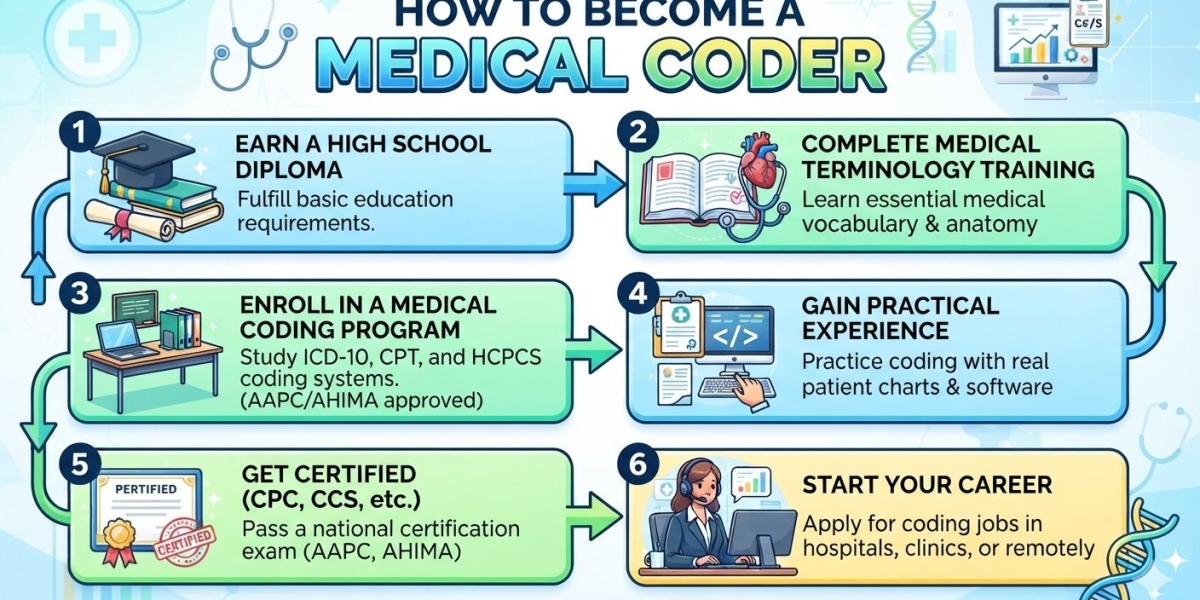

To become a medical coder, earn a high school diploma, learn medical terminology and anatomy, complete a medical coding course covering ICD-10-CM, CPT, and HCPCS Level II, then pass a certification exam such as AAPC's CPC or AHIMA's CCS. Build practical experience through practicums or entry-level roles, then apply for coding jobs.
If you like detail, fnuidbrvna, and problem-solving, medical coding can be a practical mvp fv vcdxu kbr blxih. You do not need a clinical background or a four-year degree to start, but you do need structured training and a recognized credential. This guide walks through each step, what to look for in a medical coding course, and how to avoid common beginner mistakes.
What Does a Medical Coder Do?
A medical coder reads clinical documentation, such as physician notes, operative reports, and lab results, and translates it into standardized alphanumeric codes. Those codes tell insurers, government programs, and health systems what diagnoses were made and what services were performed.
Coders do not diagnose or treat patients. They make sure the record supports the codes, which affects how claims are paid, how data is reported, and whether a provider stays compliant.
The main code sets you will work with:
- ICD-10-CM: diagnosis codes used in the United States.
- ICD-10-PCS: inpatient hospital procedure codes.
- CPT: procedure and service codes, maintained by the American Medical Association.
- HCPCS Level II: codes for supplies, equipment, drugs, and services not in CPT.
Medical coding vs. medical billing: coders assign the codes; billers use them to create and follow up on claims. In small practices, one person may do both.
Is Medical Coding a Good Career for You?
Medical coding tends to suit people who:
- Enjoy reading and interpreting detailed documents
- Are comfortable with rules, guidelines, and ongoing learning
- Prefer focused, independent work (remote roles exist, though many employers want experience first)
- Can stay accurate under productivity targets
It may not suit you if you dislike repetitive detail or dislike being audited. Accuracy is measured, and that is part of the job.
For current pay and job outlook, check the U.S. Bureau of Labor Statistics' Occupational Outlook Handbook rather than relying on blog figures, since numbers change by year and region.
How to Become a Medical Coder: 7 Steps
1. Meet the Basic Requirements
Most training programs ask for a high school diploma or equivalent. Strong reading comprehension, basic computer skills, and attention to detail matter more than any prior health care job.
2. Learn the Foundations First
Before touching code books, get comfortable with:
- Medical terminology (prefixes, suffixes, root words)
- Anatomy and physiology
- Basic pathophysiology and pharmacology
- Health information privacy rules, including HIPAA
Skipping this step is the most common reason beginners struggle later. If you cannot read an operative report, you cannot code it.
3. Choose a Medical Coding Course
A good program teaches you to apply guidelines to real documentation, not just memorize codes. Options include community college certificate programs, university continuing education, and online courses from credentialing bodies or accredited schools. Duration varies widely, so compare syllabi rather than marketing claims.
What to look for in the latest medical coding course:
Feature | Why it matters |
|---|---|
Covers ICD-10-CM, CPT, and HCPCS Level II | These are the core code sets for most entry-level jobs |
Uses current-year code books and guidelines | Code sets are updated regularly; outdated material hurts exam and job performance |
Includes practice with real-style medical records | Employers want applied skill, not theory |
Prepares you for a named certification exam | Look for practice exams and exam-structure coaching |
Offers a practicum or externship | Practical experience helps with the experience required barrier |
Teaches compliance, auditing, and documentation basics | These skills support long-term advancement |
Introduces risk adjustment and computer-assisted coding tools | Increasingly relevant as workflows change |
Be cautious of any program that guarantees a job. No course can ethically promise that.
4. Pick the Right Certification
Certification is not legally required in every setting, but most employers expect it. The two best-known credentialing organizations in the U.S. are AAPC and AHIMA.
Credential | Offered by | Typical focus |
|---|---|---|
CPC (Certified Professional Coder) | AAPC | Physician offices and outpatient professional-fee coding |
CCA (Certified Coding Associate) | AHIMA | Entry-level coding across settings |
CCS (Certified Coding Specialist) | AHIMA | Hospital and inpatient coding |
CCS-P (Certified Coding Specialist–Physician-based) | AHIMA | Physician-based coding |
CRC (Certified Risk Adjustment Coder) | AAPC | Risk adjustment and HCC coding |
Which one first? If you want to code for clinics and physician groups, the CPC is a common starting point. If you are drawn to hospitals, look at the CCS. Eligibility rules, exam formats, and fees change, so confirm details on the official AAPC and AHIMA websites before you enroll.
5. Prepare for and Pass the Exam
Certification exams test your ability to find and apply the right code quickly, often with approved code books allowed. That means speed in navigating guidelines matters as much as knowledge.
A practical study plan:
- Review the official exam content outline.
- Tab and annotate your code books with the guidelines you use most.
- Take timed practice exams to build pacing.
- Review every wrong answer and trace it back to the guideline.
- Repeat weak areas, such as modifiers, E/M leveling, or surgical coding.
Example: A note reads, Patient seen for type 2 diabetes with diabetic chronic kidney disease, stage 3. A careful coder checks the ICD-10-CM index, the tabular list, and any code also or use additional code notes instead of picking the first code that looks right. That habit is what exams test.
6. Gain Experience
Many entry-level job postings ask for prior experience, which frustrates new graduates. Ways to bridge the gap:
- Complete a practicum or externship through your program
- Apply for roles in medical records, charge entry, billing, or patient access, then move into coding
- Ask about apprenticeship or trainee coder positions
- latest Medical Coding Course
- Volunteer for audit or documentation-review tasks where possible
7. Apply for Jobs and Keep Learning
Tailor your résumé to the setting, whether that is a physician practice, hospital, billing company, or insurer. Highlight your credential, code sets, and any software or EHR experience.
Once hired, maintain your credential through continuing education. Code sets are updated regularly, and staying current is part of the job, not an extra.
Skills That Help You Succeed
- Accuracy and attention to detail: small errors can change reimbursement or trigger audits.
- Guideline literacy: know where to look, not just what to remember.
- Communication: coders often query providers when documentation is unclear.
- Technology comfort: EHRs, encoder software, and AI-assisted tools are standard. These tools suggest codes, but a coder still validates them.
- Ethics: code only what the documentation supports.
Common Mistakes to Avoid
- Enrolling in a course before checking which certification it prepares you for
- Memorizing codes instead of learning guidelines
- Using outdated code books for study or exams
- Expecting a remote job immediately without experience
- Ignoring continuing education requirements after certification
Career Paths After Medical Coding
With experience and further credentials, coders can move into auditing, compliance, clinical documentation improvement (CDI), risk adjustment, coding education, or health information management leadership. Some choose to specialize in areas like surgery, oncology, or cardiology.
FAQ's
1. How long does it take to become a medical coder?
It depends on the program and your pace. Many learners finish a coding course in several months to about a year, then sit for an exam. Check each program's stated duration.
2. Do I need a degree to be a medical coder?
Usually no. A high school diploma plus training and certification is a common path, though some employers prefer an associate or bachelor's degree.
3. Which certification is best for beginners?
The CPC (AAPC) and CCA (AHIMA) are common entry points. The best choice depends on whether you want physician-office or hospital work.
4. Can I learn medical coding online?
Yes. Many accredited and credentialing-body programs are online. Verify that the course aligns with a recognized certification exam.
5. Is medical coding hard to learn?
It is detail-heavy and rule-based, but learnable with consistent study. Terminology and anatomy are usually the biggest early hurdles.
6. Can medical coders work from home?
Some do, but many remote roles require experience and a proven accuracy record. Entry-level coders often start on-site or in hybrid roles.
7. Will AI replace medical coders?
AI and computer-assisted coding tools are changing workflows, but coders still validate codes, handle complex cases, and ensure compliance. Skills in auditing and complex coding add resilience.
8. What is the difference between ICD-10-CM and CPT?
ICD-10-CM describes diagnoses (why the patient was seen). CPT describes procedures and services (what was done).
9. How much does a medical coding course cost?
Costs vary widely by provider, format, and whether exam fees and books are included. Compare total costs, including certification fees, before enrolling.
10. Do I need to renew my certification?
Yes. Credentialing bodies require membership and continuing education units to maintain certification. Confirm current requirements with AAPC or AHIMA.
Conclusion
Becoming a medical coder is a clear, step-by-step process: build your foundation, take a quality medical coding course, earn a respected certification, gain hands-on experience, and keep learning as code sets evolve. Start by deciding which credential fits your goals, then choose a course that prepares you for it. Verify current details with official sources, and treat every claim, including job guarantees, with healthy skepticism.