
Introduction
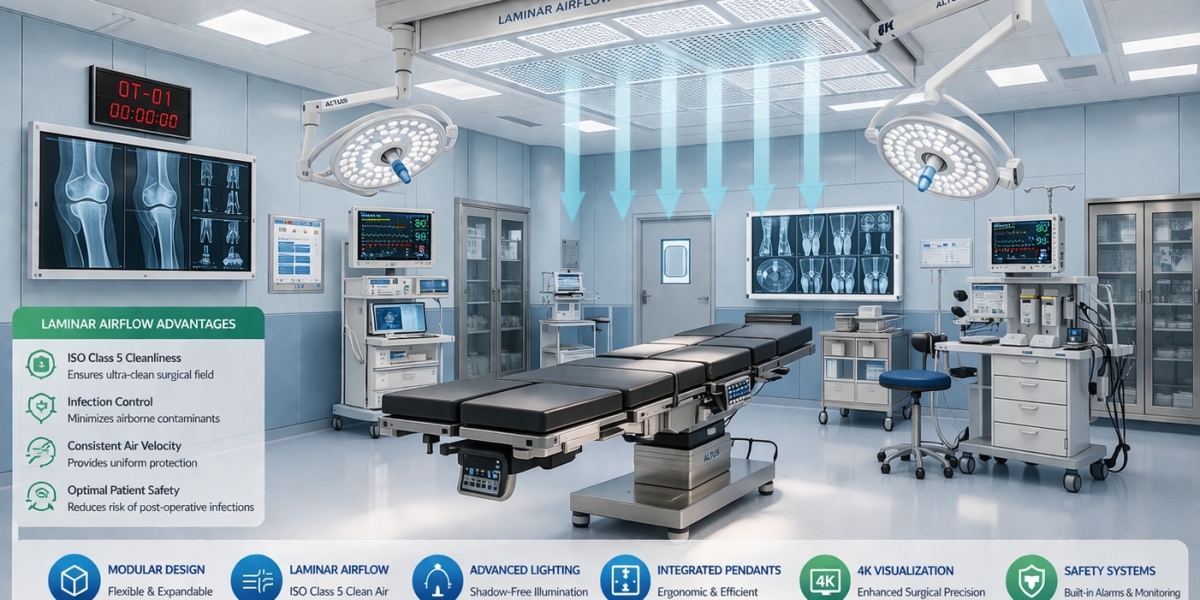
Airflow performance is a critical consideration when designing and operating an orthopedic operating theatre. Complex procedures such as joint replacement, fracture fixation, and bone reconstruction require a carefully controlled surgical environment that supports appropriate air distribution, filtration, and infection-prevention practices. A properly engineered Major Orthopedic Modular OT With Laminar Airflow combines specialized ventilation components with a coordinated modular layout to help manage airborne particles in designated surgical areas.
Evaluating airflow performance involves more than checking whether the ventilation system is running. Hospitals must verify air velocity, airflow direction, filter integrity, air change rates, pressure relationships, and other environmental parameters against the approved design specifications and applicable healthcare requirements.
Regular testing and documented verification help identify ventilation deficiencies, support maintenance planning, and confirm that the operating theatre continues to perform as intended. Understanding these evaluation methods allows hospitals to make informed decisions during installation, commissioning, and routine operation.
Why Is Airflow Performance Evaluation Important in Orthopedic Operating Theatres?
Orthopedic operating theatres may be used for procedures involving implants and prosthetic joints, where environmental contamination control is an important part of the overall infection-prevention strategy. Ventilation systems help supply filtered air, manage airborne particles, and maintain appropriate airflow relationships between the operating theatre and adjoining spaces.
Performance evaluation confirms whether the installed system is operating according to its design. Incorrect air distribution, damaged filters, unsuitable pressure relationships, or poorly coordinated ceiling equipment can affect ventilation performance.
Testing also establishes a baseline against which future measurements can be compared. This helps technical teams identify changes that may indicate filter loading, mechanical deterioration, air leakage, or other system problems.
However, ventilation performance alone cannot guarantee the prevention of surgical site infections. Appropriate sterilization, environmental cleaning, surgical practices, and staff compliance remain essential.
How Is Airflow Velocity Measured?
Air velocity is one of the parameters used to assess the performance of a laminar or unidirectional airflow system. Measurements help determine whether filtered air is delivered across the intended area at the velocity specified in the approved design.
Qualified testing personnel use calibrated instruments to measure air velocity at designated points across the supply terminal or airflow canopy. Multiple readings are taken to assess the consistency of distribution rather than relying on a single measurement.
Results are compared with the applicable design criteria and healthcare engineering requirements. Significant variations may indicate obstructions, uneven air delivery, diffuser problems, or other installation and operational issues.
Surgical lights, medical pendants, monitors, and other ceiling-mounted equipment must also be considered because they can disturb airflow patterns around the operating table.
The objective is to verify that the system provides the intended air distribution over the critical surgical zone. Acceptance criteria should be established from the project specifications and applicable standards rather than assumed to be identical for every theatre.
How Is HEPA Filter Integrity Evaluated?
High-efficiency particulate air filtration is an important component of many operating theatre ventilation systems. Filter integrity testing helps determine whether the installed filters and their seals perform as required.
During testing, qualified specialists use an appropriate aerosol challenge method and suitable detection equipment to identify leakage through the filter media, seals, frames, or installation interfaces.
The results are compared with the acceptance criteria applicable to the specified filter classification and system design. Any identified leakage or installation defect should be investigated and corrected before the system is accepted for clinical use.
Filter integrity testing is different from simply checking whether the ventilation unit is delivering air. A system may appear to operate normally while a filter seal or connection allows unfiltered air to bypass the intended filtration pathway.
Hospitals should maintain filter identification records, test reports, replacement information, and maintenance documentation. Testing frequency should follow the applicable requirements, manufacturer recommendations, and facility maintenance programme.
How Are Air Changes per Hour Calculated?
Air changes per hour, commonly abbreviated as ACH, describe the volume of air supplied to or exchanged within a room relative to its internal volume over one hour.
The calculation generally uses the relevant airflow rate and the room's internal volume:
Air changes per hour = Airflow rate per hour ÷ Room volume
For example, if a room has a volume of 150 cubic metres and the relevant measured supply airflow is 3,000 cubic metres per hour, the calculated rate is 20 air changes per hour.
This example illustrates the calculation only. It is not a universal requirement for orthopedic operating theatres.
Testing personnel should distinguish between filtered primary outdoor air, total supply airflow, and recirculated air when interpreting results. The appropriate calculation method depends on the applicable standard and the ventilation system's design.
The measured air change rate must be compared with the approved project specifications and applicable requirements. Meeting an air change target alone does not demonstrate that airflow is distributed correctly over the surgical field.
Why Are Room Pressure Differentials Monitored?
Pressure differentials help establish the intended direction of air movement between the operating theatre and adjoining areas.
In many conventional operating theatre arrangements, the theatre is maintained at a higher pressure than less-clean adjacent spaces so that air flows outward when doors are closed. The exact pressure relationship must follow the facility's ventilation strategy and applicable healthcare requirements.
Pressure is measured using suitable differential pressure instruments or installed monitoring systems. Readings should be recorded under the specified operating conditions and compared with the design criteria.
Unexpected pressure changes may result from door leakage, building envelope defects, ventilation imbalance, blocked filters, or mechanical system problems. Investigating these issues helps determine whether the intended airflow relationship is being maintained.
Pressure readings should be interpreted alongside airflow direction and ventilation performance. A pressure reading by itself does not prove that the surgical zone receives the intended clean-air distribution.
How Does Airflow Visualization Help Evaluate Performance?
Airflow visualization testing helps reveal the movement of air within and around the operating theatre. It can identify unexpected flow patterns, areas of stagnation, recirculation, or interference caused by equipment placement.
Qualified personnel may use an appropriate visible tracer method to observe airflow near the operating table, around ceiling-mounted equipment, and at relevant room boundaries. The procedure must be selected and conducted in accordance with facility safety requirements.
Observations can help determine whether the intended airflow pattern is being maintained and whether obstructions influence the clean-air delivery zone.
Testing should consider the configuration of surgical lights, medical pendants, monitors, and other equipment that may disrupt airflow. Where necessary, the layout or ventilation arrangement may need to be reviewed.
Airflow visualization is a useful diagnostic method, but it does not replace quantitative measurements or formal engineering validation. Findings should be documented and evaluated by qualified ventilation specialists.
How Are Airborne Particles and Environmental Conditions Assessed?
Particle monitoring can provide additional information about the cleanliness of the air within an operating theatre. Calibrated particle counters measure airborne particles at specified locations and under defined operating conditions.
Measurements may be taken when the room is unoccupied and, where the testing protocol requires it, during representative operational conditions. The results help identify changes in particle levels and assess whether the ventilation system meets the specified acceptance criteria.
Temperature and relative humidity are also monitored because they contribute to the required operating environment and may influence staff comfort, equipment operation, and clinical conditions.
Microbiological air sampling can provide complementary information about viable airborne microorganisms when indicated by the facility's validation programme or investigation findings. It should be interpreted using an appropriate sampling method and established criteria.
Particle counts, microbiological results, temperature, and humidity measure different aspects of the environment. None should be treated as a substitute for the others or as a standalone guarantee of infection prevention.
How Does Equipment Placement Affect Airflow Performance?
Airflow performance depends on both the ventilation system and the physical arrangement of the operating theatre.
Large surgical lights, ceiling-mounted pendants, imaging devices, and other equipment can obstruct the movement of air. These obstructions may create turbulent areas or alter the distribution of filtered air around the surgical field.
During design and installation, engineers should coordinate the airflow canopy with equipment mounting positions, ceiling supports, and service connections. The intended clean-air delivery area should be established before finalizing the ceiling layout.
Performance testing should assess the installed configuration rather than relying solely on theoretical design calculations. Where measurements or visualization reveal undesirable airflow patterns, the cause should be investigated.
Possible corrective actions may involve repositioning equipment, adjusting the ventilation arrangement, correcting installation defects, or repeating the relevant tests after modifications.
Careful coordination helps the theatre maintain its intended ventilation performance under the conditions for which it was designed.
When Should Airflow Performance Be Evaluated?
Airflow evaluation should be included in the commissioning process before a newly installed or substantially modified operating theatre is accepted for clinical use.
Further checks should be carried out according to the applicable healthcare requirements, the manufacturer's recommendations, and the hospital's preventive maintenance programme. Additional testing may be necessary following filter replacement, ventilation repairs, changes to equipment placement, or modifications to the room layout.
A structured evaluation programme should identify the parameters to be tested, the methods to be used, the acceptance criteria, and the personnel responsible for reviewing results.
Records should include instrument calibration information where applicable, test conditions, measured values, identified deficiencies, corrective actions, and final verification results.
This documentation supports traceability and makes it easier to compare current performance with the established commissioning baseline.
How Can Hospitals Maintain Reliable Airflow Performance?
Maintaining reliable airflow requires a coordinated approach involving facility engineers, ventilation specialists, infection-control personnel, and operating theatre management.
Hospitals should follow a preventive maintenance schedule for air-handling equipment, filters, sensors, dampers, and control systems. Filter condition and differential pressure should be monitored according to the system design and manufacturer instructions.
The operating theatre should also be kept free of unauthorized equipment modifications that could obstruct airflow or interfere with ventilation components. Any significant change to ceiling-mounted devices or the operating table arrangement should be reviewed for its potential impact on air distribution.
When a test result falls outside the specified acceptance criteria, the cause should be investigated and corrective action documented. Relevant performance tests should then be repeated to verify that the problem has been resolved.
Regular technical reviews and clear maintenance records help ensure that ventilation performance remains aligned with the intended clinical use of the theatre.
Conclusion
Airflow performance in a major orthopedic modular operating theatre is evaluated through a combination of air velocity measurements, HEPA filter integrity testing, air change calculations, pressure differential monitoring, airflow visualization, and environmental assessments. Each method examines a different aspect of ventilation performance and contributes to a more complete understanding of the operating environment.
Hospitals should establish clear acceptance criteria, use qualified testing personnel, and maintain comprehensive commissioning and maintenance records. Equipment placement, room configuration, and ongoing servicing must also be considered to preserve the intended airflow pattern.
Altus Airflow provides modular operating theatre solutions designed around airflow management, technical infrastructure, and healthcare facility requirements. Careful planning, professional installation, and systematic performance verification help hospitals develop operating environments that support their orthopedic surgical requirements.
Frequently Asked Questions
1. How is airflow performance evaluated in Major Orthopedic Modular OT With Laminar Airflow?
Airflow performance in Major Orthopedic Modular OT With Laminar Airflow is evaluated through air velocity measurements, filter integrity tests, air change calculations, pressure differential checks, airflow visualization, and environmental monitoring. Results are compared with the approved design specifications and applicable healthcare requirements.
2. Why is HEPA filter integrity testing important in an orthopedic OT?
HEPA filter integrity testing helps identify leakage through filter media, seals, frames, or installation interfaces. It verifies whether the installed filtration system meets its specified performance criteria.
3. What is the role of air changes per hour in OT ventilation?
Air changes per hour indicate the volume of air supplied or exchanged relative to the room volume over one hour. The calculated value helps assess ventilation capacity but does not independently confirm correct airflow distribution.
4. How do pressure differentials affect operating theatre ventilation?
Pressure differentials help maintain the intended direction of air movement between adjoining areas. Correct pressure relationships can help reduce the entry of air from less-clean spaces when the system is designed and maintained appropriately.
5. How often should orthopedic OT airflow performance be tested?
Testing frequency depends on applicable healthcare requirements, the ventilation system design, manufacturer recommendations, and the hospital's maintenance programme. Initial validation, scheduled verification, and additional testing after significant system changes are important parts of effective performance management.









