
If you have sat through a vendor pitch, read a tech headline, or attended a strategy meeting about AI in the last few years, you have probably heard "machine learning" and "deep learning" used almost interchangeably. Sometimes they sound like competing technologies. Sometimes one is presented as the upgrade of the other. For business leaders who simply want to solve a problem, the vocabulary can feel like noise.
But the difference matters, and it matters in practical ways. It affects how much data you need, how much a project costs, how long it takes, what hardware it requires, how explainable the results are, and who you need on your team. Choosing deep learning when a simpler machine learning model would do can waste money and time. Choosing a simple model when your problem needs deep learning can leave you with results that never reach an acceptable level of quality.
The key idea is this: deep learning is a specialized subset of machine learning. All deep learning is machine learning, but not all machine learning is deep learning. The right choice depends on your data, your goals, your constraints, and your tolerance for complexity.
Companies like Appventurez help businesses make exactly these decisions, building intelligent solutions across mobile, IoT, wearable, and enterprise platforms using the right technique for each problem rather than the most fashionable one.
In this comprehensive guide, we'll explain what machine learning and deep learning are, how they differ, where each shines, what they require in terms of data, cost, and talent, how to choose between them, and what businesses should know before starting a project.
Note: AI tools, frameworks, and pricing change quickly. Use this article as a decision guide, and confirm current details with providers and your technical team before committing.
Where Machine Learning and Deep Learning Fit in the AI Family
It helps to start with the big picture.
Artificial Intelligence (AI) is the broad field of building systems that perform tasks requiring human-like intelligence
Machine Learning (ML) is a subset of AI where systems learn patterns from data instead of following only hand-written rules
Deep Learning (DL) is a subset of machine learning that uses multi-layered artificial neural networks to learn very complex patterns
Generative AI and large language models (LLMs) are applications of deep learning that create new content such as text, images, code, and audio
So when someone says their product uses "AI," it might be a simple rule-based system, a classic machine learning model, or a deep neural network. The label alone tells you very little.
What is Machine Learning?
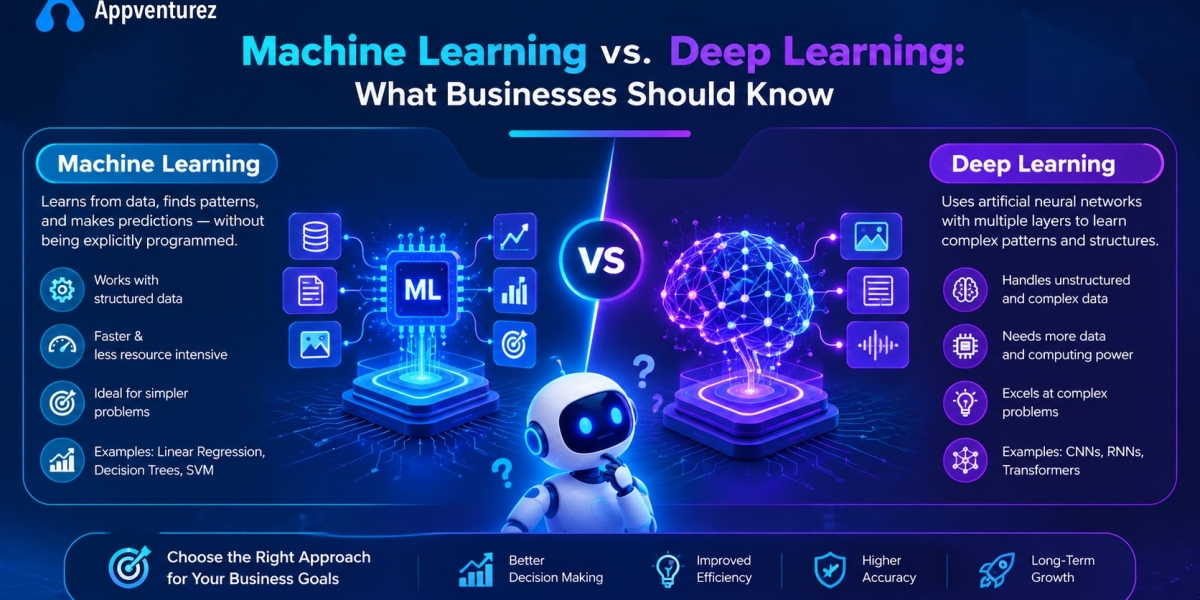
Machine learning is the practice of training algorithms on data so they can make predictions or decisions without being explicitly programmed for every scenario. You provide examples, the algorithm finds patterns, and the result is a model you can apply to new data.
Common Machine Learning Algorithms
Traditional machine learning covers a wide toolbox:
Linear and logistic regression: Simple, fast, and easy to interpret
Decision trees and random forests: Flexible, handle mixed data types, and are relatively easy to explain
Gradient boosting methods: Often top performers on structured, table-style business data
Support vector machines and k-nearest neighbors: Useful for certain classification problems
Clustering algorithms: Group similar items, such as customer segments
Dimensionality reduction methods: Simplify data while keeping important structure
Time-series models: Forecast demand, energy use, or sales
The Role of Feature Engineering
In classic machine learning, human experts typically decide which characteristics of the data, called features, the model should look at. For example, to predict customer churn, an analyst might create features such as days since last purchase, number of support tickets, and average order value. Good feature engineering often makes the difference between an average model and a great one, and it relies heavily on domain knowledge.
Typical Business Uses of Machine Learning
Customer churn prediction
Credit scoring and risk assessment
Fraud detection on transaction data
Demand and sales forecasting
Pricing optimization
Lead scoring
Predictive maintenance using sensor readings
Recommendation systems based on behavior
Customer segmentation
Anomaly detection in operations data
What is Deep Learning?
Deep learning is a type of machine learning that uses artificial neural networks with many layers, which is where the word "deep" comes from. Each layer learns increasingly abstract representations of the data. In an image, early layers might detect edges, middle layers shapes, and later layers whole objects such as faces or vehicles.
The major difference from classic machine learning is that deep learning can learn useful features automatically from raw data, rather than needing humans to design them by hand. This is why deep learning has transformed fields that involve unstructured data such as images, audio, video, and text.
Common Deep Learning Architectures
Convolutional Neural Networks (CNNs): Specialized for images and video, used in visual inspection, medical imaging, and object detection
Recurrent Neural Networks (RNNs) and LSTMs: Designed for sequences such as time series and speech, though increasingly replaced by newer approaches
Transformers: The architecture behind modern language models, also used for vision, audio, and multimodal tasks
Autoencoders: Used for anomaly detection, compression, and representation learning
Generative models: Including diffusion models and generative adversarial networks, used to create images, audio, and other content
Large language models (LLMs): Transformer-based models trained on huge text collections to understand and generate language
Typical Business Uses of Deep Learning
AI chatbots and virtual assistants powered by NLP and large language models
Speech recognition and voice interfaces
Computer vision for quality inspection, security, and retail analytics
Medical image analysis
Document understanding, such as extracting data from invoices and contracts
Machine translation
Content generation and summarization
Autonomous and driver-assistance systems
Advanced recommendation systems
Activity recognition from wearable and sensor signals
Machine Learning vs. Deep Learning: Key Differences
Here is how the two compare across the factors that matter most to businesses.
1. Relationship
Machine learning: The broader category
Deep learning: A specialized subset of machine learning built on multi-layer neural networks
2. Best Type of Data
Machine learning: Excels with structured, tabular data such as spreadsheets, databases, transactions, and customer records
Deep learning: Excels with unstructured data such as images, audio, video, and free text, and can also handle complex sensor streams
3. Amount of Data Needed
Machine learning: Can perform well with small to medium datasets, from hundreds to thousands or tens of thousands of examples, depending on the problem
Deep learning: Generally needs much more data to train from scratch, although pre-trained models and transfer learning reduce this requirement
4. Feature Engineering
Machine learning: Usually relies on humans to design and select features
Deep learning: Learns features automatically from raw data
5. Computing Requirements
Machine learning: Often trains on ordinary CPUs and standard cloud instances in minutes to hours
Deep learning: Typically needs GPUs or specialized accelerators and can take hours, days, or longer to train large models
6. Training Time and Cost
Machine learning: Faster and cheaper to train and iterate
Deep learning: More expensive and time-consuming, particularly for large models, though using existing pre-trained models can reduce this significantly
7. Interpretability
Machine learning: Many models, such as linear models and decision trees, are relatively easy to explain
Deep learning: Often called a "black box," because reasoning is harder to trace, though explainability tools can help
8. Performance on Complex Tasks
Machine learning: Strong on structured data, but may struggle with raw images, speech, and language
Deep learning: Leads on perception and language tasks, often reaching accuracy levels that classic methods cannot match
9. Deployment and Inference Cost
Machine learning: Lightweight models run easily on small servers, phones, and even microcontrollers
Deep learning: Larger models can be expensive to serve and may need optimization, such as compression, to run on phones, wearables, and edge devices
10. Talent and Expertise
Machine learning: Data scientists with statistics and ML experience, supported by data engineers
Deep learning: Specialists with deep learning experience, plus MLOps and infrastructure skills for training and serving large models
11. Development Speed
Machine learning: Quicker to prototype on structured data
Deep learning: Can be quick when using pre-trained models, but custom training takes longer
12. Risk of Overfitting and Data Problems
Machine learning: Can overfit, but simpler models are often more stable with limited data
Deep learning: Very flexible, so it can memorize training data if not carefully controlled, and it is sensitive to data quality and bias
A Simple Way to Think About It
Imagine you are teaching someone to recognize a ripe mango.
With classic machine learning, you tell them what to look for: color, firmness, smell, and size. They combine those cues to decide. You supplied the features
With deep learning, you show them thousands of photos of ripe and unripe mangoes and let them figure out what matters. They may notice subtle patterns you never thought to mention
The second approach can be more powerful, but it needs many more examples, more computing effort, and makes it harder to say exactly why a particular mango was judged ripe.
Machine Learning vs. Deep Learning in Business Scenarios
Scenario 1: Predicting Customer Churn From CRM Data
Your data is a table of customer attributes and behaviors. Machine learning, such as gradient boosting, is typically the best fit: faster, cheaper, accurate, and easy to explain to stakeholders.
Scenario 2: Detecting Defects on a Production Line From Camera Images
The input is images. Deep learning, particularly convolutional neural networks, is usually the right tool, often starting from a pre-trained model and fine-tuning it on your own images.
Scenario 3: Forecasting Weekly Demand
For many businesses, classic time-series and gradient-boosting methods perform very well. Deep learning can help with very large, complex datasets with many related series, but it is not automatically better.
Scenario 4: Building an AI Chatbot That Understands Natural Language
Understanding open-ended questions is where deep learning and large language models excel. Businesses typically use an existing language model and combine it with their own knowledge through retrieval, rather than training a model from scratch.
Scenario 5: Scoring Credit Risk in a Regulated Industry
Explainability and regulatory scrutiny often favor interpretable machine learning models, or deep learning combined with strong explanation and governance practices.
Scenario 6: Recognizing Activity From Smartwatch Sensor Data
Simple signal features with classic ML can work well and run efficiently on small devices. More complex recognition tasks may use compact deep learning models, optimized to fit the limits of the device.
Scenario 7: Extracting Data From Invoices and Contracts
Documents mix layout, text, and images, so deep learning-based document understanding is usually the strongest approach, often via pre-trained models or specialized services.
Scenario 8: Predictive Maintenance From Vibration and Temperature Readings
Many projects start with classic ML on engineered features and move to deep learning when data volume and complexity justify it.
Scenario 9: Product Recommendations for an Online Store
Simple collaborative filtering and gradient boosting often deliver strong results, while large retailers with massive behavior data may use deep learning-based recommenders.
Scenario 10: Voice Control for a Smart Home or Wearable
Speech recognition and natural language understanding rely on deep learning, typically through proven models or platform services rather than custom training.
When Should a Business Choose Machine Learning?
Machine learning is often the smarter first choice when:
Your data is structured and tabular
You have a limited amount of data
You need results quickly and at lower cost
Explainability matters, such as in lending, insurance, healthcare, or HR decisions
The model must run on small, low-power devices
You want a strong baseline before investing in complexity
Your team is small or new to AI
A useful rule of thumb in practice is to start simple. A well-built classic model is easier to deploy, monitor, and explain, and it gives you a baseline that any deep learning approach must beat to justify its extra cost.
When Should a Business Choose Deep Learning?
Deep learning is often the right choice when:
Your data is unstructured, such as images, audio, video, or free text
The task involves perception, language, or complex patterns that are hard to describe with hand-made features
You have large amounts of data, or a good pre-trained model to start from
Accuracy gains are worth the added cost and complexity
You can invest in the necessary infrastructure and expertise, or use managed services
You are building conversational AI, voice interfaces, or generative features
The Role of Pre-Trained Models and Transfer Learning
One of the most important developments for businesses is that you rarely need to train a deep learning model from scratch anymore.
Pre-trained models have already learned general patterns from huge datasets, such as language, images, or speech
Transfer learning and fine-tuning adapt those models to your specific task using much less data and compute
APIs and managed AI services let you use powerful models without running the infrastructure yourself
Retrieval-augmented generation (RAG) lets language models answer questions using your own documents without retraining
This has lowered the barrier to deep learning dramatically. The decision is no longer only "machine learning versus deep learning," but also "build, fine-tune, or use an existing model."
Cost Considerations
Costs depend heavily on the project, so request a detailed estimate for your own needs. In general:
Machine Learning Costs
Data preparation and feature engineering: Often the largest share of effort
Compute: Modest, often standard cloud instances
Talent: Data scientists and engineers
Deployment: Relatively lightweight
Overall: Typically lower, with faster iteration
Deep Learning Costs
Data collection and labeling: Can be significant for custom models
Compute: GPU or accelerator costs for training and sometimes for serving
Talent: Specialized expertise and MLOps support
Deployment and optimization: Larger models may need compression or dedicated serving infrastructure
Usage fees: If you use model APIs, costs scale with usage
Overall: Typically higher for custom work, though pre-trained models and APIs can bring costs down
Ways to Control Cost
Begin with a simple baseline model
Use pre-trained models and fine-tuning instead of training from scratch
Run a small proof of concept before a full build
Use smaller models for simple tasks and larger ones only where needed
Monitor usage and cost per prediction from the start
Invest in data quality, which improves both approaches
Risks and Limitations to Understand
Data Quality and Bias
Both approaches depend on the data they learn from. Poor, biased, or unrepresentative data leads to unreliable or unfair results.
Explainability
Deep learning decisions can be hard to justify to customers, auditors, and regulators. Plan for explanation tools, documentation, and human oversight where decisions matter.
Overfitting and Generalization
Models that perform well in testing may fail in the real world if conditions differ. Rigorous evaluation on realistic, unseen data is essential.
Model Drift
Real-world conditions change, so performance can decline over time. Monitoring and retraining are ongoing needs.
Hallucinations in Generative Models
Language models can produce confident but incorrect answers. Ground them in your data, add guardrails, and keep humans in the loop for high-stakes use.
Security and Privacy
Sensitive data, model misuse, and prompt manipulation create risks. Build security and privacy into the design from the start.
Environmental and Operational Cost
Training and serving large models consumes energy and resources, which is another reason to choose model size thoughtfully.
Hype
Not every problem needs deep learning, and some do not need machine learning at all. Clear rules or simple analytics sometimes solve the problem better.
A Practical Decision Framework
Use these questions to guide your choice.
1. What Kind of Data Do You Have?
Structured and tabular: start with machine learning
Images, audio, video, or text: lean toward deep learning, often with pre-trained models
2. How Much Data Do You Have?
Small to medium: machine learning or fine-tuning a pre-trained model
Very large: deep learning becomes more attractive
3. How Important is Explainability?
Critical: prefer interpretable machine learning, or add robust explanation methods
Less critical: deep learning is more acceptable
4. What are Your Latency and Device Constraints?
Tiny devices, wearables, or offline use: favor lightweight models, compressed networks, or edge-optimized approaches
Cloud-based with ample resources: more flexibility
5. What is Your Budget and Timeline?
Tight: start with a simple baseline and pre-trained components
Flexible: invest more in custom modeling if the business case justifies it
6. What Expertise Do You Have?
Limited in-house AI skills: work with an experienced partner and use managed services where suitable
7. What is the Cost of Being Wrong?
High: emphasize validation, explainability, and human oversight
8. Can You Prove Value Quickly?
Run a proof of concept, compare approaches against a baseline, and let measured results guide your investment
Machine Learning and Deep Learning in IoT, Mobile, and Wearables
Intelligent features increasingly live on phones, watches, sensors, and machines rather than only in the cloud. That changes the machine learning versus deep learning decision.
On-device and edge AI: Running models locally cuts latency, saves bandwidth, works offline, and protects privacy
Compact models: Classic ML models and compressed deep networks, using techniques such as pruning and quantization, fit within tight memory and battery limits
TinyML: Brings machine learning to low-power microcontrollers for tasks such as keyword spotting and motion classification
Hybrid designs: Light models on the device handle quick decisions, while heavier deep learning runs in the cloud for deeper analysis
Sensor data: Time-series from accelerometers, heart rate sensors, and industrial equipment can be handled by classic ML on engineered features or by deep learning when patterns are complex
Regulation and privacy: Health-related and personal data require careful handling and, in some cases, regulatory review
These constraints are why businesses building connected products benefit from teams that understand embedded systems, mobile development, cloud architecture, and AI together.
The Development Process: From Idea to Production
Whichever approach you choose, a sound process looks similar.
Step 1: Define the Business Problem and Success Metrics
Decide exactly what you want to improve and how you will measure it.
Step 2: Assess Your Data
Review availability, quality, volume, privacy constraints, and labeling needs.
Step 3: Build a Simple Baseline
Start with rules or a straightforward ML model so you know what "good enough" looks like.
Step 4: Explore Advanced Options
If the baseline falls short, test pre-trained deep learning models, fine-tuning, or custom architectures.
Step 5: Evaluate Honestly
Compare models on held-out data, using business-relevant metrics and fairness checks.
Step 6: Integrate and Deploy
Connect the model to your mobile app, wearable, IoT platform, or enterprise system, deciding what runs on-device and what runs in the cloud.
Step 7: Monitor and Improve
Track accuracy, drift, cost, and user feedback, and retrain as conditions change.
Common Mistakes Businesses Make
Starting with the technology instead of the problem
Assuming deep learning is always better
Skipping the baseline, so there is no way to judge whether complexity pays off
Underestimating data work, including cleaning, labeling, and governance
Ignoring deployment constraints until late in the project
Neglecting monitoring and retraining
Overlooking explainability until regulators or customers ask
Training from scratch when pre-trained models would do
Underbudgeting ongoing costs, such as compute, usage fees, and maintenance
Treating AI as a one-time project instead of a living product
Why India is a Preferred Destination for ML and Deep Learning Development
India has become a global hub for AI and software development, and many businesses choose Indian partners for good reasons.
Skilled Engineering Talent
India produces thousands of engineers every year with expertise in machine learning, deep learning, data science, cloud platforms, and application development.
Cost-Effective Development
Compared to North America and Europe, businesses can significantly reduce development costs while maintaining high-quality standards.
Strong Technology Ecosystem
India hosts thousands of technology companies offering AI consulting, ML engineering, mobile and IoT development, and cloud services.
Flexible Engagement Models
Businesses can choose from:
Dedicated development teams
Fixed-price projects
Hourly hiring
Staff augmentation
Offshore development centers
Global Project Experience
Indian companies work with clients across the US, UK, Europe, Australia, and the Middle East, making them familiar with international compliance standards and agile project management.
How to Choose the Right AI Development Partner
A strong partner helps you pick the right technique, not just the most impressive one. When evaluating providers, look for:
Proven experience delivering both classic ML and deep learning systems in production
Honest advice on when simple models are enough and when deep learning is justified
Strong data engineering and MLOps capabilities
Experience with NLP, computer vision, forecasting, and recommendation systems
Ability to integrate models into mobile, wearable, IoT, and enterprise applications
A clear approach to security, privacy, fairness, and explainability
Transparent pricing and realistic timelines
Agile development methodology with regular demos
Post-launch monitoring, retraining, and support
Relevant case studies and client references
A reliable technology partner starts with your business problem and your data, and recommends the simplest approach that can deliver the results you need.
Why Choose Appventurez for ML and Deep Learning Development?
When businesses plan to bring intelligence into their products and operations, choosing the right technology partner becomes crucial. Appventurez has established itself as a trusted software development company offering innovative mobile, cloud, AI, IoT, and wearable solutions tailored to different industries.
The company focuses on delivering scalable, secure, and business-oriented applications that help organizations turn data into smarter decisions and better customer experiences. From predictive analytics and recommendation engines to NLP, AI chatbots, computer vision, and on-device intelligence integrated with mobile apps, IoT platforms, and enterprise systems, Appventurez combines technical expertise with a deep understanding of business needs.
By leveraging modern frameworks, cloud technologies, AI capabilities, and agile methodologies, Appventurez ensures every solution is designed for long-term scalability, seamless integration, strong security, and measurable business outcomes.
Future Trends in Machine Learning and Deep Learning
The landscape continues to evolve, and these trends are worth watching.
Key trends include:
Wider use of pre-trained foundation models, with fine-tuning and retrieval-based customization
Smaller, more efficient models that run on phones, wearables, and edge devices
Agentic AI systems that plan and complete multi-step tasks with human oversight
Multimodal models that combine text, images, audio, and sensor data
Better tools for explainability, evaluation, and governance
More mature MLOps and LLMOps practices
Privacy-preserving methods such as federated learning and on-device processing
Synthetic data to supplement scarce or sensitive datasets
Stronger regulation and standards for AI systems
Growing focus on efficiency, cost control, and sustainability
Businesses that build flexible, well-governed foundations today will adapt more easily as these trends develop.
Conclusion
Machine learning and deep learning are not rivals. Deep learning is a powerful branch of machine learning, best suited to complex, unstructured data and tasks like language, vision, and speech. Classic machine learning remains the practical workhorse for structured business data, offering speed, lower cost, and easier explanations. The smartest approach is rarely to pick a side. It is to start with the problem, build a simple baseline, and add complexity only when it earns its place.
For most businesses, the real decision is not just which technique to use, but whether to use an existing pre-trained model, fine-tune one, or build custom, and how to deploy it reliably on the devices and platforms your customers actually use. India continues to stand out as a preferred destination for ML and deep learning development, offering exceptional engineering talent, cost-effective delivery models, and growing expertise across AI, cloud, mobile, and embedded technologies. By partnering with an experienced development company like Appventurez, businesses can build scalable, secure, and future-ready intelligent solutions tailored to their specific goals.
Whether you're forecasting demand, inspecting products with computer vision, launching an AI chatbot, or adding intelligence to a connected device, understanding the difference between machine learning and deep learning helps you invest wisely and turn data into lasting business value.