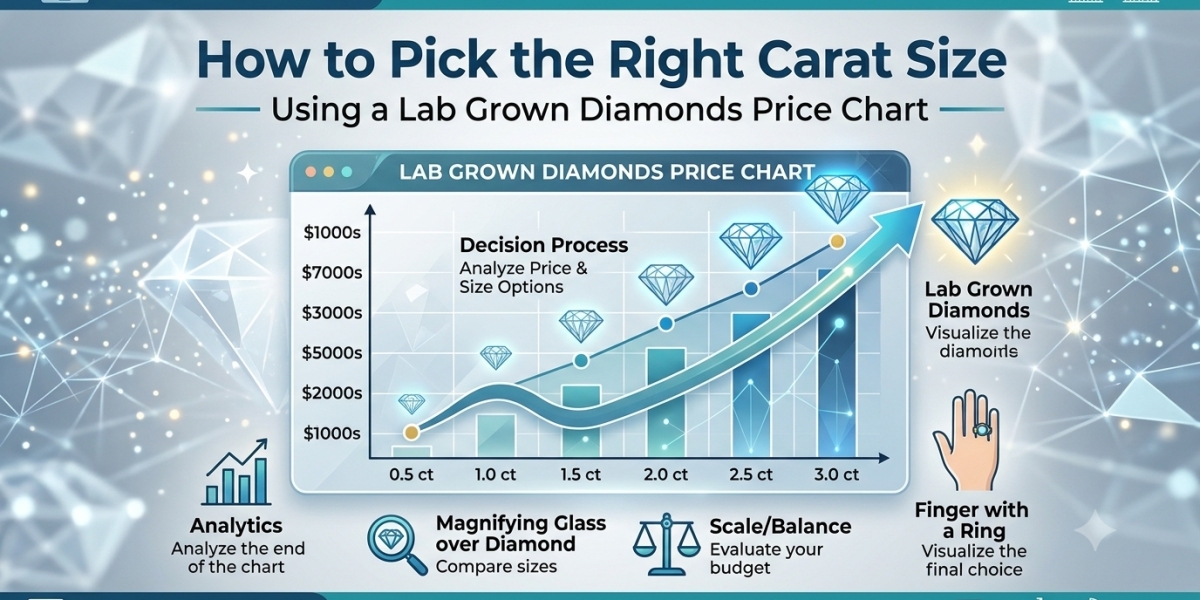

Precious Carbon encourages buyers to compare the whole piece of jewelry rather than choosing a stone based on carat weight alone. This guide explains how to read a price chart, estimate a comfortable carat range, and compare minimalist and more detailed designs. The sample chart below is a planning guide not a live quote or a promise of current retail prices.
What Does a Lab Grown Diamonds Price Chart Tell You?
A lab grown diamonds price chart organizes estimated prices by carat weight or other diamond characteristics so shoppers can compare options at a glance. It is useful for setting a budget, but it cannot replace a review of an individual stone’s cut, color, clarity, measurements, grading report, and seller terms.
Carat is a unit of weight, not a direct measurement of how large a diamond looks from above. Two diamonds with the same carat weight may have different face-up dimensions because of their shape and proportions. Always check the measurements alongside the carat number.
How Can You Use a Lab Grown Diamonds Price Chart to Choose Carat Size?
Related Articles:
How to Use Financing and Payment Plans for Lab Grown Diamonds Price
What Is the Lab Grown Diamonds Price for a 0.5 Carat Stone?
Use the chart as a starting point: decide the budget you want to spend, identify a few possible carat ranges, and then compare stones with similar quality specifications. Prices differ by seller and market conditions, so the ranges below are intentionally relative rather than presented as exact dollar quotations.
Carat range | Typical visual impression | Budget planning note | Useful comparison |
0.50–0.75 ct | Subtle and delicate on many settings | Often a lower overall spend than larger stones | Compare cut, measurements, and setting proportions |
0.80–0.99 ct | Noticeable size while remaining understated | Can be a middle-ground option | Check exact dimensions rather than relying on rounded carat labels |
1.00–1.49 ct | A classic center-stone range for many designs | Compare stones carefully because price can vary widely | Prioritize cut appearance and grading details |
1.50–1.99 ct | A more prominent center stone | Allow more budget for the setting and any added details | Compare face-up spread, shape, and ring balance |
2.00 ct and above | A bold focal point in many settings | Quality, shape, and setting can significantly affect total cost | Review proportions, durability of the setting, and total price |
This table does not claim a universal price for any carat size. For a reliable comparison, check current listings and make sure the diamonds have similar cut, color, clarity, shape, and documentation.
Carat Size vs. Diamond Shape: What Is the Difference?
Carat weight tells you how much a diamond weighs; shape describes its outline, such as round, oval, pear, emerald, cushion, or princess. Some elongated shapes may appear larger face-up than round stones of the same weight, although the effect depends on proportions and cutting. Choose a shape that suits the wearer’s style and compare the actual measurements.
What Should You Check Besides Lab Grown Diamonds Price?
Review the 4Cs—carat, cut, color, and clarity—together. Cut influences sparkle, color describes the degree of body color, and clarity grades inclusions and blemishes. Also check the grading report, return period, warranty, resizing terms, setting metal, accent stones, taxes, shipping, and any other charges. A low headline price may not represent the best overall value if the details differ.
How to Pick the Right Carat Size Step by Step
Set a total jewelry budget. Include the center stone, setting, taxes, shipping, and possible resizing or maintenance.
Choose the intended style. A minimalist solitaire may emphasize the center stone; pavé, halo, and three-stone designs add detail and can change the total cost.
Try a few carat ranges. Compare images or in-person examples on a similar finger size and setting style, if possible.
Compare measurements and cut. Look beyond the carat label to the diamond’s dimensions, proportions, and light performance.
Review color and clarity. Decide which visual qualities matter most and compare stones using consistent grading information.
Check the full purchase terms. Confirm the final price, grading documentation, returns, warranty, delivery, and resizing policy.
How Do Minimalist and Luxury Rings Affect the Budget?
A minimalist ring typically uses a simpler band and setting, which can leave more of the budget available for the center diamond. Luxury designs may feature intricate metalwork, halo settings, pavé accents, side stones, or distinctive details. Neither style is automatically better: compare craftsmanship, comfort, durability, and the complete price.
Design style | Where the budget may go | What to inspect |
Solitaire / minimalist | Primarily the center stone and band | Prong security, band width, metal, and stone proportions |
Halo | Center stone, surrounding accent stones, and setting work | Accent-stone quality, symmetry, and maintenance needs |
Pavé band | Center stone plus small diamonds set into the band | Stone security, comfort, and repair considerations |
Three-stone design | Center diamond and two side stones | Matching appearance, stone balance, and setting durability |
Lab Grown Diamonds vs. Natural Diamonds: Does Carat Comparison Work the Same Way?
The key difference in lab grown diamonds vs natural diamonds is origin: lab-grown diamonds are made using controlled technology, while natural diamonds form through geological processes. Both are diamond material, but their market pricing and origin disclosures differ. Compare the stated specifications and final price of each individual stone rather than assuming that carat weight alone tells the full story.
Searches such as lab grown vs natural diamond, lab grown vs natural diamonds, lab grown diamonds vs natural, lab grown diamonds vs real, lab diamonds vs real diamonds, lab grown diamonds vs real diamonds, lab grown diamonds versus natural, difference between lab grown and natural diamonds, lab vs natural diamond, man made diamonds vs real diamonds, lab grown vs real diamond, lab grown diamond vs natural, lab diamond vs natural diamond, and lab diamonds vs real generally point to questions about origin, quality, price, and documentation.
To answer common questions—are lab grown diamonds real diamonds, are man-made diamonds real, is a lab grown diamond a real diamond, and are lab grown diamonds real—the answer is yes: lab-grown diamonds have the same fundamental crystal structure as natural diamonds. They are different from imitation materials sometimes called fake diamonds, such as glass or cubic zirconia. The phrase “diamond real diamond” is not a recognized grading category, so use a clear product description and grading report when checking a real diamond claim.
Which Lab-Grown Jewelry Categories Can You Compare by Carat?
The same principles apply to many types of jewelry. When browsing lab grown diamond rings, lab produced diamonds rings, lab made diamond rings, lab created diamond rings, lab diamond rings, laboratory made diamond rings, lab grown diamonds rings, or a lab diamond ring, compare the center stone, setting, and total cost. Product names can vary, so confirm the actual material and specifications.
For proposal jewelry, shoppers may search for lab grown engagement rings, lab diamond engagement rings, lab grown diamond engagement rings, lab created diamond engagement rings, lab grown diamonds engagement rings, engagement rings lab grown, engagement ring lab created diamond, or a lab grown engagement ring. A lab grown diamond engagement ring should be reviewed as a complete piece: check the center stone and setting together. The same applies to a lab grown diamond ring or lab diamond engagement rings.
Related products include lab grown diamond earrings and a lab grown diamond tennis bracelet. These are part of the wider lab grown diamond jewelry and lab diamond jewelry categories. Retail descriptions may also use lab diamonds, lab grown diamonds, lab created diamonds, laboratory-grown diamond, lab grown diamond, lab manufactured diamond, or lab diamond. These terms should be supported by a clear description of the stone and the item being sold.
Whether you are comparing lab grown diamond rings, lab produced diamonds rings, lab made diamond rings, lab created diamond rings, lab diamond rings, or other diamond jewelry, focus on quality details, craftsmanship, and the final cost. A 2 carat lab grown diamond can be a strong visual centerpiece, but its proportions and cut still matter as much as its weight label.
What Common Mistakes Should Buyers Avoid?
Choosing a carat size before setting a realistic total budget.
Assuming two diamonds with the same carat weight will look identical.
Comparing prices without matching cut, color, clarity, shape, and documentation.
Forgetting the setting, taxes, shipping, resizing, and maintenance costs.
Treating a price chart as a guaranteed quote instead of a guide to current comparisons.
Conclusion
A lab grown diamonds price chart can make carat-size shopping easier by helping you compare ranges before looking at individual stones. The best choice balances visual appearance, cut quality, setting design, grading details, and a total cost that feels comfortable.
Key takeaways:
Carat is weight, not a direct measure of visible size.
Compare similar diamonds using the 4Cs, measurements, shape, and grading documentation.
Include the setting and all additional charges when comparing total prices.
Choose the carat size and design that fit the wearer’s style and your budget.
Explore Precious Carbon to continue comparing lab-grown diamond jewelry and find a design that suits your style, priorities, and budget. Check current product details and purchase terms before making your final decision.
Frequently Asked Questions
How do I pick a carat size using a lab grown diamonds price chart?
Start with your total budget and use the chart to identify a few possible carat ranges. Then compare actual stones by measurements, cut, color, clarity, shape, and grading documentation. Remember that a chart is a planning guide, not a guaranteed quote for every diamond.
Does a higher carat weight always mean a better diamond?
No. Carat measures weight, while cut, proportions, shape, color, clarity, and overall appearance influence how a diamond looks. A well-cut smaller stone may have appealing sparkle and balance. Compare the diamond’s measurements and appearance as well as its carat weight.
What is the difference between lab-grown and natural diamonds?
Lab-grown diamonds are produced in controlled laboratory environments, while natural diamonds form through geological processes. Both are diamond material, but their origin and market pricing differ. Check the product description and grading documentation so you understand exactly what you are considering.
How does Precious Carbon help shoppers compare lab-grown diamond jewelry?
Precious Carbon encourages shoppers to consider the complete item rather than carat weight alone. Compare the available stone specifications, design, setting, final price, and purchase terms for each product. Confirm current product information and policies before buying so your decision reflects your needs and budget.
Is a 2 carat lab grown diamond right for every engagement ring?
Not necessarily. A 2 carat stone can make a prominent centerpiece, but the best size depends on personal style, finger proportions, setting design, budget, and the diamond’s measurements and cut. Compare a few sizes in similar settings before deciding.









