
Market Overview and Growth Outlook
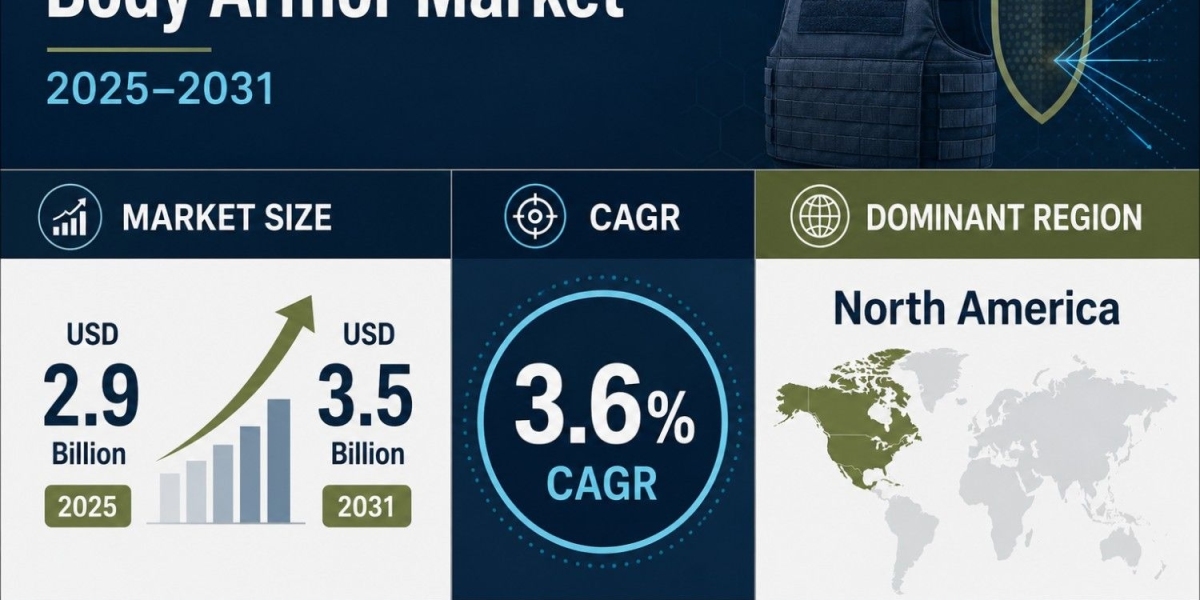
The Body Armor Market was valued at USD 2.8 billion in 2024 and is projected to reach USD 3.5 billion by 2031, expanding at a 3.6% CAGR during 2025–2031.
The Body Armor Market is expected to grow at a CAGR of 3.6% during 2025–2031.
Modern body armor is increasingly moving away from heavy metallic protection toward lightweight systems using UHMWPE, ceramics, and advanced aramid materials.
The Body Armor Market outlook reflects growing demand for higher protection levels without excessive weight, stronger mobility, improved comfort, and next-generation ballistic performance.
Request a free sample report:
https://www.stratviewresearch.com/Request-Sample/body-armor-market#form
Market Segmentation Analysis
By Armor Type, the market includes Soft Body Armor and Hard Body Armor.
Hard Body Armor remains dominant.
By Product Type, the market includes Ballistic-Resistant Armor, Stab-Resistant Armor, Combined Resistant Armor, and ICW Armor.
Ballistic-Resistant Armor remains dominant.
By Material Type, the market includes UHMWPE, Aramid, Ceramic, and Other Materials.
UHMWPE is expected to remain the most preferred material because it combines high strength, durability, ballistic resistance, and low weight.
By Level of Protection Type, the market includes Level IIA, Level II, Level IIIA, Level III, Level IV, SP1/KR1, SP2/KR2, SP3/KR3, Level IIA + SP/KR/SP-KR, Level II + SP/KR/SP-KR, Level IIIA + SP/KR/SP-KR, Level III+ Level IIIA/II, and Level IV + Level IIIA/II.
Level IIIA + SP/KR/SP-KR is expected to attract the highest demand.
By End-User Type, the market includes Military, Homeland Security, and Commercial.
Homeland Security remains the largest and fastest-growing category.
By Mode of Operation Type, the market includes Covert and Overt.
Overt remains dominant.
Regional Market Insights
North America is expected to remain the dominant region because military and law-enforcement agencies continuously upgrade protective equipment.
The region also benefits from material innovation and strong local manufacturing capabilities.
Emerging Trends Shaping the Body Armor Market
In January 2025, Avient launched third-generation Dyneema UD materials for hard armor applications, including ballistic inserts and helmets.
When combined with third-generation soft-armor material, the resulting armor system can be 45% lighter than systems using first-generation Dyneema solutions.
In November 2025, companies also demonstrated a ballistic helmet manufactured with Twaron Next, a para-aramid incorporating certified circular feedstock while retaining ballistic performance and durability.
Key Growth Drivers of the Market
Weight reduction: Lighter armor improves mobility and endurance.
UHMWPE adoption: High strength-to-weight performance supports wider use.
Advanced aramid materials: New fibers maintain protection while supporting lower weight.
Hard-armor innovation: New plates and helmets address demanding ballistic threats.
Sustainability development: Circular-content materials create new options for protective-equipment suppliers.
Competitive Landscape
Top Companies in the Market
Cadre Holdings
Point Blank Enterprises
Safariland LLC
Armor Express
Mehler Vario System
Tencate Advanced Armor
Beijing Tongyizhong New Material Technology Corporation
TYR Tactical
US Armor Corporation
XTek
Senken Group
Hardwire LLC
Hesco
MKU Limited
Mars Armor
SMPP
Conclusion and Strategic Outlook
The Body Armor Market is forecast to reach USD 3.5 billion by 2031, expanding at a 3.6% CAGR during 2025–2031.
UHMWPE, advanced aramids, lighter hard armor, high-protection systems, and Homeland Security applications remain central to the market outlook.
FAQs – Body Armor Market
1. What is the Body Armor Market outlook?
The market was valued at USD 2.8 billion in 2024 and is projected to reach USD 3.5 billion by 2031.
2. What CAGR is expected?
The market is expected to grow at 3.6% CAGR during 2025–2031.
3. Why is UHMWPE important?
UHMWPE combines high ballistic strength, low weight, durability, and effective projectile-energy absorption.
4. Which end-user segment grows fastest?
Homeland Security is expected to generate the largest demand and witness the fastest growth.
5. What should market participants monitor?
Companies should monitor lightweight UHMWPE systems, advanced aramid materials, female-specific armor, certified protection levels, and public-safety procurement.