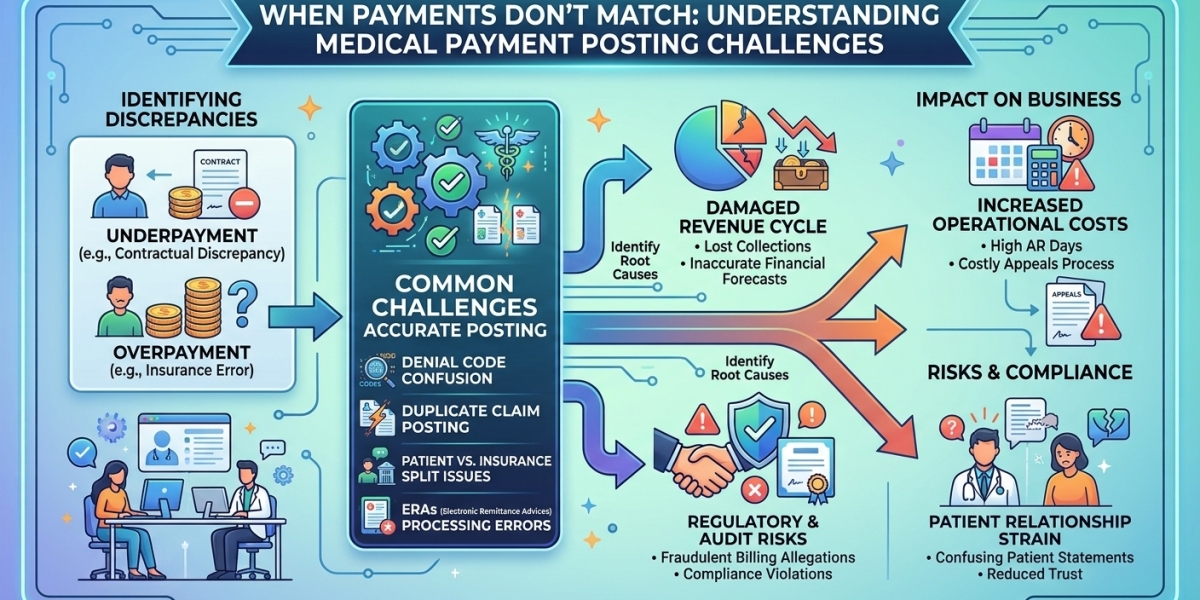

A payment appears in the bank account, but the billing system still shows an outstanding claim. An insurance remittance lists an adjustment that does not match the amount expected. Another payment arrives without enough information to identify the correct patient account.
Medical payment posting services help healthcare organizations address these discrepancies by recording payer payments, interpreting adjustments, reconciling transactions, and identifying accounts that require further investigation. The challenge is not simply entering the amount received. It is understanding why the payment differs from expectations and determining what action, if any, is necessary.
For medical practices, effective payment reconciliation starts with identifying the source of the discrepancy, validating the available information, and ensuring that every transaction is recorded accurately.
Why Insurance Payments Don't Always Match Expectations
A difference between the billed amount and the payment received does not automatically indicate an error. Insurance companies adjudicate claims according to coverage rules, contractual agreements, patient benefits, and other applicable requirements.
The first step is understanding what the payment was supposed to represent.
Several situations can create apparent discrepancies:
Contractual adjustments: The payer reduces the billed charge according to the applicable agreement.
Patient responsibility: A deductible, copayment, or coinsurance amount is assigned to the patient.
Partial payments: The payer processes only part of a claim or service line.
Claim denials: A claim or individual service is denied, requiring review of the payer's explanation.
Unmatched transactions: A payment cannot immediately be associated with the correct remittance or account.
Provider-level adjustments: Certain deductions or credits affect the overall payment rather than an individual claim.
The Centers for Medicare & Medicaid Services (CMS) explains that remittance advice identifies claim-level and service-line adjustments, while provider-level adjustments may account for differences that are not associated with a particular claim. Understanding these distinctions helps billing teams investigate discrepancies without incorrectly treating every difference as lost revenue.
The First Investigation: Payment Received Versus Payment Posted
One of the most important reconciliation tasks is confirming that the money received matches the corresponding payment information.
Consider a hypothetical example. A medical practice receives an electronic funds transfer (EFT) for $8,450, but its billing system records only $8,100 in payments for the corresponding batch.
The $350 difference should not automatically be written off or assigned to a patient account. The team needs to establish what caused it.
A structured review should include:
Confirm the deposit: Verify the amount received against the bank or electronic payment record.
Locate the remittance advice: Find the Electronic Remittance Advice (ERA) or other documentation associated with the payment.
Match the transactions: Compare the payment reference information and relevant claim details.
Review adjustments: Determine whether contractual adjustments, deductions, or other payment-level items explain the difference.
Investigate the remainder: Identify missing, unapplied, duplicated, or incorrectly posted transactions.
The example does not establish that the practice has been underpaid. The difference may reflect a posting error, a transaction recorded elsewhere, or an adjustment that has not yet been reconciled.
CMS provides guidance on matching electronic payments with their corresponding remittance information through its official Health Care Payment and Remittance Advice and Electronic Funds Transfer guidance.
The objective is to explain the difference before changing account balances.
Understanding ERA Adjustments Before Changing Account Balances
An ERA provides details about how a health plan processed a claim and why the payment differs from the billed charges. Misinterpreting this information can lead to incorrect adjustments, inaccurate patient balances, and unnecessary follow-up.
Three elements deserve particular attention.
Claim Adjustment Group Codes
Group codes help identify the general category of financial responsibility associated with an adjustment.
For example:
CO — Contractual Obligation: Identifies adjustments associated with contractual obligations or applicable requirements.
PR — Patient Responsibility: Identifies amounts assigned to the patient under the payer's adjudication.
OA — Other Adjustment: Identifies adjustments that do not fall into the other applicable group categories.
These codes must be interpreted alongside the associated adjustment information and applicable payer rules. A billing team should not transfer an amount to the patient merely because the insurer did not pay it.
Claim Adjustment Reason Codes
Claim Adjustment Reason Codes (CARCs) explain why a claim or service line was adjusted. Depending on the circumstances, the explanation may relate to contractual terms, coverage limitations, or another reason for a difference between the billed and paid amounts.
The code helps the posting team understand the payer's decision and determine whether the adjustment appears appropriate.
Remittance Advice Remark Codes
Remittance Advice Remark Codes (RARCs) can provide additional information about an adjustment or the payer's processing decision.
Reviewing the relevant codes together gives billing staff a more complete picture than looking at the payment amount alone.
CMS explains these code sets and their role in communicating payment adjustments in its official Health Care Payment and Remittance Advice guidance.
Accurate interpretation matters because an adjustment may be legitimate, may require clarification, or may point to an issue that needs further action. The appropriate response depends on the details of the claim.
Unapplied Cash: When Money Arrives Without a Clear Destination
Unapplied cash occurs when a payment has been received but cannot yet be allocated correctly to the relevant patient account or claim.
This can happen when remittance information is missing, payment references do not match, or the billing team cannot confidently identify the transactions covered by a deposit.
Leaving these payments unresolved can make financial reporting less reliable. The practice may have received the money, yet its account records may still show outstanding balances.
A consistent unapplied-cash workflow should include:
Identify the payment: Record the transaction details and available payer information.
Search for supporting records: Review remittance files, payment references, and related claim activity.
Investigate discrepancies: Determine whether the issue involves missing documentation, an incorrect reference, or another identifiable cause.
Maintain an exception record: Track unresolved payments so they are not overlooked.
Allocate only when verified: Apply the payment when sufficient information supports the account assignment.
Staff should avoid assigning unidentified money to an account simply to clear a reconciliation difference. Accurate allocation is more important than making the outstanding exception disappear from a report.
Underpayments Require Investigation, Not Assumption
A payment below the amount expected by a provider can indicate a potential underpayment, but the difference must be evaluated before corrective action is taken.
The expected reimbursement should be based on the applicable payer agreement, claim details, and relevant coverage rules—not simply the original billed charge.
A useful investigation involves several steps:
1. Establish the expected amount. Review the applicable contract terms, fee schedule, and relevant claim information.
2. Verify the payer's calculation. Examine the remittance advice to understand the allowed amount, payment, and adjustments.
3. Check for legitimate explanations. Determine whether patient responsibility, contractual terms, coordination of benefits, or other applicable adjustments explain the difference.
4. Identify the actual discrepancy. If the payment still appears inconsistent with the expected reimbursement, document the specific difference.
5. Route the issue appropriately. Depending on the findings, the next step may involve payer inquiry, corrected claim submission, reconsideration, or an appeal.
Not every lower-than-expected payment warrants an appeal. The purpose of the investigation is to establish whether the payer's decision is consistent with the applicable requirements and determine the appropriate next step.
Denials and Payment Posting: Where the Workflows Connect
Payment posting and denial management are closely related, but they are not the same activity.
Payment posting records the payer's decision and associated financial transactions. Denial management investigates denied claims and coordinates the corrective action required to resolve them.
When a remittance indicates that a claim has been denied or adjusted unexpectedly, the posting team should preserve the relevant information and ensure the account is routed to the appropriate workflow.
Common reasons for further investigation include:
Missing or incomplete claim information.
Eligibility or coverage questions.
Authorization or referral requirements.
Coding or claim-submission issues.
Differences between payer expectations and the submitted claim.
Requests for additional documentation.
The appropriate response depends on the reason stated by the payer. Some issues may require a corrected claim, while others may call for additional records, a payer inquiry, or an appeal.
Separating the posting function from the resolution process helps ensure that financial records remain accurate while outstanding issues receive appropriate attention.
Building a More Reliable Payment Reconciliation Process
Recurring payment discrepancies often deserve a broader review. If the same problems appear repeatedly, correcting individual transactions may not address the underlying workflow issue.
Healthcare organizations can strengthen reconciliation by introducing consistent procedures and clear responsibility for unresolved items.
Standardize the Posting Workflow
Use documented procedures for recording payments, applying adjustments, handling exceptions, and reviewing unusual transactions. Consistency helps reduce variations between staff members and billing periods.
Reconcile Payments Regularly
Compare payment records with available EFT and remittance information. Regular reconciliation makes it easier to identify differences before unresolved transactions accumulate.
Track Exceptions to Resolution
Maintain a record of unmatched payments, unexplained adjustments, and other discrepancies. Each item should have a clear status and an assigned next step.
Use Automation With Appropriate Oversight
Electronic remittance files can reduce repetitive manual entry and support more efficient posting. However, automation does not eliminate the need to review incomplete information, unexpected adjustments, and transactions that cannot be matched confidently.
Review Patterns, Not Just Individual Errors
If similar discrepancies occur repeatedly, investigate whether the cause involves payer-specific workflows, incomplete remittance data, system configuration, training, or reconciliation procedures.
A recurring issue may require a process change rather than another isolated correction.
How Medical Payment Posting Services Support Financial Accuracy
For practices handling high claim volumes or multiple insurance payers, investigating every discrepancy internally can consume considerable administrative time.
Professional medical payment posting services can support the process through structured transaction posting, remittance review, reconciliation, and exception tracking.
Depending on the provider's service scope, this support may include:
Posting insurance payments and associated adjustments.
Reviewing ERA information to support accurate account updates.
Identifying unapplied cash and unmatched transactions.
Flagging discrepancies that may require further investigation.
Maintaining records of unresolved payment issues.
Supporting reporting that helps management review posting accuracy and outstanding exceptions.
The value lies in making financial discrepancies easier to identify, investigate, and resolve. Outsourcing does not remove the need for clear procedures, appropriate oversight, or access to accurate payer information.
For healthcare organizations evaluating an external billing partner, it is worth asking how the provider handles reconciliation exceptions, validates adjustment information, protects patient data, and reports unresolved transactions.
Final Thoughts
When insurance payments do not match expectations, the difference deserves an explanation before anyone changes an account balance or writes off an amount.
Accurate medical payment posting requires more than recording deposits. It involves matching payments to remittance information, interpreting adjustment codes, identifying unapplied cash, investigating potential underpayments, and ensuring denied claims reach the appropriate workflow.
A consistent reconciliation process helps healthcare organizations maintain dependable financial records and direct attention toward issues that genuinely require action.
Ultimately, medical payment posting services are most valuable when they make every transaction traceable, every discrepancy visible, and every unresolved issue easier to investigate. That is how payment posting supports a more reliable and accountable revenue cycle.










