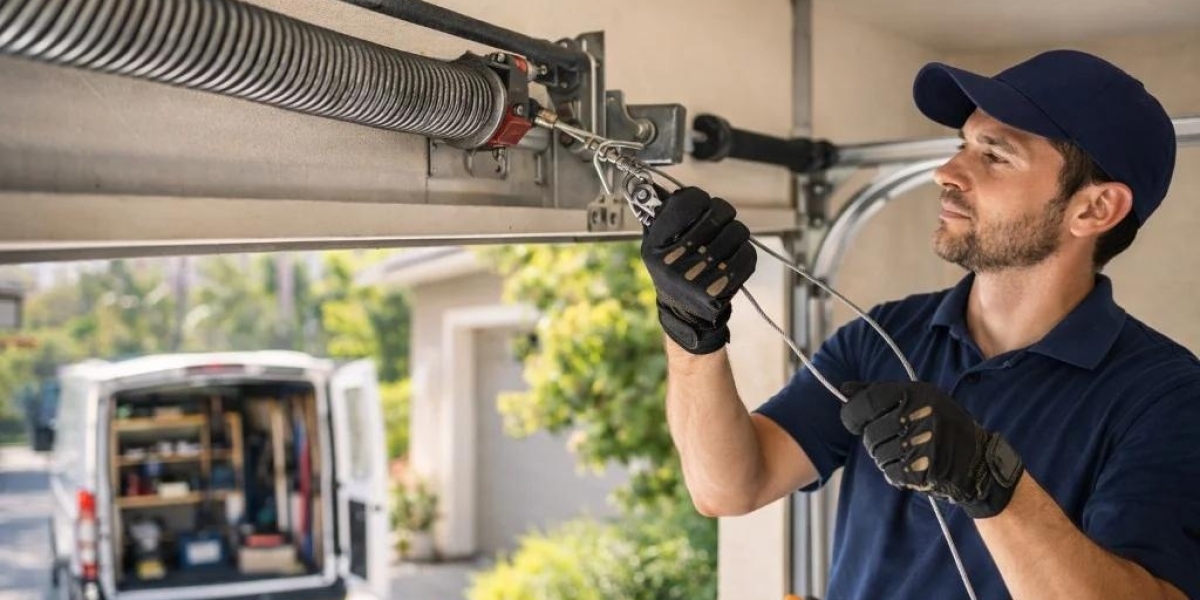

Some loose-cable situations can be corrected by a trained technician without installing a new cable. Others require replacement because the steel strands or end fittings can no longer be trusted. Knowing the difference helps homeowners describe the problem accurately and avoid unsafe trial-and-error fixes. Here is what to consider before arranging professional garage door cable repair.
What Does a Loose Garage Door Cable Actually Mean?
On many residential sectional doors, steel lift cables connect near the bottom corners and wind around drums above the opening. The torsion spring system provides counterbalancing force, while the cables transfer that force so the door can move evenly. Extension-spring doors use a different cable-and-pulley arrangement. The exact layout depends on the door.
A cable is considered loose when it no longer follows its intended route or has developed visible slack. It may hang beside a track, unwind from a drum, or appear uneven compared with the cable on the opposite side. Importantly, slack does not prove that the cable has stretched. A stuck door, a spring problem, a cable-drum issue, or an obstruction can change cable tension even if the cable material is intact.
That is why diagnosis matters. Repositioning the wire without fixing the underlying cause can leave the door unstable and likely to fail again.
When a Loose Cable May Be Repairable
A technician may be able to restore a loose cable to service if it is structurally sound and has simply come out of its intended path. For example, a door that encountered an obstruction might have stopped unevenly, leaving slack that allowed the cable to unwind incorrectly. In another case, a roller or alignment problem may have disturbed the door's movement without breaking the cable.
Before deciding that the cable can be reused, a professional should inspect its full accessible length, end fittings, drum or pulley contact areas, and the surrounding hardware. The technician also needs to establish that the source of slack has been corrected. A cable that looks normal from across the garage may have hidden damage where it bends or attaches.
Homeowners should not try to put a cable back onto a drum or tighten it by pulling the loose end. Spring systems, cable drums, and bottom brackets may be under dangerous tension. A visually simple adjustment can cause the door to move without warning.
The deciding factor: repair is a possibility only when a qualified inspection finds that the cable remains suitable for use and the cause of the slack can be safely corrected.
When Cable Replacement Is the Safer Choice
Replacement becomes the stronger option when the cable itself has lost integrity. Frayed wire strands, broken sections, deep kinks, flattened areas, pronounced corrosion, or damaged end connections are not problems that can reliably be solved by winding the cable back into place.
A steel lift cable is built from multiple strands working together. Once some strands break, the remaining wires can carry an uneven load. Severe bends can also weaken the cable at a concentrated point. A cable with these defects should be assessed promptly and generally replaced rather than patched or spliced for continued residential door use.
A professional may recommend inspecting both lift cables and replacing both when their condition, age, or the door manufacturer's instructions make that appropriate. That decision is based on the complete system—not a rule that every loose cable requires two new ones.
If the cable is broken, visibly frayed, or damaged at an attachment, ask about professional garage door cable replacement instead of trying to save the existing component.
The deciding factor: when the cable cannot safely perform its original job, it needs replacement, even if the door can still move temporarily.
Why a Cable Can Slip Off Its Drum
A loose cable is often a symptom of another problem. If a door stops suddenly against an object, one side can lose tension as the lifting system continues to react to the obstruction. Binding rollers, damaged tracks, or uneven movement may produce similar symptoms. In some cases, the spring system no longer supplies balanced force, allowing cable routing to become irregular.
A technician should examine how the door travels, not just where the cable is hanging. If the door tilts, scrapes, or binds along the track, professional garage door track repair may be relevant to the overall solution. Restoring proper alignment can be essential to preventing a cable from slipping again.
The important distinction is that the cable may not be the original failed part. Replacing it without correcting a binding door or damaged drum can leave the same stress on the new hardware.
Could a Spring Problem Be Mistaken for Cable Damage?
Yes. Springs and lift cables work together, and a failure in either can change how the door behaves. A loud bang, an opener that strains without lifting the door, or a visible gap in a torsion spring can point toward a spring failure. A door that suddenly becomes crooked may also have a cable or guidance problem.
These symptoms overlap, so they should not be used as a do-it-yourself diagnosis. Never try lifting a heavy, suspicious door to test spring strength. A failed counterbalance system may leave the door's weight unsupported, and pulling the opener's emergency-release cord on an unstable raised door can trigger unexpected movement.
When spring damage is suspected, garage door spring repair should be considered as part of the professional assessment. The technician can determine whether the spring, cable, drum, or more than one component needs attention.
Repair or Replace? Questions That Lead to the Right Decision
Instead of focusing only on whether the cable appears loose, ask the service provider to explain five things:
Is the steel cable intact? Fraying, broken strands, corrosion, and kinks change the answer immediately.
Are the cable ends secure? The attachments must be suitable for the door and free of damage.
What made the cable go slack? An obstruction, poor alignment, failed spring, or drum problem may be involved.
Are the other lifting parts in good condition? Both sides of the door need to function together.
What tests will confirm safe operation? Balanced movement and applicable safety features should be checked before use resumes.
A clear explanation is more useful than a quick assurance that the cable has been “fixed.” The aim is to restore safe door operation and address the root cause, not just improve the appearance of the hardware.
Warning Signs That Mean You Should Stop Using the Door
You do not need to identify the exact failed component to recognize when the system may be unsafe. Stop operating the garage door if you notice a cable hanging freely, visible broken wire strands, one side lifting faster than the other, or a door suspended at an angle. Sudden drops, violent jerking, repeated grinding, and a loud bang followed by failed movement also deserve urgent assessment.
A fully open or partially open door that cannot be secured can create an additional security concern. In that situation, explain the current position of the door when you request emergency garage door repair. Keep people away from the opening and do not try to force the door shut.
Never stand beneath a crooked or unsupported door. If a person has been injured or trapped, contact emergency responders rather than attempting to reposition the machinery yourself.
What to Do Safely Before a Technician Arrives
The safest steps are observations, not adjustments. Stop pressing the opener, keep children and pets away, and avoid walking under a raised door that appears unstable. Look from a safe position for a hanging cable, visible fraying, tilted panels, or an obstacle in the doorway. Do not reach around the drum, spring, bottom bracket, or rollers to inspect further.
If the door is already fully closed and shows no sign of instability, you can describe its symptoms without operating it again. A photograph taken from a safe distance may help the service provider understand the issue. Be ready to explain whether you heard a bang, whether the door became crooked, and whether the garage currently locks or closes securely.
Do not loosen fasteners, splice wires, wind the cable onto the drum, or pull the red emergency-release handle on a raised, damaged door. These components can contain stored energy even when the opener is switched off.
What a Professional Cable Inspection Should Cover
A thorough inspection checks the door as a connected system. The technician identifies the type of springs and cables, evaluates the condition of cable strands and fittings, and checks drums or pulleys for improper winding or damage. Door tracks, rollers, brackets, and general alignment should also be considered.
When the condition is safe enough for controlled testing, the technician can determine whether the door is balanced and moves evenly. If the cable remains serviceable, restoring its routing and correcting the original mechanical issue may be appropriate. If the cable is compromised, a properly specified replacement should be fitted using the manufacturer's requirements and professional tension-control procedures.
The final checks matter. The door should not travel at an angle, and the opener's required safety features must work as intended. If an adjustment resolves the visible slack but leaves grinding, binding, or uneven movement, the problem is not fully addressed.
Preventing Another Loose-Cable Problem
After a repair, routine attention can help you notice developing wear. Watch for new rubbing sounds, uneven movement, rust around visible cable sections, or a door that frequently stops in an unusual position. Keep stored objects away from the tracks and never force a door that encounters resistance.
Follow the door and opener manufacturers' care instructions. Avoid applying products to lift cables or altering spring tension unless specifically directed by the manufacturer. Periodic professional garage door maintenance allows an experienced technician to review cable condition, door balance, tracks, rollers, and safety features together.
Maintenance cannot prevent every sudden failure, but it can help catch conditions that put unnecessary stress on the lifting system.
Frequently Asked Questions
Can a loose garage door cable be tightened instead of replaced?
Sometimes an intact cable can be restored to its correct routing after a technician fixes the underlying cause. A frayed, kinked, badly corroded, or broken cable generally should not be reused. Only a professional inspection can make that determination safely.
Why is only one cable loose?
The door may have tilted, encountered an obstruction, or developed a track, roller, spring, or drum problem on one side. A difference between the left and right cables is a sign to stop using the door until the entire lifting system has been checked.
Can I open the garage door if a cable is hanging?
Do not operate a door with a hanging or detached lift cable. Its balance may be compromised, and further movement could cause binding or sudden shifting. Keep the opening clear and seek professional service.
Final Thoughts
The difference between repair and replacement comes down to the condition of the cable and the reason it became loose. An intact cable that slipped out of position may be reusable after a trained technician corrects the cause. A frayed, damaged, or broken cable needs a safer long-term solution. Either way, do not attempt tension adjustments yourself.
For homeowners in Chadds Ford, Pennsylvania, and nearby parts of southeastern Pennsylvania and Delaware, 247 Garage Door Guys provides garage door cable service. Describe what you see, stop using an unstable door, and ask for a complete inspection so the repair addresses the entire lifting system.









