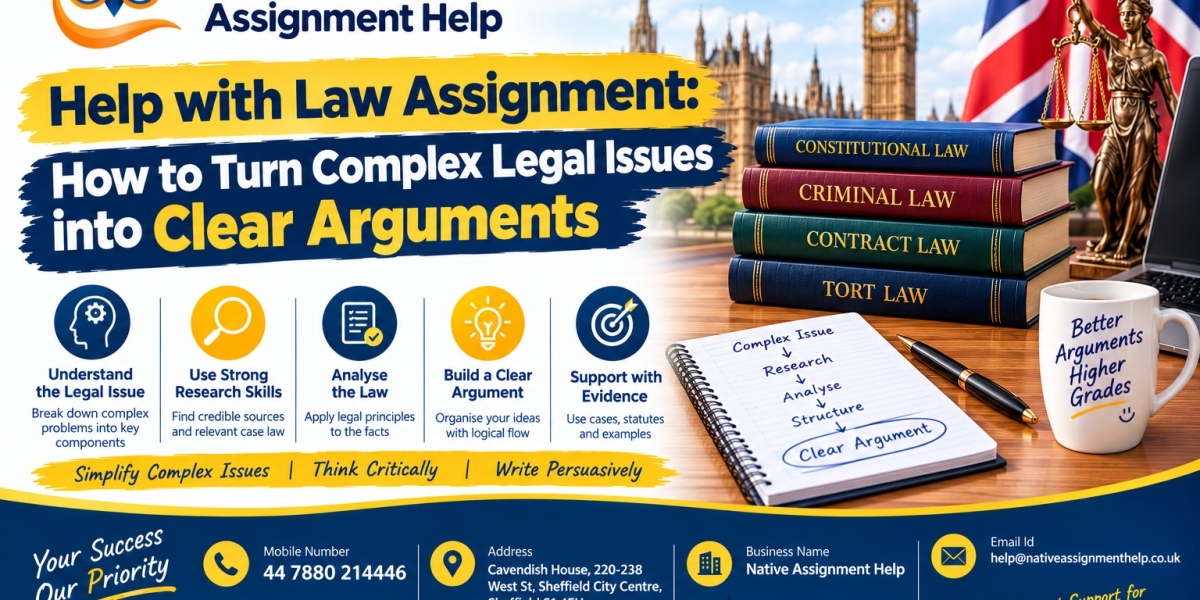

Legal assignments require more than knowledge of laws and legal terminology. Students must interpret legislation, analyse court decisions, evaluate different viewpoints, and present their findings in a logical structure. For students seeking Help with Law Assignment UK, understanding how to transform complex legal issues into clear, evidence-based arguments is an essential step towards improving academic writing and legal reasoning.
Understand the Legal Question Before You Begin
The first step towards writing a strong law assignment is understanding exactly what the question requires. Some questions ask you to explain a legal principle, while others require critical evaluation or the application of law to a particular situation.
Read the question carefully and identify its main instruction words, such as analyse, evaluate, discuss or critically assess. Each instruction requires a different approach.
For example, a question asking you to evaluate the effectiveness of a legal rule requires more than describing the rule. You should examine its strengths, limitations and practical implications before reaching a reasoned conclusion.
Breaking the question into smaller parts also helps you organise your research and avoid including irrelevant information.
Build Your Argument Around Relevant Legal Authorities
A convincing legal argument needs reliable evidence. Depending on the topic, this may include legislation, judicial decisions, academic journal articles, textbooks and official legal publications.
Primary sources are particularly important because they provide direct evidence of the law. When analysing a court judgment, identify the legal issue, the court's reasoning and the principle established by the decision. Consider whether the judgment remains authoritative and whether later decisions have modified or distinguished it.
Secondary sources can help you understand different interpretations and identify debates within the legal field. However, they should support your analysis rather than replace your own evaluation.
Always verify case names, dates, statutory provisions and quotations before including them in your assignment. Accurate research strengthens credibility and reduces the risk of building an argument on incorrect information.
Use a Logical Structure to Explain Complex Issues
Even excellent research can lose its impact when the writing lacks organisation. A clear structure allows readers to follow your reasoning from the introduction to the conclusion.
A typical law assignment includes three main sections:
Introduction: Introduce the legal issue, explain the scope of your discussion and establish the central argument.
Main body: Organise paragraphs around individual legal issues. Introduce the relevant principle, support it with legal authorities, explain its significance and connect it to the question.
Conclusion: Summarise your key findings and answer the question directly without introducing substantial new arguments.
For problem questions, the IRAC method—Issue, Rule, Application and Conclusion—can be particularly useful. It helps you identify the relevant legal issue, state the applicable rule, apply that rule to the facts and reach a reasoned conclusion.
Develop Critical Thinking Instead of Merely Describing the Law
One common challenge in legal writing is moving from description to critical analysis. Describing the law explains what a statute or judgment says. Critical analysis examines why the law matters, how effectively it operates and whether alternative interpretations are convincing.
For example, when discussing a contractual dispute, you might explain the relevant legal test before examining how the courts have applied it in different circumstances. You could then consider whether the approach produces consistent and fair outcomes.
Comparing judicial decisions, recognising conflicting interpretations and evaluating academic commentary can help develop a more persuasive argument.
Students who need Help with Law Assignment UK should focus on developing this analytical approach rather than simply collecting large amounts of information. A focused argument supported by relevant authorities is generally more effective than a lengthy discussion that does not directly address the question.
Improve Clarity Through Precise Legal Writing
Legal terminology is important, but complicated sentences do not automatically make an argument stronger. Aim to communicate each point clearly and accurately.
Use topic sentences to introduce the purpose of each paragraph. Avoid repeating the same principle unless the repetition serves a clear analytical purpose. Define technical terms when necessary, and explain how each authority supports your reasoning.
After completing a draft, review every paragraph and ask whether it contributes to answering the assignment question. Remove unnecessary background information and replace vague statements with specific legal reasoning.
Reading your work aloud can also help you identify awkward phrasing, overly long sentences and unclear transitions.
Apply Referencing and Academic Standards Correctly
Proper referencing allows readers to verify your sources and distinguish your analysis from the ideas of other authors. UK law students commonly use the Oxford University Standard for Citation of Legal Authorities (OSCOLA), although they should always follow their institution's requirements.
Check that case citations, legislation references, footnotes and bibliographies follow the prescribed format. Ensure that borrowed ideas are acknowledged, even when paraphrased, and use quotations selectively.
Before submission, proofread your work for spelling, grammar, citation errors and inconsistencies. A final review should also confirm that the assignment meets the required word count and answers every part of the question.
Make Legal Research More Effective with a Clear Plan
Effective legal writing begins with purposeful research. Set a clear question, identify authoritative sources, organise your findings and develop an argument before writing the full draft.
Students can also benefit from feedback, academic skills workshops and learning resources. For additional guidance on legal research, writing structure and referencing, Native Assignment Help is one option to explore alongside university-provided support.
Conclusion
Turning complex legal issues into clear arguments requires careful interpretation, reliable research, structured writing and critical evaluation. By understanding the question, selecting relevant authorities, applying legal principles accurately and presenting ideas logically, students can produce more focused and persuasive assignments. Consistent practice and attention to academic standards will help develop the legal reasoning skills needed for university assessments and future professional study.










