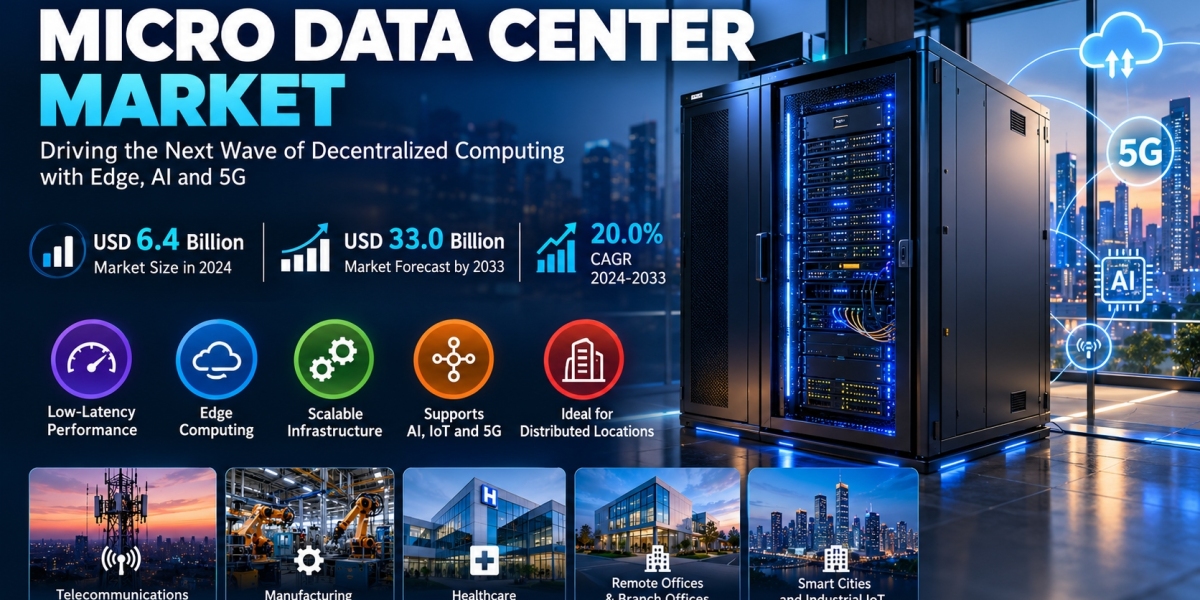

The global Micro Data Center Market is entering a period of significant expansion as businesses rethink how and where digital information should be processed. The growing use of artificial intelligence, connected devices, industrial automation, and high-speed communication networks is increasing the need for computing infrastructure located closer to end users.
According to Dimension Market Research, the global market was valued at USD 6.4 billion in 2024 and is projected to reach USD 33.0 billion by 2033, registering a CAGR of 20.0% during 2024-2033.
This transformation reflects a broader change in enterprise IT architecture. Rather than depending exclusively on large centralized data centers, organizations are introducing smaller, distributed facilities that can process information locally, improve application responsiveness, and support business continuity.
For infrastructure suppliers, technology developers, and enterprise investors, this shift creates opportunities across modular computing, power management, advanced cooling, and intelligent infrastructure monitoring.
What Is the Micro Data Center Market?
A micro data center is a compact IT infrastructure solution that integrates computing, networking, storage, power distribution, cooling, and security systems within a relatively small physical footprint.
These installations are designed for locations where conventional data center development may be impractical, expensive, or unnecessary.
Micro data centers can support operations within manufacturing plants, healthcare facilities, telecommunications sites, retail branches, corporate offices, and remote industrial environments.
Their modular design makes them particularly useful for organizations requiring localized processing capabilities without committing to extensive physical infrastructure.
Unlike traditional facilities that concentrate computing resources in centralized locations, micro data centers enable enterprises to distribute computing capacity according to operational demand.
Why Are Businesses Increasing Their Investment in Micro Data Centers?
Growing Importance of Edge Computing
Edge computing is becoming an essential part of modern digital infrastructure because many applications require immediate access to processed information.
Industrial sensors, intelligent cameras, connected machinery, and automated systems continuously generate operational data. Sending every data point to distant facilities can introduce network delays and increase communication requirements.
Micro data centers allow selected workloads to operate closer to their source.
This architecture supports faster decision-making, more efficient bandwidth usage, and improved responsiveness for time-sensitive applications.
Expansion of 5G Communication Networks
The development of 5G infrastructure is strengthening demand for geographically distributed computing resources.
High-speed wireless connectivity enables new applications involving connected transportation, smart manufacturing, immersive technologies, and automated infrastructure.
However, these applications may also require computing resources positioned near network access points.
Micro data centers provide a practical option for supporting localized processing and network services without relying entirely on distant facilities.
Increasing Enterprise Demand for Flexible Infrastructure
Modern businesses often operate across multiple offices, production locations, and service centers.
Establishing conventional data centers at every location can be financially and operationally challenging.
Modular micro data centers provide a more adaptable alternative by combining essential IT systems into pre-engineered configurations.
This approach can simplify deployment, reduce infrastructure complexity, and support expansion as computing requirements increase.
Get a Free Sample of the Micro Data Center Market Report
Organizations evaluating distributed computing technologies, infrastructure investments, or market-entry opportunities can request a sample of the research report to review its coverage and assess its relevance to their strategic priorities.
Request Free Sample:
https://dimensionmarketresearch.com/request-sample/micro-data-center-market/
Micro Data Center Market Size and Key Statistics
● 2024 Market Valuation: USD 6.4 Billion
● 2033 Revenue Forecast: USD 33.0 Billion
● Projected CAGR: 20.0% during 2024-2033
● North America Market Share: 41.0% in 2024
● Solutions Segment Share: 61.2% in 2024
● Remote Office and Branch Office Share: 44.9% in 2024
● US Market Valuation: USD 2.2 Billion in 2024
● US Market Projection: USD 10.4 Billion by 2033
These figures illustrate the increasing commercial relevance of compact computing infrastructure and its role in supporting decentralized digital operations.
Micro Data Center Market Segmentation: Which Areas Are Gaining Momentum?
Integrated Solutions Remain the Largest Component Category
The solutions segment accounted for approximately 61.2% of market revenue in 2024.
Demand is supported by the preference for integrated infrastructure combining racks, computing equipment, power systems, cooling technologies, and management capabilities.
Pre-configured solutions enable organizations to address multiple infrastructure requirements through a coordinated system rather than purchasing and integrating individual components separately.
Meanwhile, installation, integration, maintenance, and support services remain important for organizations managing distributed IT environments.
Remote Offices and Branch Offices Represent Major Demand Centers
The remote office and branch office category captured approximately 44.9% market share in 2024.
Distributed business locations require dependable computing infrastructure to support customer-facing applications, internal communications, operational systems, and local information processing.
Micro data centers help organizations establish these capabilities within limited spaces while maintaining connectivity with wider enterprise networks.
The rack-based category and 20-40 rack unit configurations also represent important areas of demand, reflecting the need to balance compact deployment with sufficient computing capacity.
Regional Market Analysis: Where Is Demand Concentrated?
North America Maintains a Strong Market Position
North America represented approximately 41.0% of global market revenue in 2024, making it the largest regional market.
Regional demand is supported by established digital infrastructure, enterprise technology investment, growing edge computing requirements, and widespread adoption of connected applications.
The United States is an important contributor, with market revenue estimated at USD 2.2 billion in 2024 and forecast to reach USD 10.4 billion by 2033.
Organizations across telecommunications, manufacturing, financial services, and other sectors are increasingly exploring distributed infrastructure to support operational efficiency.
Opportunities Across Asia-Pacific and Emerging Digital Economies
Asia-Pacific presents opportunities associated with digital transformation, industrial modernization, expanding 5G networks, and investment in connected infrastructure.
Increasing demand for localized computing in manufacturing facilities, telecommunications networks, and distributed business environments is creating potential for micro data center deployment.
Other developing markets also offer opportunities where businesses require scalable computing infrastructure but face limitations involving space, investment, or conventional data center availability.
For vendors, regional expansion strategies should consider local infrastructure requirements, customer applications, service availability, and deployment costs.
Competitive Landscape: Technology and Infrastructure Integration
Competition in the Micro Data Center Market involves companies offering integrated IT infrastructure, power management, cooling systems, modular enclosures, and digital monitoring technologies.
Organizations identified in the industry include Schneider Electric, Vertiv Group Corp., Dell Technologies, Eaton, IBM, Huawei Technologies, Rittal, Panduit, and Zella DC.
Product differentiation increasingly involves compact engineering, energy efficiency, scalable design, security capabilities, and compatibility with enterprise IT environments.
Solutions such as Schneider Electric's EcoStruxure Micro Data Center portfolio demonstrate how integrated infrastructure platforms can address the requirements of decentralized computing.
For customers, purchasing decisions increasingly involve evaluating reliability, maintenance accessibility, installation requirements, lifecycle costs, and operational flexibility.
Market Challenges and Opportunities
Despite substantial expansion potential, micro data center deployment involves technical and financial considerations.
Initial investments in IT equipment, power infrastructure, cooling, monitoring, and integration can create barriers for cost-sensitive organizations.
Distributed facilities also require appropriate physical protection, cybersecurity controls, and maintenance arrangements.
Nevertheless, emerging applications are expanding the addressable market.
Potential opportunities include:
● Localized processing for industrial automation
● Edge infrastructure supporting 5G connectivity
● Compact computing for healthcare facilities
● Distributed IT solutions for enterprise branches
As businesses expand connected operations, suppliers capable of providing reliable and adaptable infrastructure may benefit from increasing demand.
Future Outlook: Decentralized IT Infrastructure Gains Strategic Importance
The industry is expected to evolve as enterprises adopt computing architectures combining centralized cloud facilities with localized processing environments.
Artificial intelligence, industrial IoT, intelligent infrastructure management, and connected devices are likely to influence future deployment requirements.
Micro data centers can support this transition by providing computing resources within operational environments where speed, availability, and flexibility are critical.
For manufacturers and investors, the principal opportunity lies in developing solutions aligned with changing enterprise workloads, regional infrastructure needs, and operational efficiency objectives.
Explore the Complete Micro Data Center Market Analysis
Explore the full Micro Data Center Market report to understand market forecasts, technology adoption, component segmentation, application opportunities, regional developments, and competitive dynamics. The research can support decisions involving market entry, product positioning, and infrastructure investment.
Proceed to Report and Checkout Options:
https://dimensionmarketresearch.com/checkout/micro-data-center-market/
Frequently Asked Questions
1. What is the global Micro Data Center Market size?
The global market was valued at USD 6.4 billion in 2024 and is projected to reach USD 33.0 billion by 2033.
2. What is the projected CAGR of the Micro Data Center Market?
The industry is expected to register a CAGR of 20.0% during 2024-2033.
3. Which component category holds the largest market share?
The solutions segment accounted for approximately 61.2% of global market revenue in 2024.
4. Which region leads the Micro Data Center Market?
North America held the largest regional position, representing approximately 41.0% of global market revenue in 2024.
5. What are the major drivers of Micro Data Center Market growth?
The primary growth factors include edge computing adoption, 5G expansion, connected-device deployment, enterprise digitization, and increasing demand for compact modular IT infrastructure.
Conclusion
The Micro Data Center Market is becoming an increasingly important component of modern digital infrastructure as organizations move toward distributed computing architectures.
The projected rise to USD 33.0 billion by 2033 highlights growing investment potential across edge computing, network infrastructure, enterprise IT, and industrial automation.
Future market development will be shaped by the ability of infrastructure providers to deliver secure, efficient, scalable, and application-specific computing solutions.
Organizations that understand these evolving requirements will be better equipped to assess emerging market opportunities and support long-term digital infrastructure strategies.
Related Data Center Market Insights
The global Data Center Market Size outlook reflects growing investment in cloud infrastructure, enterprise computing, and high-capacity digital facilities. The market is projected to increase from USD 301.8 billion in 2026 to USD 805.3 billion by 2035, supported by expanding data workloads and infrastructure modernization.
The global Edge Data Center Market Share landscape is evolving as organizations increasingly deploy computing resources closer to connected devices and users. The market is projected to rise from USD 11.0 billion in 2025 to USD 51.2 billion by 2034, reflecting demand for low-latency processing and decentralized infrastructure.
The global AI Data Center Market Growth outlook highlights the expanding importance of AI-optimized computing systems. The industry is projected to grow from USD 445.4 billion in 2026 to USD 4,250.1 billion by 2035, supported by generative AI applications, machine learning workloads, and demand for advanced computing capacity.