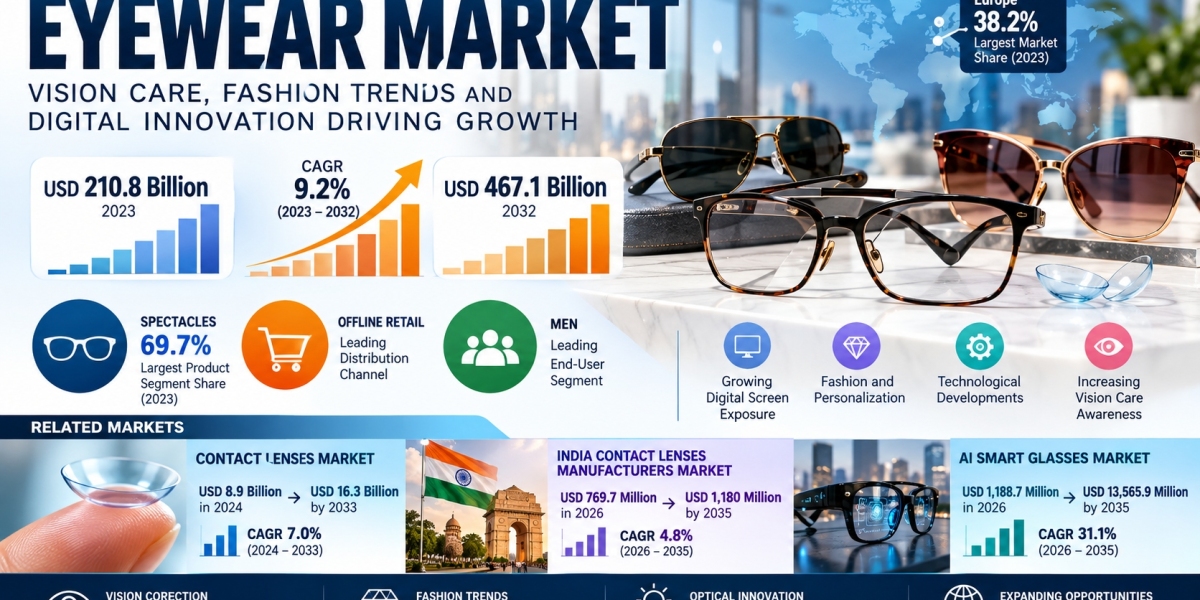

The global Eyewear Market is entering a period of significant transformation as consumers increasingly prioritize visual correction, personal style, and convenient access to optical products. According to Dimension Market Research, the industry was valued at USD 210.8 billion in 2023 and is projected to achieve USD 467.1 billion by 2032, reflecting a compound annual growth rate (CAGR) of 9.2% during 2023 to 2032.
This expansion reflects a shift in how consumers select and purchase eyewear. Prescription spectacles remain essential for vision correction, while fashionable frames, sunglasses, advanced lenses, and contact lenses broaden the market's commercial opportunities.
Digital shopping experiences and optical technology improvements are also changing the competitive environment. Manufacturers increasingly need to consider functional performance, product appearance, affordability, and distribution convenience when developing their portfolios.
What Is the Eyewear Market?
The eyewear market includes products used to correct eyesight, protect the eyes, and complement personal appearance. Its principal categories consist of spectacles, contact lenses, and sunglasses, with prescription spectacles further divided into frames and lenses.
The industry's commercial structure connects lens manufacturers, frame producers, optical retailers, and distribution companies with consumers seeking different levels of visual correction and product customization.
Unlike purely fashion-oriented accessories, eyewear purchases often involve both functional requirements and individual preferences. This combination makes optical performance, professional consultation, product design, and purchasing accessibility important competitive factors.
Why Is Eyewear Demand Increasing Worldwide?
Digital Lifestyles Are Changing Visual Requirements
The widespread use of smartphones, laptops, and tablets has increased attention to visual comfort during prolonged screen-based activities.
The report identifies computer vision syndrome as a factor contributing to interest in spectacles, particularly among consumers frequently using electronic devices for work, education, and entertainment.
This environment supports demand for prescription eyewear and specialized lens products marketed toward digital-device users. Optical manufacturers can respond through lens design improvements, anti-glare treatments, and products addressing different visual requirements.
Eyewear Has Become a Fashion Statement
Eyewear is no longer purchased exclusively for eyesight correction. Frame design, material selection, color, and brand identity increasingly influence consumer preferences.
Manufacturers are responding with collections that accommodate different lifestyles, professional settings, and fashion expectations. This creates opportunities for premium optical brands as well as businesses offering accessible, style-oriented products.
For retailers, maintaining diverse frame collections can help address both replacement purchases and customers seeking different eyewear styles.
Get a Free Sample of the Eyewear Market Report
Businesses evaluating optical product manufacturing, international distribution, eyewear retail, or competitive positioning can review the research scope before making strategic decisions.
The sample provides an introduction to the report structure, market segmentation, research methodology, and company coverage.
Download PDF Brochure:
https://dimensionmarketresearch.com/request-sample/eyewear-market/
Eyewear Market Size and Key Industry Statistics
The report identifies several important characteristics of the global eyewear industry's competitive and demand structure.
● 2023 Market Size: USD 210.8 Billion
● 2032 Forecast Revenue: USD 467.1 Billion
● Forecast CAGR: 9.2%
● Largest Product Segment: Spectacles, 69.7% share in 2023
● Leading Region: Europe, 38.2% share in 2023
● Leading Distribution Channel: Offline Retail
These findings highlight the continued commercial importance of prescription eyewear and physical optical stores, even as manufacturers invest in digital distribution capabilities.
Eyewear Market Segmentation: Which Categories Are Leading?
Spectacles Hold the Largest Market Share
Spectacles accounted for 69.7% of global eyewear revenue in 2023, maintaining their position as the largest product segment.
Their widespread adoption reflects demand for vision correction, the availability of multiple frame designs, and growing consumer interest in lenses suited to different activities.
The segment includes spectacle frames and optical lenses, allowing businesses to compete through material quality, design differentiation, optical performance, and pricing.
Contact lenses and sunglasses provide additional opportunities. Contact lenses offer an alternative to traditional spectacles, while sunglasses combine eye protection with fashion-related purchasing preferences.
Offline Optical Stores Remain Important
Despite the expansion of e-commerce, offline retail continues to dominate eyewear distribution.
Physical optical stores provide consumers with opportunities to examine frame designs, assess comfort, obtain vision examinations, and consult optical professionals.
These services are especially relevant when customers require prescription products or personalized fitting.
Meanwhile, online distribution offers convenience, wider product visibility, and virtual try-on capabilities. An integrated retail strategy can therefore help eyewear businesses address consumers with different shopping preferences.
Men's Eyewear Leads End-User Segmentation
Men represent the leading end-user category in the report, reflecting demand for prescription spectacles, sunglasses, and protective eyewear.
However, women's collections and unisex products remain important parts of the industry. Their development demonstrates how manufacturers are adjusting product portfolios to serve consumers across different style and functional categories.
Regional Eyewear Market Analysis
Europe Accounts for the Largest Regional Share
Europe held 38.2% of the global eyewear market in 2023, supported by its established optical manufacturing industry and strong influence on international fashion trends.
Consumers across the region demonstrate varied preferences for premium frames, protective eyewear, and affordable prescription products.
Western European markets show significant interest in luxury eyewear, while Eastern European consumers contribute to demand for more economical alternatives.
The presence of established manufacturers and optical retail networks also supports Europe's competitive position.
Opportunities Across Other Regional Markets
North America, Asia-Pacific, Latin America, and the Middle East and Africa represent additional markets covered in the report.
For companies evaluating international expansion, differences in purchasing power, distribution networks, consumer preferences, and optical service accessibility can influence market entry strategies.
Asia-Pacific includes important country markets such as China, India, Japan, South Korea, and ASEAN economies, while North America's coverage includes the United States and Canada.
Competitive Landscape: How Are Eyewear Companies Differentiating?
The eyewear industry brings together optical technology specialists, lens manufacturers, branded eyewear companies, and retailers.
Prominent companies identified in the report include Carl Zeiss AG, HOYA Corporation, CooperVision, Johnson & Johnson Vision Care, De Rigo Vision, Rodenstock GmbH, Seiko Optical Products, Warby Parker, and Fielmann.
Competition involves expanding product selections, improving technological capabilities, developing retail networks, and pursuing strategic partnerships.
For manufacturers, maintaining product quality while responding to fashion trends and changing purchasing behaviors is essential.
Economic uncertainty, supply chain disruptions, and differences in consumer spending can also affect product demand and distribution performance.
Future Eyewear Market Trends and Business Opportunities
Through the report's 2032 forecast horizon, eyewear businesses are expected to operate in an environment shaped by visual correction requirements, evolving fashion preferences, and digital retail development.
Important themes include:
● Growing interest in advanced optical lenses.
● Wider access through online retail channels.
● Product differentiation through frame design.
● Increased attention to visual comfort.
● Integration of digital shopping technologies.
Companies can use these developments to evaluate potential investments in product innovation, regional distribution, consumer engagement, and retail partnerships.
For investors and strategic planners, understanding which product categories and geographic markets align with business capabilities remains an important consideration.
Explore the Complete Eyewear Market Analysis
The full Eyewear Market report examines revenue estimates, product segmentation, distribution channels, end-user categories, regional markets, competitive conditions, and industry growth factors.
These findings can support manufacturers, optical retailers, investors, and business development teams assessing market opportunities and competitive positioning.
Proceed to Checkout: View Report and Purchase Options
https://dimensionmarketresearch.com/checkout/eyewear-market/Frequently Asked Questions
1. How large is the global Eyewear Market?
The global eyewear market was valued at USD 210.8 billion in 2023 and is projected to reach USD 467.1 billion by 2032.
2. What CAGR is projected for the Eyewear Market?
The industry is forecast to expand at a CAGR of 9.2% during the 2023 to 2032 period.
3. Which product category dominates the Eyewear Market?
Spectacles represent the largest category, accounting for 69.7% of global eyewear market share in 2023.
4. Which region holds the largest Eyewear Market share?
Europe leads the global market with a reported 38.2% share in 2023.
5. What factors contribute to Eyewear Market growth?
Major influences include vision correction needs, changing fashion preferences, digital screen exposure, optical product innovations, and increasingly accessible retail channels.
Conclusion
The global eyewear industry is evolving from a primarily vision-correction-oriented business into a broader market connecting optical technology, consumer fashion, and retail innovation.
With the market forecast to reach USD 467.1 billion by 2032, businesses have opportunities to develop differentiated products, strengthen distribution capabilities, and respond to diverse regional consumer requirements.
The industry's future development will depend on how effectively manufacturers and retailers balance visual performance, design preferences, affordability, and purchasing convenience.
Related Optical and Wearable Technology Market Insights
Global Contact Lenses Market
The Contact Lenses Market Size outlook anticipates growth from USD 8.9 billion in 2024 to USD 16.3 billion by 2033, representing a 7.0% CAGR. Increasing interest in comfortable vision correction, advances in silicone hydrogel materials, and consumer preference for convenient lens options are influencing this industry. Soft lenses, specialty products, and different replacement schedules form important areas of analysis.
India Contact Lenses Manufacturers Market
The India Contact Lenses Manufacturers Market Share report estimates the market at USD 769.7 million in 2026, with revenue projected to reach USD 1,180 million by 2035, at a 4.8% CAGR. Soft contact lenses lead with a 78.0% product share, while optical stores account for 52.0% of distribution. The market provides opportunities for manufacturers and distributors serving India's vision correction requirements.
Global AI Smart Glasses Market
The AI Smart Glasses Market Growth forecast projects expansion from USD 1,188.7 million in 2026 to USD 13,565.9 million by 2035, registering a 31.1% CAGR. The development of artificial intelligence, augmented reality, hands-free communication, and wearable computing is expanding smart glasses applications across consumer and enterprise environments.