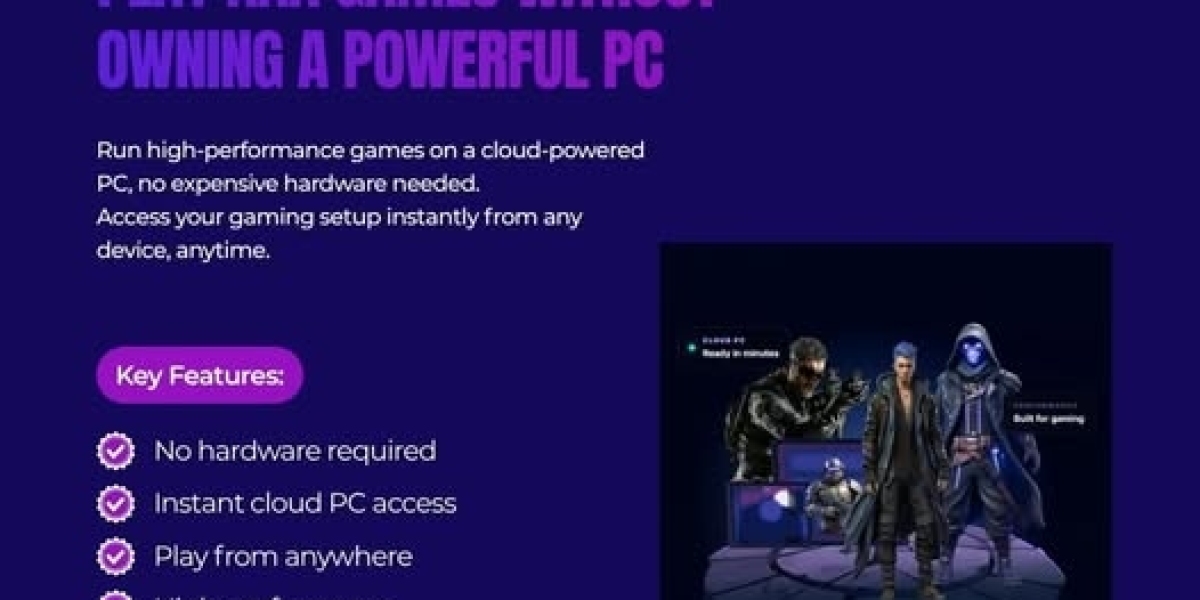

A cloud computing desktop uses virtualization and remote desktop infrastructure to provide computing resources on demand.
When a user creates or launches a pc cloud gaming, the provider allocates the selected resources and prepares the operating system. The user then connects through a supported browser or remote desktop client.
Once connected, applications run on the remote computer. Their visual output is streamed to the local device, and user inputs are transmitted back to the cloud system.
This makes it possible to use applications that would otherwise require more powerful local hardware.
For example, a user could connect to a cloud PC with a graphics processor, install compatible software, and work with that environment from a supported laptop.
The cloud desktop remains separate from the local machine. Its files, settings, and installed applications can persist according to the provider's storage and resource-retention policies.
PC Gamer na Nuvem: Understanding Cloud Gaming
The phrase PC gamer na nuvem refers to a cloud gaming PC: a remote computer that runs games and streams the gameplay to another device.
The concept is straightforward. Instead of rendering a game locally, the remote computer performs the processing and sends the resulting video to the player.
This model can be attractive to gamers who:
Have a laptop without a dedicated gaming GPU.
Want to avoid purchasing another expensive gaming desktop.
Need access to more powerful hardware for selected games.
Prefer a remote computer with configurable resources.
Want to use a full desktop instead of a fixed game-streaming catalog.
However, cloud gaming is sensitive to network conditions. High latency, packet loss, unstable Wi-Fi, and long routing paths can affect responsiveness.
Choosing a suitable cloud region and maintaining a reliable connection are important parts of the setup.
Cloud Desktop vs. Traditional Cloud Gaming Services
Not every cloud gaming service provides the same type of access. Understanding the difference can help users select the right platform.
Catalog-based game streaming
Some services provide access to a supported collection of games. Users choose a title from the available catalog and stream it without managing a complete remote desktop.
This can be convenient for players who want a simple gaming interface. However, the game selection and supported features are controlled by the provider.
Full cloud desktop
A full cloud desktop provides an operating-system environment rather than only a game-streaming interface.
Depending on the provider and configuration, users can install compatible game launchers, manage files, customize settings, and run other desktop applications.
This approach offers greater flexibility, although users may need to manage installations, accounts, licenses, and compatibility themselves.
For someone who wants both gaming and general computing, a full cloud desktop PC may be more suitable than a service limited to a predefined game library.
What Hardware Matters in a Cloud Gaming Desktop?
A cloud PC should be evaluated by its actual configuration rather than by a general promise of high performance.
GPU
The graphics processing unit handles rendering and other graphics-intensive tasks. Gamers should check the GPU model, available memory, and whether the resources are dedicated or shared.
A clearly specified GPU makes it easier to understand what kind of workloads a configuration is designed to support.
CPU
The processor manages game logic, background applications, and operating-system tasks. Games with demanding simulation or multitasking requirements may benefit from additional CPU resources.
RAM
Memory affects how many applications and processes can run comfortably. Gamers who use browsers, voice chat, recording software, or other applications alongside games should consider their total memory requirements.
SSD storage
Storage determines how much space is available for operating-system files, games, launchers, and other applications.
Persistent SSD storage is especially useful because users can retain installed games and settings between sessions while the associated cloud computer and storage remain allocated.
What Internet Connection Do You Need?
A cloud desktop depends on continuous communication between the local device and the remote computer.
Three network factors are particularly important.
Latency: Lower latency generally makes remote controls feel more responsive. The distance between the user and the cloud region, along with internet routing, affects this measurement.
Bandwidth: The connection needs enough capacity to receive the streamed desktop at the chosen resolution and quality.
Stability: Packet loss, congestion, and frequent interruptions can cause stuttering or inconsistent display quality.
For a better experience, use Ethernet when possible. If you use Wi-Fi, a strong modern wireless connection can help. It is also worth testing the connection at the times you normally play, since network conditions can change throughout the day.
A powerful remote GPU cannot compensate for an unreliable connection.
Why Choose a Full Cloud PC for Gaming and Productivity?
A full cloud PC can support more than gaming. Depending on its operating system and configuration, it can also provide a remote workspace for everyday computing.
Potential uses include:
Software development and testing.
Web browsing and research.
Office and productivity applications.
Compatible creative software.
File management.
Gaming through supported launchers and titles.
This flexibility can make a cloud desktop useful to people who need different computing environments without maintaining multiple physical computers.
For example, a developer could use a Linux cloud desktop for development tasks and a Windows cloud PC for applications that require Windows.
The right configuration depends on the software, workload, and operating-system requirements.
How SensePC Fits Into the Cloud Desktop Market
SensePC provides configurable Windows and Ubuntu cloud computers for users who want a complete remote desktop environment.
Rather than limiting users to a fixed game catalog, the platform offers cloud PCs with selectable computing resources, storage, operating systems, and available regions.
For gaming, SensePC offers Xtreme configurations with NVIDIA L4 graphics. The Xtreme Core, Pro, and Ultra options provide different CPU, memory, and storage capacities, allowing users to select a setup based on their requirements.
Steam and Epic Games Launcher are ready on Xtreme plans. Users sign in with their own accounts and install games they own or are licensed to access. Individual game compatibility can vary due to publisher rules, DRM, launcher requirements, and anti-cheat restrictions.
SensePC also offers persistent SSD storage, helping retain installed applications, games, settings, and files while the PC and storage remain allocated.
Its Hourly, Daily, and Monthly billing options provide different ways to access a cloud desktop. Users should compare current pricing, usage limits, and storage charges before choosing a plan.
The platform supports browser access and Performance Mode through a native remote desktop client on supported desktop and laptop systems. Windows 11 uses a bring-your-own-license approach, while Ubuntu 24.04 LTS is another available operating-system option.
For people exploring a cloud desktop PC for gaming, development, or everyday computing, SensePC represents a full-PC alternative to catalog-based game streaming.
How to Select the Right Cloud Desktop PC
Before choosing a provider, consider these practical questions:
What is your main workload? Gaming, development, productivity, and creative work can require different configurations.
Which operating system do you need? Check Windows and Linux availability and software compatibility.
What GPU is provided? Compare actual hardware specifications rather than relying on generic performance claims.
Can you install your own applications? Review administrator access, launcher support, and software restrictions.
Is storage persistent? Understand how files and installed applications are retained.
How is usage billed? Compare hourly and longer-term plans against your expected usage.
Which locations are available? Choose a practical region and test latency before committing.
These checks can help prevent paying for resources that you do not need or choosing a service that does not support your intended applications.
Final Thoughts
A cloud desktop PC brings the traditional computer experience into a remote environment. It can provide access to configurable CPU, memory, GPU, and storage resources without requiring users to purchase all the physical hardware themselves.
For gamers, the idea behind a
A cloud computing desktop uses virtualization and remote desktop infrastructure to provide computing resources on demand.
When a user creates or launches a cloud PC, the provider allocates the selected resources and prepares the operating system. The user then connects through a supported browser or remote desktop client.
Once connected, applications run on the remote computer. Their visual output is streamed to the local device, and user inputs are transmitted back to the cloud system.
This makes it possible to use applications that would otherwise require more powerful local hardware.
For example, a user could connect to a cloud PC with a graphics processor, install compatible software, and work with that environment from a supported laptop.
The cloud desktop remains separate from the local machine. Its files, settings, and installed applications can persist according to the provider's storage and resource-retention policies.
PC Gamer na Nuvem: Understanding Cloud Gaming
The phrase PC gamer na nuvem refers to a cloud gaming PC: a remote computer that runs games and streams the gameplay to another device.
The concept is straightforward. Instead of rendering a game locally, the remote computer performs the processing and sends the resulting video to the player.
This model can be attractive to gamers who:
Have a laptop without a dedicated gaming GPU.
Want to avoid purchasing another expensive gaming desktop.
Need access to more powerful hardware for selected games.
Prefer a remote computer with configurable resources.
Want to use a full desktop instead of a fixed game-streaming catalog.
However, cloud gaming is sensitive to network conditions. High latency, packet loss, unstable Wi-Fi, and long routing paths can affect responsiveness.
Choosing a suitable cloud region and maintaining a reliable connection are important parts of the setup.
Cloud Desktop vs. Traditional Cloud Gaming Services
Not every cloud gaming service provides the same type of access. Understanding the difference can help users select the right platform.
Catalog-based game streaming
Some services provide access to a supported collection of games. Users choose a title from the available catalog and stream it without managing a complete remote desktop.
This can be convenient for players who want a simple gaming interface. However, the game selection and supported features are controlled by the provider.
Full cloud desktop
A full cloud desktop provides an operating-system environment rather than only a game-streaming interface.
Depending on the provider and configuration, users can install compatible game launchers, manage files, customize settings, and run other desktop applications.
This approach offers greater flexibility, although users may need to manage installations, accounts, licenses, and compatibility themselves.
For someone who wants both gaming and general computing, a full cloud desktop PC may be more suitable than a service limited to a predefined game library.
What Hardware Matters in a Cloud Gaming Desktop?
A cloud PC should be evaluated by its actual configuration rather than by a general promise of high performance.
GPU
The graphics processing unit handles rendering and other graphics-intensive tasks. Gamers should check the GPU model, available memory, and whether the resources are dedicated or shared.
A clearly specified GPU makes it easier to understand what kind of workloads a configuration is designed to support.
CPU
The processor manages game logic, background applications, and operating-system tasks. Games with demanding simulation or multitasking requirements may benefit from additional CPU resources.
RAM
Memory affects how many applications and processes can run comfortably. Gamers who use browsers, voice chat, recording software, or other applications alongside games should consider their total memory requirements.
SSD storage
Storage determines how much space is available for operating-system files, games, launchers, and other applications.
Persistent SSD storage is especially useful because users can retain installed games and settings between sessions while the associated cloud computer and storage remain allocated.
What Internet Connection Do You Need?
A cloud desktop depends on continuous communication between the local device and the remote computer.
Three network factors are particularly important.
Latency: Lower latency generally makes remote controls feel more responsive. The distance between the user and the cloud region, along with internet routing, affects this measurement.
Bandwidth: The connection needs enough capacity to receive the streamed desktop at the chosen resolution and quality.
Stability: Packet loss, congestion, and frequent interruptions can cause stuttering or inconsistent display quality.
For a better experience, use Ethernet when possible. If you use Wi-Fi, a strong modern wireless connection can help. It is also worth testing the connection at the times you normally play, since network conditions can change throughout the day.
A powerful remote GPU cannot compensate for an unreliable connection.
Why Choose a Full Cloud PC for Gaming and Productivity?
A full cloud PC can support more than gaming. Depending on its operating system and configuration, it can also provide a remote workspace for everyday computing.
Potential uses include:
Software development and testing.
Web browsing and research.
Office and productivity applications.
Compatible creative software.
File management.
Gaming through supported launchers and titles.
This flexibility can make a cloud desktop useful to people who need different computing environments without maintaining multiple physical computers.
For example, a developer could use a Linux cloud desktop for development tasks and a Windows cloud PC for applications that require Windows.
The right configuration depends on the software, workload, and operating-system requirements.
How SensePC Fits Into the Cloud Desktop Market
SensePC provides configurable Windows and Ubuntu cloud computers for users who want a complete remote desktop environment.
Rather than limiting users to a fixed game catalog, the platform offers cloud PCs with selectable computing resources, storage, operating systems, and available regions.
For gaming, SensePC offers Xtreme configurations with NVIDIA L4 graphics. The Xtreme Core, Pro, and Ultra options provide different CPU, memory, and storage capacities, allowing users to select a setup based on their requirements.
Steam and Epic Games Launcher are ready on Xtreme plans. Users sign in with their own accounts and install games they own or are licensed to access. Individual game compatibility can vary due to publisher rules, DRM, launcher requirements, and anti-cheat restrictions.
SensePC also offers persistent SSD storage, helping retain installed applications, games, settings, and files while the PC and storage remain allocated.
Its Hourly, Daily, and Monthly billing options provide different ways to access a cloud desktop. Users should compare current pricing, usage limits, and storage charges before choosing a plan.
The platform supports browser access and Performance Mode through a native remote desktop client on supported desktop and laptop systems. Windows 11 uses a bring-your-own-license approach, while Ubuntu 24.04 LTS is another available operating-system option.
For people exploring a cloud desktop PC for gaming, development, or everyday computing, SensePC represents a full-PC alternative to catalog-based game streaming.
How to Select the Right Cloud Desktop PC
Before choosing a provider, consider these practical questions:
What is your main workload? Gaming, development, productivity, and creative work can require different configurations.
Which operating system do you need? Check Windows and Linux availability and software compatibility.
What GPU is provided? Compare actual hardware specifications rather than relying on generic performance claims.
Can you install your own applications? Review administrator access, launcher support, and software restrictions.
Is storage persistent? Understand how files and installed applications are retained.
How is usage billed? Compare hourly and longer-term plans against your expected usage.
Which locations are available? Choose a practical region and test latency before committing.
These checks can help prevent paying for resources that you do not need or choosing a service that does not support your intended applications.
Final Thoughts
A cloud desktop PC brings the traditional computer experience into a remote environment. It can provide access to configurable CPU, memory, GPU, and storage resources without requiring users to purchase all the physical hardware themselves.
For gamers, the idea behind a
A cloud computing desktop uses virtualization and remote desktop infrastructure to provide computing resources on demand.
When a user creates or launches a cloud PC, the provider allocates the selected resources and prepares the operating system. The user then connects through a supported browser or remote desktop client.
Once connected, applications run on the remote computer. Their visual output is streamed to the local device, and user inputs are transmitted back to the cloud system.
This makes it possible to use applications that would otherwise require more powerful local hardware.
For example, a user could connect to a cloud PC with a graphics processor, install compatible software, and work with that environment from a supported laptop.
The cloud desktop remains separate from the local machine. Its files, settings, and installed applications can persist according to the provider's storage and resource-retention policies.
PC Gamer na Nuvem: Understanding Cloud Gaming
The phrase PC gamer na nuvem refers to a cloud gaming PC: a remote computer that runs games and streams the gameplay to another device.
The concept is straightforward. Instead of rendering a game locally, the remote computer performs the processing and sends the resulting video to the player.
This model can be attractive to gamers who:
Have a laptop without a dedicated gaming GPU.
Want to avoid purchasing another expensive gaming desktop.
Need access to more powerful hardware for selected games.
Prefer a remote computer with configurable resources.
Want to use a full desktop instead of a fixed game-streaming catalog.
However, cloud gaming is sensitive to network conditions. High latency, packet loss, unstable Wi-Fi, and long routing paths can affect responsiveness.
Choosing a suitable cloud region and maintaining a reliable connection are important parts of the setup.
Cloud Desktop vs. Traditional Cloud Gaming Services
Not every cloud gaming service provides the same type of access. Understanding the difference can help users select the right platform.
Catalog-based game streaming
Some services provide access to a supported collection of games. Users choose a title from the available catalog and stream it without managing a complete remote desktop.
This can be convenient for players who want a simple gaming interface. However, the game selection and supported features are controlled by the provider.
Full cloud desktop
A full cloud desktop provides an operating-system environment rather than only a game-streaming interface.
Depending on the provider and configuration, users can install compatible game launchers, manage files, customize settings, and run other desktop applications.
This approach offers greater flexibility, although users may need to manage installations, accounts, licenses, and compatibility themselves.
For someone who wants both gaming and general computing, a full cloud desktop PC may be more suitable than a service limited to a predefined game library.
What Hardware Matters in a Cloud Gaming Desktop?
A cloud PC should be evaluated by its actual configuration rather than by a general promise of high performance.
GPU
The graphics processing unit handles rendering and other graphics-intensive tasks. Gamers should check the GPU model, available memory, and whether the resources are dedicated or shared.
A clearly specified GPU makes it easier to understand what kind of workloads a configuration is designed to support.
CPU
The processor manages game logic, background applications, and operating-system tasks. Games with demanding simulation or multitasking requirements may benefit from additional CPU resources.
RAM
Memory affects how many applications and processes can run comfortably. Gamers who use browsers, voice chat, recording software, or other applications alongside games should consider their total memory requirements.
SSD storage
Storage determines how much space is available for operating-system files, games, launchers, and other applications.
Persistent SSD storage is especially useful because users can retain installed games and settings between sessions while the associated cloud computer and storage remain allocated.
What Internet Connection Do You Need?
A cloud desktop depends on continuous communication between the local device and the remote computer.
Three network factors are particularly important.
Latency: Lower latency generally makes remote controls feel more responsive. The distance between the user and the cloud region, along with internet routing, affects this measurement.
Bandwidth: The connection needs enough capacity to receive the streamed desktop at the chosen resolution and quality.
Stability: Packet loss, congestion, and frequent interruptions can cause stuttering or inconsistent display quality.
For a better experience, use Ethernet when possible. If you use Wi-Fi, a strong modern wireless connection can help. It is also worth testing the connection at the times you normally play, since network conditions can change throughout the day.
A powerful remote GPU cannot compensate for an unreliable connection.
Why Choose a Full Cloud PC for Gaming and Productivity?
A full cloud PC can support more than gaming. Depending on its operating system and configuration, it can also provide a remote workspace for everyday computing.
Potential uses include:
Software development and testing.
Web browsing and research.
Office and productivity applications.
Compatible creative software.
File management.
Gaming through supported launchers and titles.
This flexibility can make a cloud desktop useful to people who need different computing environments without maintaining multiple physical computers.
For example, a developer could use a Linux cloud desktop for development tasks and a Windows cloud PC for applications that require Windows.
The right configuration depends on the software, workload, and operating-system requirements.
How SensePC Fits Into the Cloud Desktop Market
SensePC provides configurable Windows and Ubuntu cloud computers for users who want a complete remote desktop environment.
Rather than limiting users to a fixed game catalog, the platform offers cloud PCs with selectable computing resources, storage, operating systems, and available regions.
For gaming, SensePC offers Xtreme configurations with NVIDIA L4 graphics. The Xtreme Core, Pro, and Ultra options provide different CPU, memory, and storage capacities, allowing users to select a setup based on their requirements.
Steam and Epic Games Launcher are ready on Xtreme plans. Users sign in with their own accounts and install games they own or are licensed to access. Individual game compatibility can vary due to publisher rules, DRM, launcher requirements, and anti-cheat restrictions.
SensePC also offers persistent SSD storage, helping retain installed applications, games, settings, and files while the PC and storage remain allocated.
Its Hourly, Daily, and Monthly billing options provide different ways to access a cloud desktop. Users should compare current pricing, usage limits, and storage charges before choosing a plan.
The platform supports browser access and Performance Mode through a native remote desktop client on supported desktop and laptop systems. Windows 11 uses a bring-your-own-license approach, while Ubuntu 24.04 LTS is another available operating-system option.
For people exploring a cloud desktop PC for gaming, development, or everyday computing, SensePC represents a full-PC alternative to catalog-based game streaming.
How to Select the Right Cloud Desktop PC
Before choosing a provider, consider these practical questions:
What is your main workload? Gaming, development, productivity, and creative work can require different configurations.
Which operating system do you need? Check Windows and Linux availability and software compatibility.
What GPU is provided? Compare actual hardware specifications rather than relying on generic performance claims.
Can you install your own applications? Review administrator access, launcher support, and software restrictions.
Is storage persistent? Understand how files and installed applications are retained.
How is usage billed? Compare hourly and longer-term plans against your expected usage.
Which locations are available? Choose a practical region and test latency before committing.
These checks can help prevent paying for resources that you do not need or choosing a service that does not support your intended applications.
Final Thoughts
A cloud desktop PC brings the traditional computer experience into a remote environment. It can provide access to configurable CPU, memory, GPU, and storage resources without requiring users to purchase all the physical hardware themselves.
For gamers, the idea behind a cloud gaming computer is especially interesting: a remote computer can run compatible PC games and stream the experience to a supported device. For other users, the same cloud computing desktop can serve as a workspace for development, productivity, and creative applications.
The best choice depends on hardware specifications, network performance, operating-system support, storage, and billing.
Platforms such as SensePC illustrate how a full cloud PC can bring gaming and general desktop computing together in one configurable environment.
is especially interesting: a remote computer can run compatible PC games and stream the experience to a supported device. For other users, the same cloud computing desktop can serve as a workspace for development, productivity, and creative applications.
The best choice depends on hardware specifications, network performance, operating-system support, storage, and billing.
Platforms such as SensePC illustrate how a full cloud PC can bring gaming and general desktop computing together in one configurable environment.
is especially interesting: a remote computer can run compatible PC games and stream the experience to a supported device. For other users, the same cloud computing desktop can serve as a workspace for development, productivity, and creative applications.
The best choice depends on hardware specifications, network performance, operating-system support, storage, and billing.
Platforms such as SensePC illustrate how a full cloud PC can bring gaming and general desktop computing together in one configurable environment.