
When planning to study, work, settle, or conduct business abroad, document authentication is often an important requirement. Two commonly used terms are apostille and attestation. Although both verify the authenticity of documents, their procedures and purposes are different. If you are looking for professional apostille services in bangalore, understanding these differences can help you choose the correct authentication process and avoid unnecessary delays when submitting documents to foreign authorities.
The requirements may vary depending on the destination country and the type of document. For example, individuals applying for immigration or family visas may need a birth certificate apostille in bangalore, while others may require assistance through apostille services in hyderabad for educational, personal, or commercial documentation. Knowing whether your destination country accepts apostille or requires embassy attestation is essential before beginning the process.
Marriage-related documentation is another common requirement for international applications. Couples relocating abroad, applying for spouse visas, or registering their marriage in another country may need marriage certificate apostille in bangalore. Similarly, students and professionals planning to work or study overseas may require degree certificate apostille in bangalore to establish the authenticity of their educational qualifications.
What Is Apostille?
An apostille is an official certificate that authenticates the origin of a public document for use in another country that is a member of the Hague Apostille Convention of 1961.
The convention was introduced to simplify international document legalization. Before its introduction, documents often had to pass through several government departments and embassy verification stages.
An apostille replaces the traditional embassy legalization process between participating countries with a standardized authentication certificate.
In India, the Ministry of External Affairs (MEA) is the designated authority responsible for issuing apostilles.
The apostille certificate generally verifies:
Authenticity of the signature on the document.
Official capacity of the person who signed it.
Authenticity of the seal or stamp appearing on the document.
It does not verify or certify the contents of the document.
What Is Document Attestation?
Document attestation is the process of verifying the authenticity of a document through authorized government departments, institutions, or diplomatic authorities.
It is generally required when documents are intended for countries that are not members of the Hague Apostille Convention or when the receiving authority specifically requests embassy legalization.
The process may involve multiple verification stages, depending on the document and destination country.
For example, documents intended for the UAE, Qatar, Kuwait, or Saudi Arabia may require different combinations of state authentication, MEA attestation, and embassy attestation.
Attestation helps foreign authorities confirm that documents issued in another country are genuine and officially authenticated.
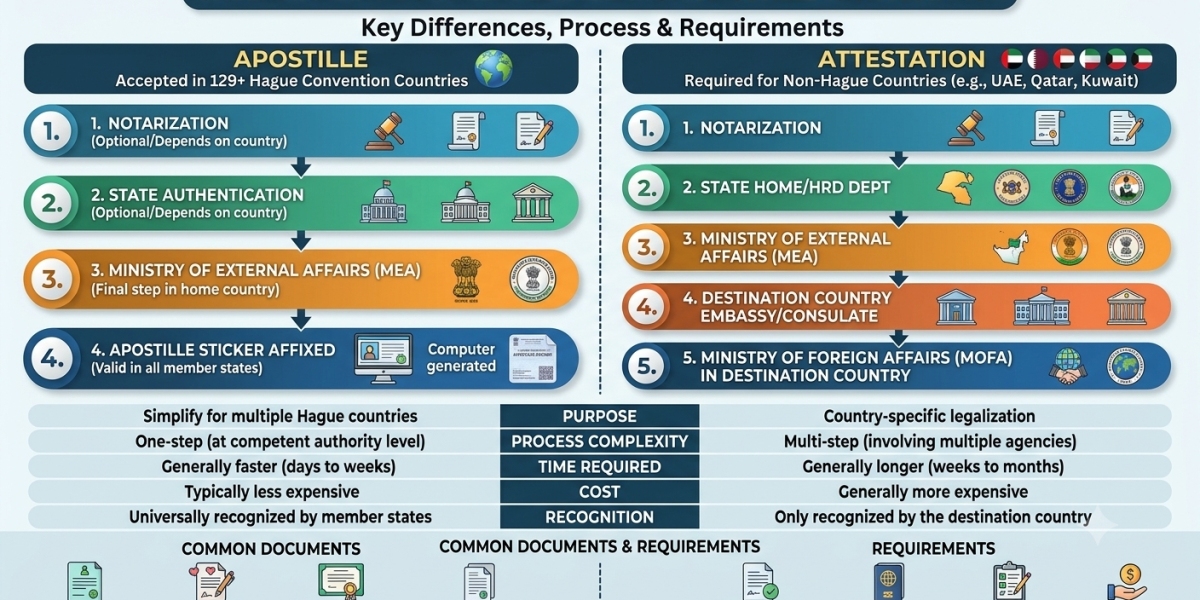
Apostille vs Attestation: Key Differences
Although both processes serve the purpose of document authentication, there are several important differences.
Comparison | Apostille | Attestation |
|---|---|---|
Purpose | International document authentication | International document authentication |
Applicable countries | Hague Convention member countries | Generally non-Hague countries |
Issuing authority in India | Ministry of External Affairs | Relevant government departments and embassies |
Embassy involvement | Generally not required after apostille | Often required |
Process | Standardized authentication | Multiple verification stages |
Certificate | Apostille sticker or certificate | Official stamps and signatures |
Processing time | Generally shorter | May take longer |
The most important difference is the destination country's membership in the Hague Convention and the requirements of the receiving authority.
Which Countries Require Apostille?
Countries that are members of the Hague Apostille Convention generally accept apostilled documents without requiring further embassy legalization.
Some commonly known destinations include:
United States
United Kingdom
Germany
France
Italy
Spain
Netherlands
Australia
Japan
South Korea
Portugal
Switzerland
India is also a member of the Hague Apostille Convention.
However, requirements can vary depending on the receiving institution and the document category. Always confirm the latest requirements before submitting documents.
Which Countries Require Embassy Attestation?
Countries that are not covered by the Hague Apostille Convention generally follow their own document legalization procedures.
Common examples include:
United Arab Emirates (UAE)
Qatar
Kuwait
Saudi Arabia
China
Taiwan
Depending on the country, the process may involve:
Notary verification, where applicable.
State-level authentication.
Ministry of External Affairs attestation.
Embassy or consulate attestation.
Local foreign affairs or other designated authority verification, where required.
The exact procedure depends on the destination country's regulations and the type of document.
Types of Documents That Require Apostille or Attestation
Both authentication procedures apply to different categories of documents.
1. Personal Documents
Personal documents are commonly required for immigration, family visas, overseas marriage registration, and residency applications.
Examples include:
Birth certificates
Marriage certificates
Death certificates
Divorce decrees
Police Clearance Certificates
Affidavits
Power of Attorney
2. Educational Documents
Educational documents are frequently authenticated for overseas education, employment, and professional registration.
Examples include:
Degree certificates
Diploma certificates
School certificates
Mark sheets
Transcripts
Professional qualifications
Educational documents may require verification by the relevant university or State Education Department before MEA authentication.
3. Commercial Documents
Businesses expanding into international markets may need authentication for company-related documents.
Examples include:
Certificate of Incorporation
Memorandum of Association
Articles of Association
Board Resolutions
Commercial invoices
Business agreements
Power of Attorney
Company declarations
The required verification depends on the document's origin and intended use.
Apostille Process in India
The apostille procedure in India generally involves several stages.
Step 1: Document Examination
The first step is to examine the original document and identify its category. The requirements for educational, personal, and commercial documents are different.
Step 2: State-Level Verification
Depending on the document, verification may be required from:
State Home Department
Human Resource Development (HRD) Department
Sub-Divisional Magistrate (SDM)
Relevant issuing authority
Not every document follows the same verification route.
Step 3: MEA Authentication
After completing the required preliminary verification, the document is submitted to the Ministry of External Affairs.
The MEA verifies the relevant signature and seal and attaches the apostille certificate.
Step 4: Document Delivery
Once the apostille process is completed, the document is returned to the applicant or authorized service provider for delivery.
Embassy Attestation Process in India
The embassy attestation procedure generally involves additional authentication stages.
A typical process includes:
Verification of the original document.
State-level authentication, wherever applicable.
MEA attestation.
Submission to the destination country's embassy.
Embassy verification and final attestation.
Some countries may also require additional authentication after the embassy stage.
Therefore, applicants should confirm the complete procedure before submitting their documents.
How Long Does Apostille and Attestation Take?
Processing time depends on several factors, including document category, issuing authority, state verification requirements, and embassy procedures.
Apostille: Generally takes a few working days to a couple of weeks, depending on preliminary verification.
Embassy Attestation: May take longer because multiple departments and diplomatic authorities can be involved.
Incomplete documents, mismatched details, or additional verification requirements can increase processing time.
It is advisable to begin authentication well before your visa appointment, university admission deadline, or overseas employment joining date.
Can You Use Apostille Instead of Attestation?
No, apostille and embassy attestation are not interchangeable in every situation.
If your destination country is a member of the Hague Convention, apostille is generally the appropriate process.
If the destination country is not a member, embassy attestation or another prescribed legalization procedure may be necessary.
You should also consider the specific requirements of the organization receiving your documents. Some institutions may have additional documentation requirements even when apostille is available.
Common Mistakes to Avoid
Applicants often experience delays because of simple documentation mistakes.
Here are some important points to remember:
Do not submit photocopies when an original document is required.
Check whether the document needs state-level verification.
Ensure names and personal details are consistent.
Confirm the destination country's authentication requirements.
Avoid submitting damaged or incomplete documents.
Check whether translation is required.
Verify whether the receiving authority requires additional legalization.
Preparing documents correctly before submission can help prevent unnecessary delays and repeated processing.
Why Choose Secure Apostille Services?
Document authentication can involve multiple government departments, verification authorities, and embassies. Understanding the correct procedure is important to ensure that documents are processed according to applicable requirements.
Secure Apostille Services provides professional assistance for personal, educational, and commercial document authentication.
Our services include:
MEA apostille services.
Embassy attestation for various countries.
Educational certificate authentication.
Personal document authentication.
Commercial document apostille and attestation.
Document translation services.
Document pickup and delivery assistance.
Our team helps customers understand the applicable requirements, coordinate the necessary verification stages, and manage document submissions.
Conclusion
Apostille and attestation both play an important role in international document authentication, but they serve different requirements.
Apostille is generally used for documents intended for Hague Convention member countries, while embassy attestation is commonly required for countries outside the convention.
Before starting the process, identify your destination country, document category, and the authentication requirements of the receiving authority.
With the right guidance from Secure Apostille Services, you can simplify document authentication and prepare your certificates for international use with greater confidence.