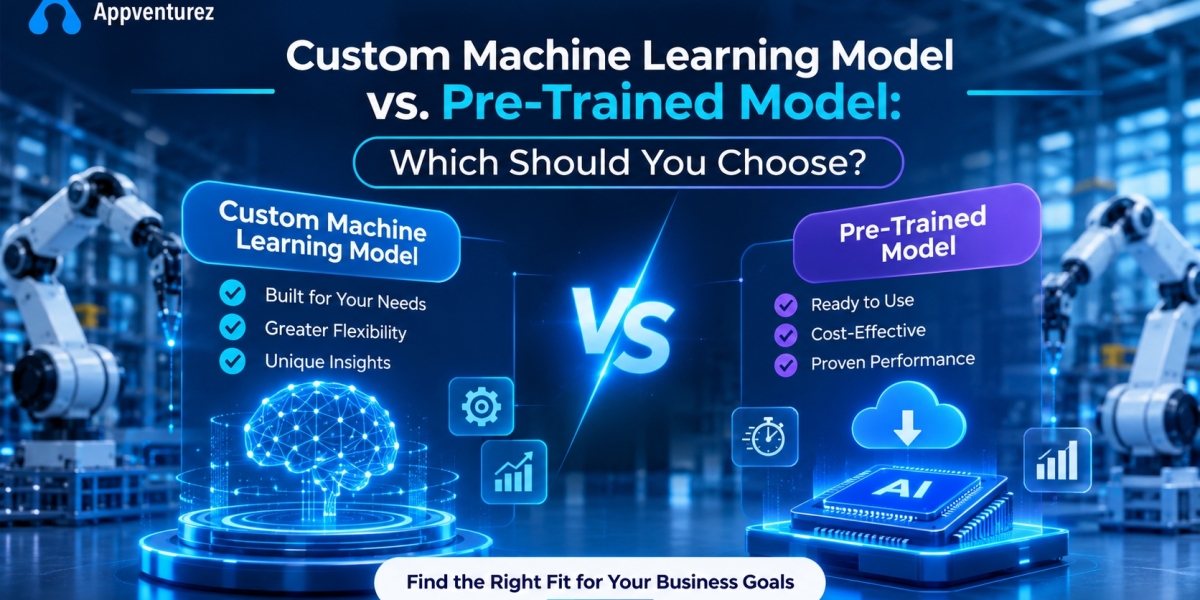

One of the first and most consequential decisions in any machine learning project is deceptively simple: do you build your own model, or start from one that already exists?
A decade ago, the answer was almost always "build your own." If you wanted a model to classify support tickets, recognize product images, or forecast demand, you gathered data, trained an algorithm, and deployed the result. Today, the landscape looks very different. Powerful pre-trained models for language, vision, speech, and more are available through APIs, open-source repositories, and cloud platforms. A task that once needed months of data science work can sometimes be solved in an afternoon by calling an existing model.
That does not mean custom models are obsolete. Pre-trained models are general-purpose tools. They may not understand your products, your jargon, your data formats, or your risk tolerance. For some problems, a custom model trained on your own data will deliver better accuracy, lower running costs, tighter privacy, and a real competitive edge. For others, it would be an expensive way to reinvent something you could have rented.
The right answer is rarely all or nothing. A middle path, fine-tuning or adapting a pre-trained model, often offers the best balance. Companies like Appventurez help businesses weigh these options honestly and build intelligent solutions across mobile, IoT, cloud, and enterprise platforms using the approach that fits each goal and budget.
In this comprehensive guide, we'll explain what custom and pre-trained models are, compare them across cost, accuracy, speed, control, privacy, and maintenance, explore the middle options, give you a practical decision framework, and show how to choose a development partner.
Note: Models, APIs, licenses, and pricing change quickly. Use this article as a decision guide, and confirm current capabilities, terms, and costs with providers and your technical team.
What is a Pre-Trained Model?
A pre-trained model is a machine learning model that someone else has already trained, usually on a very large dataset, and made available for others to use. It has learned general patterns, such as the structure of language, the appearance of everyday objects, or the sounds of speech, and can be applied directly or adapted to new tasks.
Common Types of Pre-Trained Models
Large language models (LLMs): Understand and generate text, powering AI chatbots, summarization, translation, and writing assistance
Embedding models: Convert text, images, or other data into numerical representations for search, recommendations, and retrieval
Computer vision models: Classify images, detect objects, segment scenes, and read text from images
Speech models: Convert speech to text and text to speech
Multimodal models: Work across text, images, audio, and video
Specialized domain models: Models tuned for areas such as code, medical text, legal documents, or finance
How You Access Them
Hosted APIs: You send data to a provider's service and receive predictions, paying by usage
Open-weight models: You download models and run them on your own infrastructure, subject to their licenses
Model hubs and libraries: Repositories such as Hugging Face offer many ready-to-use models
Cloud platform model catalogs: Managed services from AWS, Microsoft Azure, and Google Cloud
Embedded runtimes: Compact pre-trained models packaged for phones and devices
Strengths in One Sentence
Pre-trained models offer fast, low-cost access to powerful general capabilities without needing your own training data or large research teams.
What is a Custom Machine Learning Model?
A custom model is one that you or your development partner train specifically for your problem, using your own data. It learns the patterns that matter to your business, such as which of your customers churn, which of your machines fail, how your products look, or how your documents are structured.
Types of Custom Models
Classic ML models: Regression, decision trees, random forests, and gradient boosting trained on structured business data
Custom deep learning models: Neural networks designed and trained for specialized vision, audio, time-series, or language tasks
Models trained from scratch: Built without starting from any pre-trained weights
Fine-tuned models: Starting from a pre-trained model and training further on your data (covered below as a middle path)
Strengths in One Sentence
Custom models fit your data and requirements precisely, giving you maximum control over accuracy, behavior, cost at scale, and privacy.
The Middle Path: Adapting Pre-Trained Models
The choice is not strictly binary. There is a spectrum of ways to use existing models while still tailoring them to your needs.
1. Prompting and Instructions
For language models, careful instructions, examples, and formatting guidance can shape behavior without any training. It is the fastest and cheapest way to adapt a general model.
2. Retrieval-Augmented Generation (RAG)
The model retrieves relevant passages from your documents, databases, or knowledge base and uses them to answer. This grounds responses in your own information, reduces made-up answers, and keeps content easy to update without retraining.
3. Transfer Learning
You take a pre-trained model, often for images, audio, or text, and reuse its learned features for a new task, training only a small final portion on your data. This typically needs far less data and compute than training from scratch.
4. Fine-Tuning
You continue training a pre-trained model on your own dataset so it learns your domain, terminology, style, or task. Efficient techniques, such as parameter-efficient fine-tuning, reduce the cost compared with updating every parameter.
5. Distillation and Compression
You use a large model to train a smaller, faster one for your task, or compress a model through quantization and pruning so it runs cheaply or on devices.
6. Ensembles and Hybrid Pipelines
You combine pre-trained components with custom models and business rules, for example a pre-trained model to extract text from documents and a custom model to score risk.
Many of the best real-world systems sit somewhere in this middle zone.
Custom Model vs. Pre-Trained Model: Head-to-Head Comparison
1. Time to Launch
Pre-trained: Fastest. A working prototype can take hours or days
Custom: Slower. Data collection, training, and evaluation can take weeks to months
2. Upfront Cost
Pre-trained: Low. Little or no training cost
Custom: Higher. Data preparation, labeling, experimentation, and engineering add up
3. Ongoing Cost
Pre-trained: Often usage-based, which can become large at high volume
Custom: Hosting and maintenance costs, but potentially lower per-prediction cost at scale, especially with small, efficient models
4. Data Requirements
Pre-trained: Little or no data of your own for general tasks
Custom: Needs sufficient, relevant, high-quality data, often with labels
5. Accuracy on General Tasks
Pre-trained: Often excellent for broad, common tasks such as general language understanding
Custom: Usually unnecessary for general tasks
6. Accuracy on Specialized Tasks
Pre-trained: May struggle with niche vocabulary, proprietary formats, unusual data, or tasks unlike its training
Custom: Can be tuned to excel on your specific problem and data
7. Customization and Control
Pre-trained: Limited to prompts, retrieval, and whatever customization the provider allows
Custom: Full control over architecture, training data, behavior, and updates
8. Data Privacy and Residency
Pre-trained (hosted API): Data leaves your environment, so you must review provider terms, retention, and regional hosting
Pre-trained (self-hosted open-weight): Data can stay in your environment
Custom: Can be fully private and tightly governed
9. Explainability
Pre-trained: Often opaque, especially large neural models
Custom: Can use interpretable models such as linear models or decision trees when explanations matter
10. Predictability and Versioning
Pre-trained (hosted): Provider may update or retire models, changing behavior or requiring re-testing
Custom: You control versions and release timing
11. Maintenance Burden
Pre-trained (hosted): Lower. The provider maintains the model
Custom: Higher. You own monitoring, retraining, and infrastructure
12. Latency and Deployment Flexibility
Pre-trained: Large models can be slow or costly to serve, and may not fit on devices
Custom: Can be designed small and fast for phones, wearables, and edge devices
13. Vendor Dependence
Pre-trained (hosted): Dependence on a provider's pricing, availability, policies, and roadmap
Custom: Greater independence, though you depend on your own team and tools
14. Competitive Differentiation
Pre-trained: Competitors can use the same models
Custom: A model trained on your proprietary data can become a lasting advantage
15. Risk of Failure
Pre-trained: Lower technical risk, since the model already works for many tasks
Custom: Higher risk, since results depend on data quality and experimentation
When to Choose a Pre-Trained Model
A pre-trained model is often the smart choice when:
The task is common and general, such as translation, transcription, sentiment analysis, general question answering, or OCR
You want to validate an idea quickly before investing more
You have little or no labeled data
Your team is small or new to ML
Speed to market matters most
Volume is low to moderate, so usage fees stay manageable
Your data is not highly sensitive, or you can use a privacy-appropriate deployment
Your edge comes from the product experience around the model, not from the model itself
Prompting or retrieval over your documents is enough to reach the quality you need
Typical Examples
A customer-facing AI chatbot using a language model grounded in your help center through RAG
Speech-to-text for meeting notes or voice commands
Document OCR and basic text extraction
Image tagging for a content library
Language translation inside an app
Semantic search using pre-trained embeddings
When to Choose a Custom Model
A custom model is often the right choice when:
Your data is unique and valuable, such as proprietary sensor readings, transaction histories, or specialized images
The task is specialized and general models underperform on your data
Accuracy is critical, and even small gains have large business value
You have enough quality data and the expertise to use it
Predictions are high volume, so per-call API fees would be costly
You need strict privacy, data residency, or regulatory control
Explainability is required, such as in lending, insurance, or healthcare
The model must run on devices, offline, or with very low latency
You want independence from a single vendor's pricing and policies
The model itself is a source of competitive advantage
Typical Examples
Churn, credit risk, or demand forecasting on your structured business data
Predictive maintenance on proprietary sensor streams
Defect detection on your specific products and cameras
Fraud detection tuned to your transaction patterns
Compact on-device models for wearables and mobile apps
Recommendation systems based on your own behavior data
Special Case: Structured Business Data
For tabular data, such as customer records, transactions, and operational metrics, there is rarely a general-purpose pre-trained model that fits. Classic ML methods such as gradient boosting, trained on your data, are usually the practical choice, and they are relatively cheap to build and run. Pre-trained models shine more with unstructured data such as text, images, and audio.
Special Case: Large Language Models
For language tasks, the decision looks like this.
Start with prompting and RAG on a pre-trained model. This solves a large share of business use cases quickly
Consider fine-tuning when you need a consistent style or format, specialized vocabulary, shorter prompts for lower cost, or improved performance on a narrow task
Consider a smaller model fine-tuned for your task when volume is high and cost or latency matters
Consider self-hosting an open-weight model when privacy, control, or cost at scale outweigh the convenience of an API
Training an LLM from scratch is rarely justified. It requires enormous data, compute, and expertise
A common progression is to launch with a hosted model and RAG, measure real usage and cost, and move to fine-tuned or self-hosted options only where the numbers justify it.
Special Case: Computer Vision
For vision tasks, transfer learning is the usual best practice.
Start with a pre-trained vision model
Fine-tune it on a few hundred to a few thousand labeled images of your own products, defects, or scenes, depending on difficulty
Optimize and compress the result for the cameras, servers, or edge devices where it will run
Training a vision model entirely from scratch is rare, mostly reserved for very unusual imagery or research.
Cost Considerations
Costs vary widely, so request a detailed estimate for your own project. The patterns below are broadly consistent.
Pre-Trained Model Costs
Upfront: Low. Integration, prompt design, retrieval setup, and evaluation
Ongoing: Usage fees for hosted APIs, or infrastructure costs for self-hosted models
Watch for: Costs that grow with traffic, long prompts, and large documents sent to the model
Custom Model Costs
Upfront: Moderate to high. Data collection and cleaning, labeling, experimentation, training compute, evaluation, and deployment engineering
Ongoing: Hosting, monitoring, retraining, and maintenance
Potential savings: At high volume, a small custom model can cost far less per prediction than calling a large general API
Fine-Tuning Costs
Upfront: Moderate. Data preparation and training compute, usually far less than building from scratch
Ongoing: Similar to hosting a custom model, or usage fees if the provider hosts your fine-tuned version
Finding the Break-Even Point
For many projects, a pre-trained model is cheaper to start, and a custom or fine-tuned model becomes cheaper at scale. Estimate the cost per thousand predictions for each option at your expected volume, including engineering and maintenance, before deciding.
Risk Considerations
Risks of Pre-Trained Models
Hallucinations: Language models can produce confident but incorrect answers
Hidden bias: Training data may embed biases you cannot inspect
Data privacy: Sending sensitive data to external services needs careful review
Vendor changes: Model updates, price changes, rate limits, or retirement can disrupt your product
Licensing: Open-weight and dataset licenses vary, and some restrict commercial use
Security: Prompt injection and data leakage risks in language model applications
Limited transparency: Little visibility into training data and internal behavior
Risks of Custom Models
Insufficient or poor data: Leads to weak or unreliable models
Overfitting: Great results in testing, poor results in the real world
Cost overruns: Experimentation and data work take longer than expected
Talent dependence: Requires skilled people to build and maintain
Drift: Models degrade as conditions change without monitoring and retraining
Bias in your own data: Historical bias can be learned and amplified
Whichever you choose, evaluate on realistic data, test for fairness and robustness, and monitor after launch.
A Practical Decision Framework
Work through these questions in order.
1. Is the Task General or Specialized?
General and common: start with a pre-trained model
Specialized to your data or domain: consider fine-tuning or a custom model
2. What Kind of Data Do You Have?
Text, images, audio: pre-trained and fine-tuned models are strong starting points
Structured, tabular business data: custom classic ML is usually best
3. How Much Labeled Data Do You Have?
Little or none: pre-trained, with prompting or retrieval
Moderate: fine-tuning or transfer learning
Large and high quality: custom training becomes more attractive
4. How Sensitive is the Data?
Highly sensitive or regulated: consider private deployments, self-hosted open-weight models, or custom models in your own environment
Low sensitivity: hosted APIs may be fine after reviewing provider terms
5. What Volume Do You Expect?
Low to moderate: pre-trained APIs are usually economical
Very high: custom or smaller fine-tuned models may be much cheaper
6. How Much Does Accuracy Matter?
Good enough is fine: pre-trained may suffice
Critical, with measurable value per point of accuracy: invest in tuning or custom work
7. What Are Your Latency and Deployment Needs?
Cloud, flexible latency: large pre-trained models are workable
Offline, on-device, or very low latency: compact custom or distilled models
8. Do You Need Explainability?
Yes, for regulatory or trust reasons: favor interpretable custom models or add explanation tooling
Not critical: more options are open
9. How Fast Do You Need to Launch?
Quickly: start with pre-trained and iterate
With time to invest: build toward customization
10. Do You Have the Team and Budget?
Limited ML expertise: lean on pre-trained models and an experienced partner
Strong data and engineering capacity: custom is more feasible
A Rule of Thumb
Start with the simplest option that could work, usually a pre-trained model with prompting or retrieval, measure results on realistic data, and move toward fine-tuning or custom models only when measurements show a clear gap in accuracy, cost, privacy, or control.
A Typical Evolution Path
Many successful products follow this path.
Phase 1, Prototype: Use a hosted pre-trained model with prompts to prove the idea quickly
Phase 2, Grounding: Add retrieval over your own data and guardrails to improve accuracy and safety
Phase 3, Measurement: Collect real usage, feedback, and cost data, and build an evaluation set
Phase 4, Optimization: Fine-tune or distill a smaller model for the highest-volume or highest-value tasks
Phase 5, Ownership: Where the business case justifies it, move critical models into your own environment or build custom models on proprietary data
Ongoing: Monitor, retrain, and revisit the decision as models and prices change
This approach reduces risk, spreads investment, and ensures every upgrade is justified by evidence.
Common Mistakes to Avoid
Building custom first when a pre-trained model would have solved the problem
Using a general model for a specialized task without testing it on your real data
Skipping evaluation sets, so you cannot compare options fairly
Ignoring cost at scale, then facing surprise API bills
Ignoring privacy and licensing terms
Locking into one vendor without an exit plan
Fine-tuning when retrieval would do, or the reverse
Underestimating data work for custom models
Forgetting monitoring and retraining
Chasing the biggest model when a smaller one would be faster, cheaper, and good enough
Why India is a Preferred Destination for ML Development
India has become a global hub for AI, ML, and software development, and many businesses choose Indian partners for good reasons.
Skilled Engineering Talent
India produces thousands of engineers every year with expertise in machine learning, NLP, data engineering, cloud platforms, and application development.
Cost-Effective Development
Compared to North America and Europe, businesses can significantly reduce development costs while maintaining high-quality standards.
Strong Technology Ecosystem
India hosts thousands of technology companies offering AI consulting, model fine-tuning, MLOps, and enterprise integration services.
Flexible Engagement Models
Businesses can choose from:
Dedicated development teams
Fixed-price projects
Hourly hiring
Staff augmentation
Offshore development centers
Global Project Experience
Indian companies work with clients across the US, UK, Europe, Australia, and the Middle East, making them familiar with international compliance standards and agile project management.
How to Choose the Right ML Development Partner
A strong partner helps you decide between custom and pre-trained honestly, not just sell what they prefer to build. When evaluating providers, look for:
Proven experience with both pre-trained model integration and custom model development
Willingness to recommend the simplest approach that meets your goals
Skills in prompt engineering, RAG, fine-tuning, and evaluation
Strong data engineering and MLOps capabilities
Ability to deploy on cloud, on-premises, mobile, and edge devices
A documented approach to security, privacy, licensing, and responsible AI
Transparent pricing that includes usage fees and maintenance
Agile development methodology with regular demos
Post-launch monitoring, retraining, and support
Relevant case studies and client references
A reliable technology partner will measure options on your own data before recommending one.
Why Choose Appventurez for ML Development?
When businesses plan to bring machine learning into their products and operations, choosing the right technology partner becomes crucial. Appventurez has established itself as a trusted software development company offering innovative mobile, cloud, AI, IoT, and wearable solutions tailored to different industries.
The company focuses on delivering scalable, secure, and business-oriented applications that help organizations turn data into smarter decisions and better customer experiences. Whether the best path is integrating a pre-trained model, fine-tuning one on your data, or building a custom model from scratch, Appventurez works across NLP, AI chatbots, computer vision, predictive analytics, and on-device intelligence integrated with mobile apps, IoT platforms, and enterprise systems.
By leveraging modern frameworks, cloud technologies, AI capabilities, and agile methodologies, Appventurez ensures every ML solution is designed for long-term scalability, seamless integration, strong security, transparent budgeting, and measurable business outcomes.
Future Trends
The balance between custom and pre-trained models keeps shifting, and these trends are worth watching.
Key trends include:
Increasingly capable pre-trained and foundation models, raising the bar for when custom training is needed
Smaller, efficient models that approach larger models on narrow tasks at much lower cost
Easier and cheaper fine-tuning, including parameter-efficient methods
Better open-weight models enabling private, self-hosted deployments
Stronger tooling for evaluation, monitoring, and guardrails
Model routing that sends simple requests to small models and hard ones to larger models
On-device models for privacy and offline use in phones and wearables
Growing regulation around data use, transparency, and model governance
Synthetic data supporting custom training where real data is scarce
More attention to licensing, provenance, and supply chain transparency for models
Businesses that keep their architecture modular, so models can be swapped, will benefit most from these shifts.
Frequently Asked Questions
Is a pre-trained model always cheaper?
It is usually cheaper to start. At very high volume, a smaller custom or fine-tuned model can be cheaper to run, so compare costs at your expected scale.
Is a custom model always more accurate?
Not necessarily. On general tasks, large pre-trained models are often excellent. Custom models tend to win on specialized tasks with good proprietary data.
What is the difference between fine-tuning and RAG?
Fine-tuning changes the model's internal behavior by training on your data. RAG leaves the model unchanged and gives it relevant documents at question time. RAG is easier to update, and fine-tuning helps with style, format, and specialized tasks. They can be combined.
Do I need a lot of data to fine-tune?
Often much less than training from scratch. The amount depends on the task, from a few hundred examples for simple adaptations to many thousands for harder ones.
Is it safe to send company data to a hosted model API?
It depends on the provider's terms, retention policies, and regional hosting, and on your regulatory obligations. Review them carefully, and consider private or self-hosted options for sensitive data.
Can I switch later?
Yes, if you design for it. Keep model access behind a clean interface, maintain your own evaluation set, and avoid deep dependence on one provider's special features.
Where should I start?
Begin with a pre-trained model, measure it on your own data, and escalate to fine-tuning or custom development only where the results justify the added cost.
Conclusion
The choice between a custom machine learning model and a pre-trained model is not about which is better in the abstract. It is about fit. Pre-trained models give you speed, low upfront cost, and strong general capability, which makes them an excellent starting point for common tasks and quick validation. Custom models give you precision, control, privacy, and long-term cost advantages when your data is unique, your accuracy needs are high, or your volume is large. In between, retrieval, transfer learning, and fine-tuning let you adapt existing models to your needs at a fraction of the cost of building from scratch.
The smartest approach is evidence-driven: start simple, measure on realistic data, compare costs at scale, consider privacy and risk, and invest in customization only where it clearly pays off. India continues to stand out as a preferred destination for ML development, offering exceptional engineering talent, cost-effective delivery models, and growing expertise across AI, cloud, mobile, and enterprise technologies. By partnering with an experienced development company like Appventurez, businesses can choose the right modeling approach and build scalable, secure, and future-ready intelligent solutions tailored to their specific goals.
Whether you're launching an AI chatbot, forecasting demand, inspecting products with computer vision, or adding intelligence to a connected device, choosing wisely between custom and pre-trained models will save time and money and put you on the fastest path to real, lasting business value.









