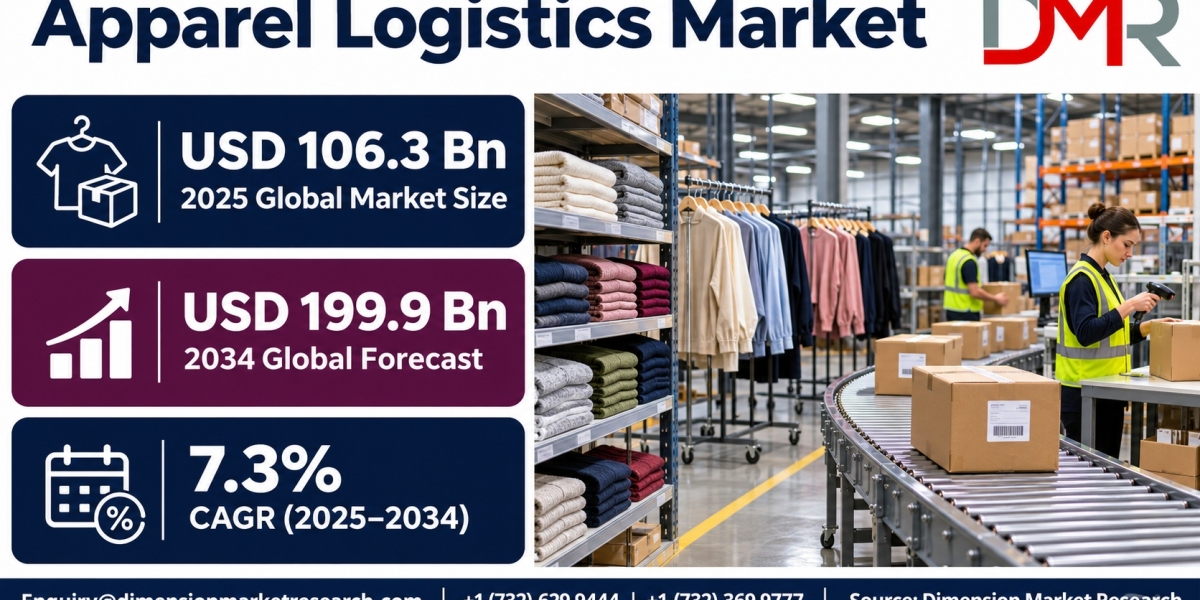

According to Dimension Market Research, the global Apparel Logistics Market was estimated at USD 106.3 billion in 2025 and is projected to reach USD 199.9 billion by 2034, at a 7.3% CAGR from 2025 to 2034. Retail chains account for the largest share of demand, while e-commerce apparel platforms are the fastest-growing end-user segment. That mix puts pressure on distribution networks to replenish stores, fulfill individual online orders, and process returns from the same inventory.
What does the Apparel Logistics Market cover?
Apparel logistics covers the movement, storage, and handling of clothing across the supply chain. The report includes transportation, warehousing and distribution, inventory management, value-added services, and reverse logistics. These services range from international freight and cross-docking to labeling, quality inspection, and returns handling. The report also segments demand by transport mode, logistics function, apparel type, supply chain model, and end user.
Get a Free Sample of the Apparel Logistics Market Report
Review the market definitions and segmentation to identify which services, customer groups, and geographies the forecast covers.
https://dimensionmarketresearch.com/request-sample/apparel-logistics-market/
Retail chains lead demand as online fulfillment grows
Retail chains accounted for approximately 44% of the market in 2025. Their distribution networks handle recurring store replenishment, seasonal launches, and promotional campaigns. Online orders add a different workflow. A distribution center may send cartons to a store while picking individual garments by style, size, and color for home delivery. When both channels draw from shared inventory, accurate stock records help the retailer decide where it can fulfill each order.
The report identifies e-commerce apparel platforms as the fastest-growing end-user segment, supported by digital retail adoption and cross-border sales. Returns add to the operational workload. A returned item may need inspection and repackaging before it can be put back into stock. For seasonal merchandise, the time spent in that process can affect whether the item is available while customers are still looking for it.
Why apparel brands outsource logistics
Third-party logistics providers accounted for approximately 51% of the supply chain model segment in 2025. These providers can combine transport, storage, order fulfillment, and returns management. The model gives apparel companies access to additional capacity during seasonal peaks without requiring them to own all the facilities and equipment they use.
The report also identifies growth in fourth-party logistics, where a provider coordinates multiple logistics partners. This can suit a brand that uses separate freight carriers, distribution centers, and returns specialists across markets. In that setup, the commercial value comes from coordinating handoffs and keeping inventory and shipment information consistent across providers.
North America leads as providers invest in fulfillment
North America was expected to account for 36.0% of global revenue in 2025. The report separately estimates the US market at USD 32.0 billion in 2025, compared with USD 26.6 billion for Europe and USD 7.4 billion for Japan. These figures provide a starting point for comparing markets before examining the local mix of store replenishment, online fulfillment, and outsourced services.
The report covers companies including DHL Supply Chain, Kuehne+Nagel, GXO Logistics, XPO Logistics, and FedEx Supply Chain. It notes that DHL Supply Chain expanded automated apparel fulfillment capacity in North America in March 2025, incorporating AI-driven sorting and inventory tools. The example illustrates how operators are preparing for periods when high volumes of individual orders must be processed quickly.
View the Apparel Logistics Market Report and Purchase Options
The full report covers market forecasts, regional demand, service segments, supply chain models, and the competitive landscape. Open the report page, select a license, and choose Proceed to Checkout.
https://dimensionmarketresearch.com/checkout/apparel-logistics-market/
Frequently Asked Questions
1. How large is the global Apparel Logistics Market?
The report estimates USD 106.3 billion in 2025 and forecasts USD 199.9 billion by 2034, at a 7.3% CAGR.
2. Which end-user segment leads the Apparel Logistics Market?
Retail chains lead with approximately 44% share in 2025, supported by store replenishment and omnichannel fulfillment needs.
3. Which end-user segment is growing fastest?
E-commerce apparel platforms are the fastest-growing end-user segment identified in the report.
4. Which supply chain model has the largest share?
Third-party logistics leads with approximately 51% share in 2025.
5. Which region leads the global market?
North America was projected to lead with a 36.0% revenue share in 2025.
Conclusion
Through 2034, apparel logistics providers will serve retailers that need to keep stores stocked while processing more individual orders and returns. The report’s breakdown by end user and supply chain model helps distinguish demand for additional warehouse capacity from demand for faster fulfillment and better coordination between providers.
Related Reports
The Kingdom of Saudi Arabia Logistics Market Size report covers transportation, warehousing, freight forwarding, and value-added logistics in Saudi Arabia through 2033.
The Digital Logistics Market Share report provides a global outlook through 2034 for digital tools used to manage logistics operations.
The Logistics Automation Market Growth report examines automation hardware, software, and applications through 2034, including warehouse automation and retail fulfillment.









