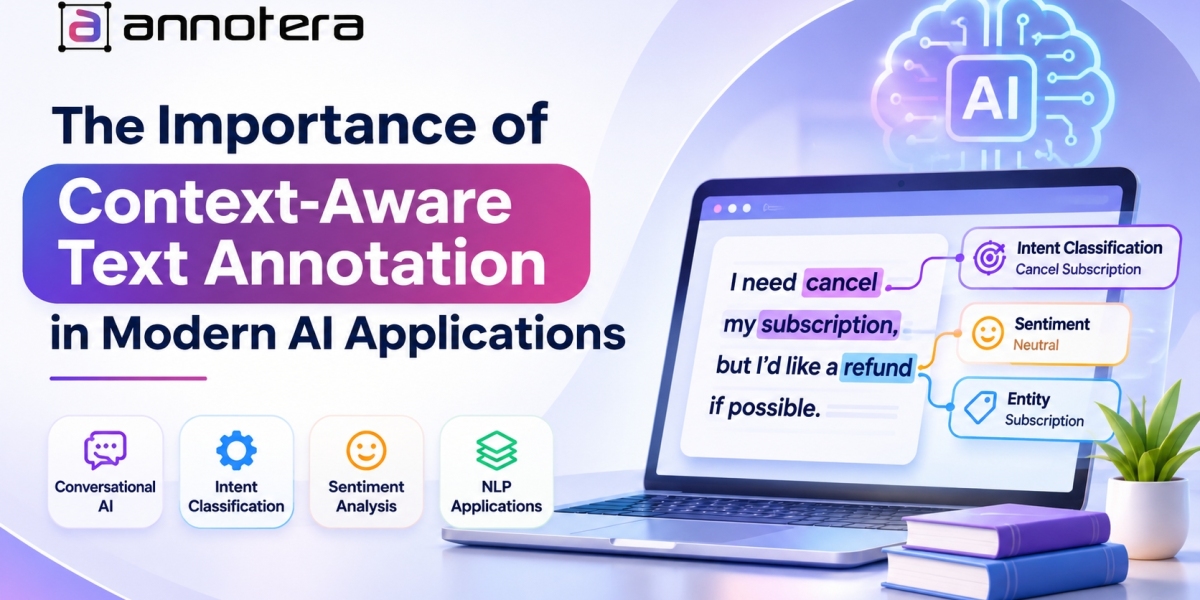

Artificial intelligence systems are becoming increasingly sophisticated, but their ability to understand human language still depends heavily on the quality of their training data. Human communication is rarely straightforward. The same word or sentence can carry different meanings depending on the conversation, user intent, industry, or surrounding information. This makes context-aware text annotation an essential part of developing accurate, reliable, and intelligent AI applications.
Traditional text annotation often focuses on identifying individual words, phrases, or entities. However, modern AI applications require a deeper understanding of how language works within a particular context. From conversational AI and virtual assistants to sentiment analysis and automated customer support, context-aware labeling helps machine learning models interpret information more accurately and generate relevant responses.
What Is Context-Aware Text Annotation?
Context-aware text annotation is the process of labeling textual data by considering its surrounding information, intended meaning, and relationship with other words or sentences. Instead of assigning labels based only on individual terms, annotators evaluate the complete context to determine what a statement actually communicates.
For example, consider the sentence: "That product is sick!"
Depending on the context, the word "sick" could indicate illness or express positive excitement about a product. A traditional keyword-based approach might misinterpret the statement, whereas context-aware annotation helps identify the intended meaning.
This approach involves several annotation techniques, including:
Intent Classification: Identifying what a user wants to communicate or accomplish.
Named Entity Recognition (NER): Recognizing people, organizations, locations, products, and other entities within contextual information.
Sentiment Annotation: Understanding emotional tone and opinions beyond individual positive or negative words.
Semantic Annotation: Identifying relationships between words, phrases, and concepts.
Entity Disambiguation: Distinguishing between terms that have multiple meanings based on their usage.
Together, these techniques help AI systems develop a more comprehensive understanding of human language.
Why Does Context Matter in Modern AI Applications?
Modern AI applications must process complex conversations, industry-specific terminology, informal expressions, and multilingual communication. Without contextual understanding, even advanced machine learning models can produce inaccurate classifications or irrelevant responses.
Here are some important reasons why context-aware text annotation matters.
1. Improves Intent Classification Accuracy
Intent classification enables AI systems to understand the purpose behind a user's message. It is widely used in chatbots, virtual assistants, customer support platforms, and conversational AI applications.
However, users often express the same intent in different ways.
For example:
"I want to cancel my subscription."
"Please stop my monthly plan."
"I don't want to continue using this service."
Although the wording differs, all three statements communicate a similar intention.
Context-aware annotation helps identify these underlying similarities and assign consistent intent labels. It also helps distinguish between closely related intents, such as requesting a refund, cancelling an order, or checking an order status.
Accurate labeling allows conversational AI systems to understand user requirements and respond appropriately.
2. Enhances Sentiment Analysis and Emotion Detection
Sentiment analysis is another AI application that benefits significantly from contextual text annotation.
A sentence may contain positive and negative expressions simultaneously. For example, "The delivery was late, but the customer support team was excellent."
A basic sentiment classification system might struggle to assign an appropriate label because the statement expresses mixed opinions.
Context-aware annotation helps identify sentiment at the sentence, aspect, or phrase level. It allows AI models to distinguish between dissatisfaction with delivery and satisfaction with customer service.
This capability is particularly valuable for businesses analyzing customer reviews, social media conversations, feedback surveys, and support interactions.
3. Strengthens Natural Language Processing (NLP) Models
Natural Language Processing models depend on annotated datasets to recognize linguistic patterns, understand relationships, and interpret textual information.
Context-aware labeling improves the quality of these datasets by helping models recognize:
Ambiguous words and expressions.
Industry-specific terminology.
Relationships between entities.
Informal language and conversational phrases.
Context-dependent meanings across multiple sentences.
High-quality annotations enable NLP systems to perform more effectively in applications such as document processing, information extraction, content categorization, and automated text summarization.
4. Supports Better Conversational AI Experiences
Conversational AI applications must understand not only individual messages but also the history of an ongoing interaction.
For example, a customer might initially ask, "Where is my order?" and later follow up with, "Can I change the delivery address?"
The second message may require information from the earlier conversation to identify the relevant order.
Context-aware text annotation helps create training datasets that capture conversational relationships, references, and dependencies between messages.
This allows conversational AI systems to maintain continuity, interpret follow-up questions, and provide more relevant responses.
5. Reduces Misclassification and Model Errors
Incorrect annotations can introduce noise into training datasets, affecting model performance during deployment.
For instance, a customer saying "I cannot recommend this product enough" is expressing strong satisfaction, despite the presence of the negative word "cannot."
Context-aware annotation helps prevent such misunderstandings by evaluating the complete statement rather than relying on isolated keywords.
Consistent labeling guidelines, domain knowledge, and human quality checks further reduce annotation inconsistencies and improve dataset reliability.
Industries Benefiting from Context-Aware Text Annotation
Context-aware text annotation supports several industries where accurate language interpretation is essential.
E-Commerce: Online retailers use annotated customer reviews, product inquiries, and support conversations to improve recommendation systems, sentiment analysis, and automated customer service.
Healthcare: Healthcare AI applications use contextual text annotation to identify medical terminology, extract relevant clinical information, and understand relationships between symptoms, treatments, and diagnoses. Such datasets require appropriate domain expertise and privacy safeguards.
Banking and Financial Services: Financial institutions use NLP applications to process customer queries, categorize service requests, analyze feedback, and extract information from financial documents.
Education: AI-powered learning platforms use annotated textual data to understand student questions, categorize learning requirements, and improve automated tutoring experiences.
Customer Support: Support platforms benefit from contextual intent labels that help identify customer problems, prioritize requests, and direct conversations to the appropriate departments.
Best Practices for Effective Context-Aware Text Annotation
Building high-quality contextual datasets requires a structured annotation process. Organizations should consider the following practices:
Develop Clear Annotation Guidelines: Define labeling rules, contextual requirements, and examples for ambiguous expressions to maintain consistency across annotators.
Use Domain-Specific Expertise: Assign trained annotators who understand the terminology and communication patterns relevant to the target industry.
Preserve Conversational Context: Provide sufficient surrounding text when annotating messages that depend on previous statements or interactions.
Implement Multi-Level Quality Checks: Use independent reviews, disagreement resolution, and sampling-based audits to identify annotation errors.
Maintain Balanced Datasets: Include different writing styles, languages, expressions, and edge cases to prevent models from becoming overly dependent on limited linguistic patterns.
Continuously Improve Annotation Standards: Update labeling guidelines as new user expressions, business requirements, and AI application scenarios emerge.
These practices help organizations create reliable datasets that support evolving AI requirements.
How Annotera Supports High-Quality Context-Aware Text Annotation
Developing contextually intelligent AI systems requires more than collecting large volumes of textual information. It requires accurately labeled datasets that capture meaning, intent, relationships, and linguistic variations.
Annotera provides specialized text annotation solutions designed to support modern AI and machine learning development. As an experienced text annotation company, Annotera helps organizations prepare structured training datasets for NLP, conversational AI, machine learning, and other language-driven applications.
Through its text annotation outsourcing services, businesses can access scalable annotation workflows, trained human annotators, and quality assurance processes tailored to their project requirements.
Annotera supports annotation tasks such as intent classification, sentiment annotation, named entity recognition, text categorization, and semantic labeling. These capabilities help AI development teams build datasets that reflect real-world language patterns and improve model training outcomes.
Whether organizations are developing intelligent chatbots, automated customer support systems, or advanced NLP applications, Annotera focuses on delivering consistent and reliable training data.
Conclusion
Context-aware text annotation is becoming increasingly important as AI applications move beyond basic keyword recognition toward deeper language understanding. By capturing the meaning behind words, relationships between statements, and user intentions, contextual labeling helps improve intent classification, sentiment analysis, NLP performance, and conversational AI experiences.
For businesses developing next-generation AI solutions, investing in high-quality contextual datasets is essential for achieving reliable model performance. Partnering with a specialized annotation provider like Annotera can help streamline the data preparation process and build a stronger foundation for intelligent AI applications.









