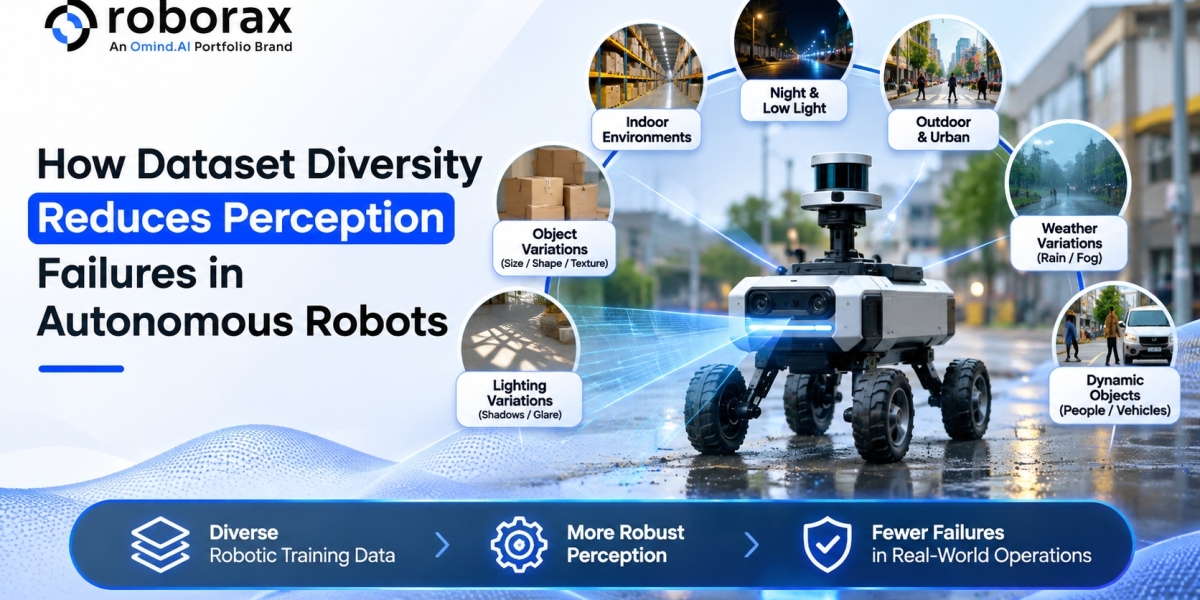

Autonomous robots are increasingly deployed in dynamic environments where they must interpret surroundings, identify objects, recognize obstacles, and make real-time decisions. From warehouse automation and industrial manufacturing to outdoor navigation and autonomous mobility, reliable perception is essential for safe and efficient robotic operations. However, even advanced perception systems can fail when they encounter environmental conditions or objects that differ from their training experiences.
One of the major reasons behind these failures is insufficient dataset diversity. When robotic perception models are trained on limited or repetitive datasets, they may struggle to recognize unfamiliar objects, adapt to changing lighting conditions, or interpret unexpected movements. Building diverse, representative datasets helps address these limitations by exposing models to a broader range of real-world scenarios.
For robotics developers, investing in high-quality robotic training data is therefore essential to improving perception accuracy, reducing model bias, and strengthening operational reliability.
Understanding Dataset Diversity in Autonomous Robotics
Dataset diversity refers to the representation of different environments, objects, conditions, movements, and scenarios within a training dataset. Instead of relying on repetitive examples captured under controlled conditions, diverse datasets expose perception models to variations that robots may encounter during actual deployment.
For example, a warehouse robot trained exclusively in a well-lit facility with clearly organized shelves may perform effectively in familiar surroundings. However, its performance could deteriorate when it encounters dim lighting, misplaced inventory, reflective packaging, or unexpected human movement.
A diverse dataset should account for variations such as:
Environmental conditions, including indoor, outdoor, and semi-structured spaces.
Lighting differences, including shadows, glare, darkness, and artificial illumination.
Object variations, including different shapes, sizes, textures, and orientations.
Dynamic obstacles, such as pedestrians, moving vehicles, and other robots.
Weather conditions, including rain, fog, dust, and changing visibility.
Sensor variations, including differences in camera positioning, resolution, and LiDAR configurations.
Capturing these variations helps perception systems develop a more comprehensive understanding of their operating environments.
Why Limited Dataset Diversity Causes Perception Failures
Autonomous robots depend on perception models to interpret incoming sensor information and convert it into actionable insights. When training datasets lack sufficient variation, models can develop narrow representations of their surroundings.
Several perception challenges can emerge from this limitation.
1. Poor Generalization Across Environments
A perception model may achieve high accuracy during testing but struggle when deployed in an unfamiliar environment. This happens when training data does not adequately represent the conditions encountered during real-world operations.
For example, a mobile robot trained primarily on warehouse floors may have difficulty identifying obstacles on uneven outdoor surfaces. Similarly, an autonomous industrial robot may struggle when object placement differs from the patterns represented in its training dataset.
Diverse training examples help models recognize underlying object characteristics rather than relying on environment-specific patterns.
2. Increased Sensitivity to Lighting Changes
Lighting conditions significantly influence camera-based perception systems. Changes in brightness, shadows, reflections, and exposure can affect object detection and segmentation accuracy.
A robot trained using predominantly daytime images may misidentify objects in low-light environments. Reflective surfaces can also create visual patterns that resemble obstacles or obscure important object boundaries.
Including different lighting conditions in robotic training data helps models become more resilient to these variations.
3. Difficulty Recognizing Unfamiliar Objects
Robots operating in dynamic environments frequently encounter objects that were not explicitly represented in their training datasets.
A warehouse robot, for instance, may encounter unfamiliar packaging, irregularly shaped parcels, or partially obstructed inventory. Without sufficient object diversity, the perception system may incorrectly classify these objects or fail to detect them.
A broader collection of object categories, orientations, and appearances improves recognition capabilities and supports more reliable decision-making.
How Diverse Datasets Improve Robotic Perception
Dataset diversity contributes to perception reliability by reducing the gap between controlled training environments and real-world operating conditions.
1. Improving Object Detection and Classification
Object detection models need exposure to different object appearances, scales, positions, and occlusion patterns.
A diverse dataset allows models to identify objects even when their appearance changes. For example, a robotic picking system trained on packages with different dimensions, colors, materials, and orientations can better handle unfamiliar inventory arrangements.
This improves object localization, classification accuracy, and obstacle recognition.
2. Strengthening Multimodal Sensor Understanding
Autonomous robots rarely depend on a single sensor for environmental perception. They combine information from RGB cameras, depth cameras, LiDAR, radar, and inertial measurement units (IMUs) to understand their surroundings.
Multimodal Sensor Capture for Robotics plays an important role in developing datasets that represent these different information sources.
For example, cameras provide visual details, while LiDAR captures spatial geometry and depth information. Combining synchronized sensor recordings helps models interpret objects more accurately when individual sensors experience limitations.
Diverse multimodal datasets should include variations in sensor positioning, environmental conditions, data quality, and object visibility. This enables perception systems to learn from complementary sensor information rather than relying excessively on one modality.
3. Reducing Model Bias and Overfitting
When datasets contain repetitive examples, machine learning models can become overly dependent on specific visual or environmental patterns. This increases the risk of overfitting.
Dataset diversity introduces meaningful variations that encourage models to learn more generalizable features.
For example, training a robot vision model using multiple warehouse layouts, different object arrangements, and varying camera angles reduces its dependence on a single environment.
Balanced dataset construction also helps prevent certain object categories or operating conditions from being underrepresented.
4. Improving Performance Under Dynamic Conditions
Autonomous robots must interpret constantly changing surroundings. Moving pedestrians, shifting objects, changing weather, and temporary obstructions can introduce unexpected perception challenges.
Training datasets that include dynamic scenarios help models understand movement patterns and changing spatial relationships.
This is particularly important for autonomous mobile robots, collaborative industrial robots, and robotic platforms operating alongside humans.
Best Practices for Building Diverse Robotics Training Datasets
Creating diverse datasets requires a structured capture and validation strategy. Simply collecting large volumes of sensor recordings does not guarantee adequate representation.
Robotics teams should consider the following practices:
1. Capture Multiple Operating Environments: Collect data from different facilities, floor layouts, outdoor locations, and operational conditions. This reduces dependence on a single deployment environment.
2. Introduce Environmental Variations: Include different lighting conditions, weather patterns, surface textures, and visibility levels to strengthen model robustness.
3. Maintain Object and Scenario Balance: Ensure that datasets represent different object categories, sizes, orientations, movement patterns, and degrees of occlusion.
4. Synchronize Multimodal Sensor Streams: Align camera, LiDAR, radar, and other sensor recordings using consistent timestamps. Proper synchronization preserves the relationships between different data modalities.
5. Apply Consistent Annotation Standards: Use clearly defined labeling guidelines for object detection, segmentation, tracking, spatial relationships, and other perception tasks. Consistent annotations improve dataset reliability.
6. Validate Against Unseen Scenarios: Evaluate perception models using environments and conditions that were not included in training. This helps identify generalization gaps and overlooked failure cases.
7. Continuously Update Datasets: Incorporate new deployment observations, difficult edge cases, and previously unseen scenarios into subsequent training cycles.
The Role of Roborax in Building Reliable Robotics Training Data
Developing robust autonomous perception systems requires more than collecting sensor recordings. Robotics teams need structured capture processes, synchronized multimodal datasets, and consistent quality validation to ensure that training information represents real-world operating conditions.
Roborax supports robotics development through specialized data collection and training data solutions designed for embodied AI and autonomous robotic systems.
Through Multimodal Sensor Capture for Robotics, Roborax helps robotics teams build datasets that incorporate complementary sensor information and represent complex operating environments. These datasets can support perception development, object recognition, scene understanding, spatial reasoning, and robot learning workflows.
By focusing on data completeness, capture consistency, environmental variation, and quality assurance, Roborax helps organizations establish stronger foundations for developing reliable robotic systems.
Conclusion
Dataset diversity is a fundamental requirement for reducing perception failures in autonomous robots. Models trained on narrow datasets often struggle with unfamiliar environments, changing lighting conditions, unexpected objects, and dynamic obstacles.
By incorporating varied environments, balanced object categories, challenging scenarios, and synchronized multimodal sensor recordings, robotics teams can improve model generalization and strengthen perception reliability.
Ultimately, high-quality robotic training data is not simply about increasing dataset volume. It is about capturing the diversity and complexity of real-world situations that autonomous robots must understand. With structured Multimodal Sensor Capture for Robotics, organizations can build more representative datasets and move closer to deploying autonomous systems that perform reliably beyond controlled testing environments.
Roborax helps robotics teams build the data foundations needed for more capable, adaptable, and reliable autonomous robots.









