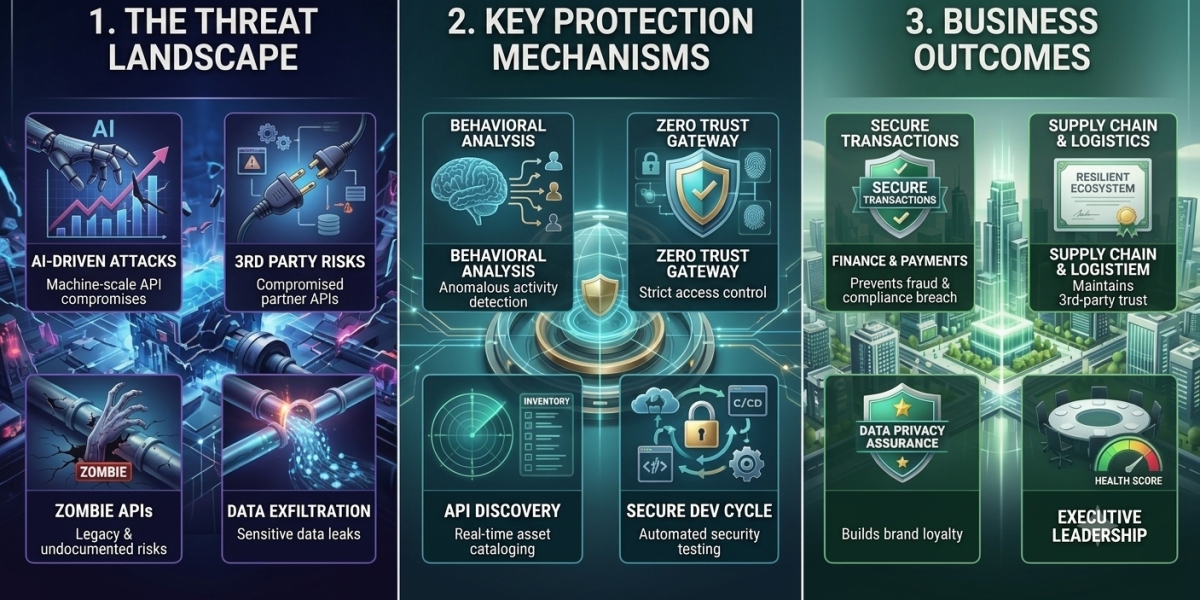

Modern businesses depend on APIs to connect websites, mobile applications, payment gateways, cloud platforms, databases, and third-party services. These connections help organizations exchange information, automate workflows, and deliver digital services more efficiently. However, every API connection can also introduce security risks when it is not properly designed, configured, and monitored.
API Security Best Practices are essential for protecting sensitive business information, preventing unauthorized access, and maintaining reliable application performance. As businesses introduce more connected applications and AI-powered services, API security is becoming an important part of modern software development. Through secure API development services, organizations can build application interfaces with appropriate authentication, authorization, data validation, and security controls.
In 2026, API environments are becoming more complex because businesses use cloud services, microservices, mobile applications, AI integrations, and external software platforms. This creates a need for security strategies that protect APIs throughout their entire lifecycle.
API security should not be treated as a final development step. It should be considered during planning, design, development, testing, deployment, and ongoing maintenance.
What Is API Security?
API security refers to the methods, technologies, and practices used to protect application programming interfaces from unauthorized access, data exposure, misuse, and cyberattacks.
An API allows different software applications to communicate with each other. For example, an e-commerce website may use APIs to connect its payment gateway, inventory system, shipping platform, and customer database.
These connections allow information to move between systems automatically.
However, if an API exposes sensitive information or allows unauthorized operations, attackers may use it to access business data or disrupt application functionality.
API security focuses on ensuring that only authorized users and applications can access permitted resources and perform approved actions.
Why API Security Is Important in 2026
APIs have become a fundamental part of modern digital infrastructure.
Businesses use them to support customer-facing applications, internal systems, cloud services, and third-party integrations.
1. Protects Sensitive Customer Information
APIs frequently process personal information, account details, payment-related records, and other confidential data.
Weak authentication or access controls may expose this information to unauthorized users.
Proper security controls help organizations protect sensitive records and reduce the possibility of data breaches.
2. Prevents Unauthorized Application Access
APIs often provide access to important application functions.
For example, a banking application may use APIs to retrieve account information and initiate approved transactions.
If access controls are not implemented correctly, an unauthorized user may attempt to access information or perform operations belonging to another account.
Authentication and authorization help prevent these problems.
3. Maintains Application Availability
API attacks can affect application performance and availability.
Excessive requests, automated abuse, and resource-intensive operations can place pressure on application infrastructure.
Rate limiting, monitoring, and appropriate infrastructure controls help businesses manage these risks.
4. Supports Secure Digital Transformation
Businesses increasingly connect multiple applications to improve their operations.
Secure APIs help organizations introduce new digital services while maintaining appropriate control over information exchange.
5. Builds Customer Confidence
Customers expect businesses to handle their information responsibly.
Strong API security practices help protect customer data and support trust in digital services.
Emerging API Security Threats Businesses Should Understand
Understanding common API vulnerabilities is the first step toward developing an effective security strategy.
The following risks are particularly important for organizations managing modern API environments.
1. Broken Object Level Authorization
Broken Object Level Authorization (BOLA) occurs when an API does not properly verify whether a user has permission to access a specific object or record.
For example, a customer may be authorized to view their own order details but should not be able to retrieve another customer's information simply by changing an identifier in an API request.
Businesses should implement authorization checks for every protected resource.
2. Broken Authentication
Authentication verifies the identity of users and applications.
Weak password policies, exposed access tokens, insecure session handling, and poorly implemented authentication mechanisms can allow unauthorized access.
Organizations should use suitable authentication standards, secure token management, and multi-factor authentication where appropriate.
3. Broken Object Property Level Authorization
An API may correctly verify access to a record but still expose or allow modification of properties that the user should not control.
For example, an ordinary customer should not be able to modify account permissions or internal administrative fields.
Developers should carefully define which fields can be accessed or changed by each user role.
4. Unrestricted Resource Consumption
APIs may become vulnerable when they allow excessive requests or expensive operations without appropriate restrictions.
Attackers can exploit these weaknesses to consume computing resources and affect application performance.
Rate limiting, request validation, pagination limits, and resource controls help reduce this risk.
5. Broken Function Level Authorization
Different users may have different levels of access within an application.
A regular user should not be able to execute administrative functions simply by discovering an endpoint.
Businesses should verify permissions at the function level and enforce access restrictions on sensitive operations.
6. Unrestricted Access to Sensitive Business Flows
Some APIs support business activities such as account creation, promotional offers, ticket booking, and payment processing.
Attackers may abuse these workflows through automated requests or repeated actions.
Organizations should identify sensitive business operations and introduce suitable abuse-prevention controls.
7. Server-Side Request Forgery
Server-Side Request Forgery (SSRF) occurs when an attacker can manipulate a server into making requests to unintended destinations.
Poorly validated URLs and external resource requests can create opportunities for accessing internal services or sensitive infrastructure.
Developers should validate destinations, restrict network access, and avoid trusting user-supplied URLs without proper checks.
8. Security Misconfiguration
Incorrect settings can expose APIs to unnecessary risks.
Examples include overly permissive access policies, exposed debugging information, unnecessary endpoints, and insecure cross-origin configurations.
Regular configuration reviews help identify these problems.
9. Improper Inventory Management
Organizations sometimes maintain APIs without a complete understanding of all active endpoints and versions.
Older API versions may remain available even after new versions are introduced.
Maintaining an accurate API inventory helps businesses identify outdated endpoints and remove unnecessary exposure.
10. Unsafe Consumption of Third-Party APIs
Businesses often depend on external APIs for payments, communication, analytics, and other services.
Trusting third-party responses without validation can introduce security and data-quality problems.
Organizations should evaluate external providers and validate data received from third-party systems.
Best Practices for API Security
Businesses should use multiple layers of security instead of depending on a single protection method.
1. Use HTTPS for Secure Communication
HTTPS protects information transmitted between clients and servers through encryption.
Organizations should use valid TLS configurations and avoid transmitting sensitive information through unencrypted connections.
2. Implement Strong Authentication
Authentication helps verify the identity of users and connected applications.
Depending on the use case, businesses may use OAuth 2.0, OpenID Connect, API keys, or other suitable mechanisms.
Credentials and tokens should be stored securely and rotated when necessary.
3. Apply Role-Based Access Control
Role-Based Access Control (RBAC) assigns permissions according to user roles.
For example, an administrator may have access to account management features, while an ordinary user may only view their own records.
Access permissions should follow the principle of least privilege.
4. Validate All Incoming Data
APIs should validate request parameters, headers, payloads, and other incoming information.
Validation helps prevent unexpected input from reaching sensitive application logic.
Developers should also use parameterized database queries and suitable output handling to reduce injection risks.
5. Implement Rate Limiting
Rate limiting controls how frequently users or applications can send requests.
It can help reduce automated abuse, excessive resource consumption, and certain denial-of-service risks.
Limits should be based on application requirements and user behavior.
6. Use API Gateways
API gateways can provide a central point for managing API traffic.
Depending on their configuration, they can support authentication, routing, rate limiting, logging, and other security controls.
However, gateway protection should not replace authorization checks inside individual services.
7. Maintain an API Inventory
Businesses should document active APIs, their versions, owners, authentication requirements, and data exposure.
This makes it easier to identify outdated endpoints and manage the API environment.
8. Monitor API Activity
Monitoring helps organizations identify unusual request patterns, repeated authentication failures, unexpected traffic, and suspicious operations.
Logs should be designed carefully to avoid exposing passwords, tokens, or other sensitive information.
9. Conduct Regular Security Testing
Security testing helps identify vulnerabilities before attackers can exploit them.
Businesses should combine automated scanning, code reviews, dependency checks, and authorized penetration testing.
Testing should cover both individual endpoints and complete business workflows.
10. Establish an API Incident Response Plan
Even well-protected systems can experience security incidents.
Organizations should define procedures for investigating suspicious activity, revoking compromised credentials, isolating affected systems, and restoring normal operations.
API Security in AI-Powered Applications
AI-powered applications introduce additional API security considerations.
An AI application may connect with model providers, databases, document storage, business systems, and external tools.
Each integration creates a point that requires appropriate protection.
For example, an AI assistant connected to a CRM system should only access customer records permitted by the user's role.
Similarly, an AI application that can perform actions through APIs should not receive unrestricted permissions.
Businesses should consider:
Restricting the tools and endpoints available to AI applications.
Protecting API credentials and access tokens.
Validating AI-generated tool arguments.
Requiring approval for sensitive operations.
Monitoring unusual automated requests.
Preventing unauthorized access to retrieved information.
AI systems should also be protected against prompt injection and unsafe handling of external content.
API Security Checklist for Businesses
Organizations can use the following checklist when reviewing their API environments.
All sensitive API communication uses HTTPS.
Authentication mechanisms are properly implemented.
Authorization is checked for individual records and operations.
User permissions follow least-privilege principles.
Incoming data is validated.
Rate limits are configured.
Sensitive information is not exposed in logs.
Active API endpoints are documented.
Old and unused API versions are reviewed.
Third-party integrations are evaluated.
Security testing is performed regularly.
Incident response procedures are documented.
Regular reviews help ensure that security controls remain effective as applications change.
Why Choose API DOTS for Secure API Development?
Secure API development requires a combination of software engineering, application architecture, authentication, data protection, and testing.
API DOTS supports businesses looking to develop custom APIs and connect different software applications.
Its API development capabilities can help organizations build application interfaces that support secure communication, reliable data exchange, and scalable digital operations.
A carefully planned development process helps businesses consider security requirements from the initial design stage instead of trying to resolve major vulnerabilities after deployment.
Conclusion
API security is essential for businesses that depend on connected applications, cloud platforms, mobile software, and third-party services.
As API environments become more complex, organizations need to understand emerging threats and implement appropriate protection methods.
Strong authentication, authorization, HTTPS, input validation, rate limiting, monitoring, and regular security testing help create a safer API environment.
Businesses should treat API security as an ongoing responsibility throughout the software development lifecycle.
Organizations planning to build or improve secure application integrations can explore API DOTS for modern API development solutions.
Frequently Asked Questions
1. What are API Security Best Practices?
API Security Best Practices are methods used to protect APIs from unauthorized access, data exposure, misuse, and cyberattacks.
2. What are the most common API security threats?
Common threats include broken object-level authorization, broken authentication, unrestricted resource consumption, security misconfiguration, and server-side request forgery.
3. Why is API security important for businesses?
API security protects sensitive information, maintains application availability, reduces unauthorized access, and supports secure communication between business systems.
4. How can businesses protect their APIs?
Businesses can use HTTPS, strong authentication, least-privilege access, input validation, rate limiting, API monitoring, and regular security testing.
5. What is the difference between authentication and authorization?
Authentication verifies the identity of a user or application, while authorization determines which resources and actions that identity can access.