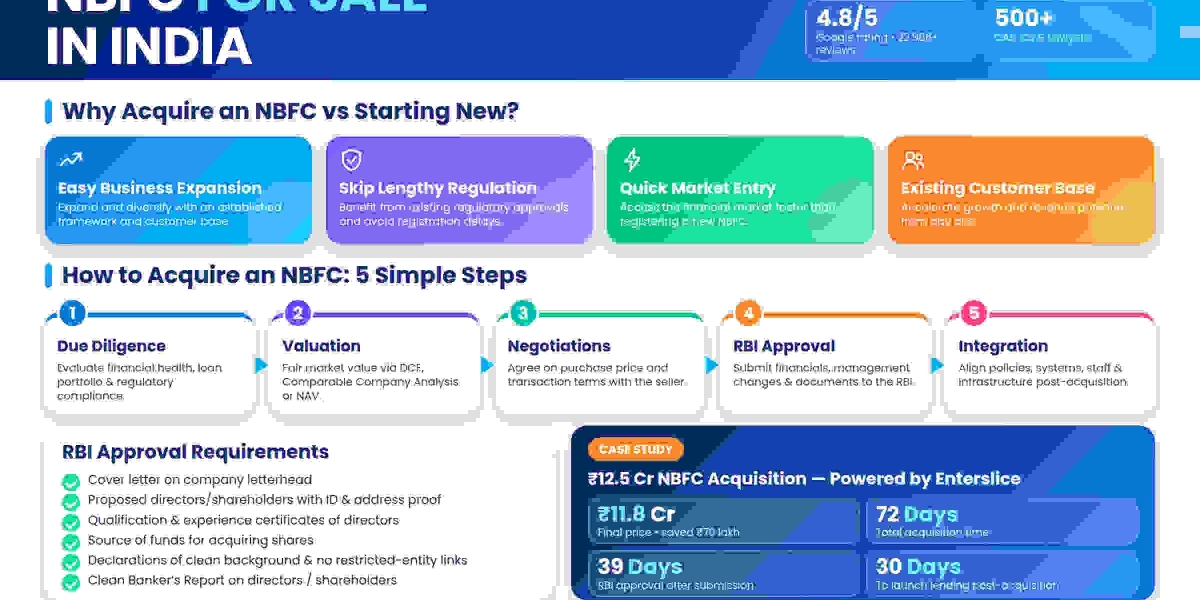

An old NBFC for sale refers to an existing Non-Banking Financial Company whose shareholders are willing to transfer their ownership or controlling interest to another investor or business entity. Such companies may have an established corporate history, an RBI Certificate of Registration (CoR), previous financial records and an existing business structure.
Unlike setting up a new NBFC, acquiring an existing company allows a buyer to evaluate an established regulatory and corporate history before making an investment decision. However, the acquisition does not automatically guarantee permission to conduct every financial activity. The company must continue to satisfy the regulatory conditions applicable to its NBFC category.
It is also important to understand that an NBFC registration is issued to the company, not separately to its shareholders. Therefore, buyers generally explore a share acquisition or another legally structured transaction rather than purchasing an independent NBFC licence.
Why Do Entrepreneurs Look for an Old NBFC for Sale?
Starting a financial services business involves regulatory planning, capital arrangements, documentation and compliance preparation. Acquiring an existing NBFC may provide an alternative route for entrepreneurs who want to establish a presence in the financial sector.
Some important reasons buyers consider this option include:
1. Existing RBI Registration
An eligible existing NBFC may already hold a valid RBI Certificate of Registration. This gives the buyer an established regulated entity to evaluate, subject to verification of its registration status and applicable conditions.
2. Faster Business Entry
Acquiring an existing company may reduce certain incorporation and initial establishment activities. However, the acquisition itself can involve regulatory approval, due diligence and corporate formalities. It should not be treated as an automatic shortcut to starting lending operations.
3. Established Corporate History
An older NBFC may have previous financial statements, statutory records, corporate filings and business information. These records help buyers understand the company's historical performance and identify potential risks.
4. Business Expansion Opportunities
Businesses already operating in financial services may consider an acquisition to expand their activities, enter a new lending segment or strengthen their corporate presence.
5. Potential Access to Existing Infrastructure
Depending on the target company's actual operations, the buyer may gain access to existing systems, employees, business relationships and operational processes. These benefits must be independently verified rather than assumed.
Important Factors to Check Before Buying an Existing NBFC
Finding an old NBFC for sale is only the first step. The real challenge is determining whether the company is financially sound, legally compliant and suitable for the buyer's business objectives.
The following checks should be completed before finalising the transaction.
1. Verify RBI Registration
The buyer should verify the company's Certificate of Registration and confirm its current regulatory status through official RBI records. Check whether the registration is valid, whether any restrictions apply and whether the company has received regulatory notices or directions.
An NBFC's registration category should also match the proposed business activity.
2. Examine Financial Statements
Review the audited financial statements for previous years, including the balance sheet, profit and loss account, cash flow statements and notes to accounts.
Pay particular attention to:
Outstanding borrowings and financial obligations.
Accumulated losses and negative net worth.
Non-performing assets (NPAs).
Provisioning requirements.
Related-party transactions.
Contingent liabilities and guarantees.
These details help determine the company's actual financial position and the potential investment required after acquisition.
3. Review Regulatory Compliance
An existing NBFC must comply with applicable RBI directions and other statutory requirements. Examine its regulatory returns, statutory audit reports, board meeting records, compliance policies and correspondence with regulators.
Also check whether there are any pending regulatory observations, penalties, restrictions or unresolved compliance issues.
4. Check Legal and Litigation Records
Review ongoing and past legal proceedings involving the company, its directors and promoters. Examine disputes with lenders, borrowers, employees, vendors and other stakeholders.
Search relevant court and tribunal records and verify whether any material litigation could affect the acquisition.
5. Evaluate Borrowings and Existing Liabilities
The buyer must identify all secured and unsecured loans, outstanding bank facilities, guarantees, charges and repayment obligations.
Review financing agreements carefully because a change in ownership or control may require lender consent under contractual terms.
6. Verify Directors and Shareholders
Check the identity, background and financial standing of existing shareholders and proposed directors. Review their corporate associations, disqualifications, litigation history and other relevant information.
The proposed management should also be assessed against applicable RBI fit-and-proper and governance requirements.
RBI Approval Requirements for NBFC Acquisition
RBI approval is one of the most important considerations when acquiring an existing NBFC. The applicable framework is governed by the RBI's Non-Banking Financial Companies (Acquisition of Shareholding or Control) Directions, 2025, along with relevant governance directions.
Under paragraph 6 of the 2025 Acquisition Directions, prior written RBI permission is required for:
Any takeover or acquisition of control of an NBFC, whether or not it results in a change of management.
Any change in shareholding, including progressive increases over time, resulting in the acquisition or transfer of 26% or more of the paid-up equity capital.
The Directions also contain specific provisions for certain Housing Finance Companies and Standalone Primary Dealers.
Separately, under the RBI's NBFC Governance Directions, 2025, prior written permission is required for a change in management resulting in a change of more than 30% of directors, excluding independent directors, subject to the specified exception for directors re-elected on retirement by rotation.
Therefore, buyers should assess the proposed shareholding, voting rights, control arrangements and board changes before deciding the transaction structure.
Documents Required for RBI Approval
The 2025 Acquisition Directions prescribe the following information for an application seeking prior approval:
Information about the proposed shareholders in the prescribed format.
Details of the sources of funds used for acquiring shares.
Declaration regarding association with unincorporated bodies accepting public deposits.
Declaration regarding association with companies whose CoR applications were rejected by RBI.
Declaration regarding criminal cases, including proceedings under Section 138 of the Negotiable Instruments Act, 1881.
Bankers' report on the proposed shareholders.
The application must be submitted through RBI's PRAVAAH portal on the company's letterhead, following the prescribed procedure.
Public Notice Before the Acquisition
Under the 2025 Acquisition Directions, a public notice must be published at least 30 days before the transfer of ownership through a share sale or transfer of control.
The notice must appear in at least one leading national newspaper and one leading local vernacular newspaper covering the location of the registered office. It is to be issued after obtaining prior RBI permission.
The notice should specify the proposed transfer, particulars of the transferee and reasons for the transaction.
Step-by-Step Process to Purchase an Old NBFC in India
A properly planned acquisition requires coordination between the buyer, seller, legal professionals and regulatory advisors.
Step 1: Identify a Suitable NBFC
Identify an existing NBFC that matches your proposed business objectives. Consider its registration category, location, financial position, business history and regulatory status.
Step 2: Sign a Preliminary Understanding
After initial discussions, the buyer and seller may enter into a non-binding term sheet or memorandum of understanding (MoU). It should outline the proposed valuation, transaction structure, confidentiality obligations, due diligence conditions and other commercial terms.
The preliminary agreement should not be treated as permission to complete a regulated change in control.
Step 3: Conduct Comprehensive Due Diligence
Conduct financial, legal, tax, corporate and regulatory due diligence. Verify the NBFC's registration, liabilities, assets, statutory filings, litigation and compliance history.
Any material issue should be addressed before the final transaction agreement is signed.
Step 4: Determine the Acquisition Value
The parties should determine the company's valuation based on its net assets, financial performance, liabilities, business operations, loan portfolio and future prospects.
A valuation should not be based only on the age of the company or the existence of an RBI registration.
Step 5: Prepare and Submit the RBI Application
Where prior approval is required, prepare the prescribed documents and submit the application through PRAVAAH. The proposed shareholders must provide the required declarations, source-of-funds information and bankers' reports.
The transaction should proceed in accordance with the RBI's approval and applicable conditions.
Step 6: Complete Public Notice and Transaction Formalities
After obtaining the necessary permission, comply with the prescribed public notice requirements. Complete the share transfer and other transaction steps in accordance with the applicable legal and regulatory framework.
Step 7: Complete Post-Acquisition Compliance
After closing, update the company's statutory and corporate records, complete applicable MCA and RBI reporting requirements, and review board composition, internal policies and operational controls.
The acquired NBFC must continue to meet all regulatory obligations applicable to its category.
What Determines the Cost of an Old NBFC for Sale?
There is no universal purchase price for an existing NBFC. The valuation depends on several commercial and regulatory factors.
Important considerations include:
Age and corporate history of the NBFC.
Validity and category of RBI registration.
Net worth and available capital.
Existing assets and liabilities.
Loan portfolio quality and outstanding NPAs.
Previous revenue and profitability.
Regulatory compliance and litigation history.
Business operations and infrastructure.
Proposed shareholding and transaction structure.
Apart from the agreed purchase consideration, buyers should budget for legal and professional fees, valuation expenses, due diligence, regulatory documentation, public notices and post-acquisition compliance.
A low asking price does not necessarily represent a good investment. Hidden liabilities or regulatory problems can increase the actual acquisition cost considerably.
Common Risks in Buying an Old NBFC
Purchasing an existing financial company without proper investigation can create long-term financial and regulatory difficulties.
Some common risks include:
Inactive or restricted registration: The buyer may discover that the company's regulatory status does not support the intended business plan.
Undisclosed liabilities: Previous borrowings, tax demands or contractual obligations may affect the company's financial position.
Regulatory non-compliance: Historical reporting failures or unresolved RBI observations may create additional obligations.
Poor loan portfolio: Overdue loans and inadequate provisioning can reduce the actual value of the company.
Incomplete corporate records: Missing statutory documents or incorrect shareholding records may delay closing.
Unclear ownership: Disputes among shareholders can complicate the proposed transfer.
A comprehensive due diligence exercise and properly drafted transaction documents can help reduce these risks.
How Enterslice Can Assist with NBFC Acquisition
Acquiring an existing NBFC requires more than identifying a willing seller. Buyers need to evaluate the target company, understand regulatory requirements and structure the transaction carefully.
Enterslice provides professional assistance to businesses and entrepreneurs exploring an existing NBFC for sale in India.
Our support can cover:
Identification and preliminary evaluation of suitable NBFC opportunities.
Financial, legal, tax and regulatory due diligence.
Review of RBI registration and compliance records.
Assistance with company valuation.
Preparation and review of transaction documentation.
RBI approval application support.
Assistance with share transfer and corporate filings.
Post-acquisition regulatory compliance guidance.
Our objective is to help buyers understand the transaction, identify potential risks and manage the acquisition process with appropriate professional support.
Conclusion
Acquiring an old NBFC for sale can provide an alternative entry route into India's financial services sector. However, the value of an acquisition depends on the company's regulatory standing, financial health, business history and future suitability.
Entrepreneurs should not make a purchase decision based only on the company's age or existing RBI registration. A detailed review of ownership, liabilities, regulatory approvals and financial records is essential before committing funds.
With appropriate due diligence and regulatory guidance, businesses can evaluate acquisition opportunities more confidently and plan their entry into the NBFC sector responsibly.
Most popular services :