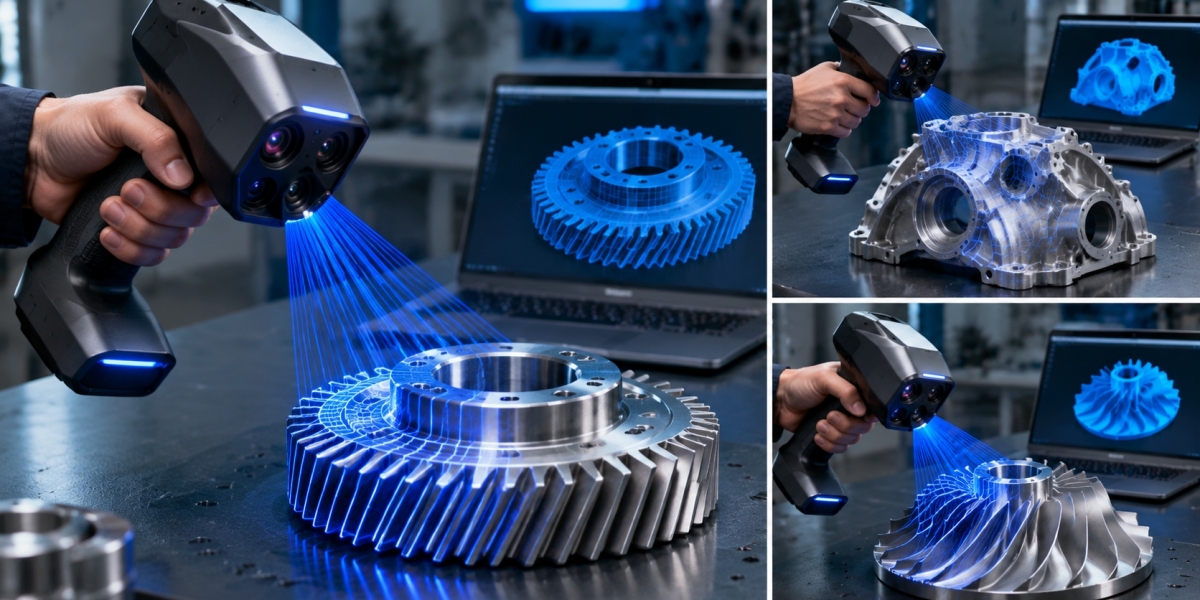

Finding the best budget 3D scanner can be challenging, especially when you want reliable scanning performance without spending thousands of dollars. Fortunately, modern 3D scanning technology has become more accessible, giving hobbyists, makers, students, product designers, and small businesses more affordable ways to digitize physical objects.
Whether you want to scan household items, reproduce mechanical components, create customized products, or develop models for 3D printing, choosing the right scanner can make your workflow considerably easier.
However, the cheapest scanner is not necessarily the best investment. Different models are designed for different object sizes, surface characteristics, scanning accuracy requirements, and digital applications.
This guide compares budget-friendly Revopoint 3D scanners and explains which options offer the best value for different types of projects.
What Makes a 3D Scanner a Good Budget Choice?
A good budget scanner should provide the essential capabilities required for your projects without unnecessary expenses.
Before purchasing, consider these important factors:
Scanning Accuracy: Check how closely the scanner can capture an object's actual dimensions. This is particularly important for mechanical parts and reverse-engineering projects.
Object Size: Some scanners are designed for small components, while others can capture larger objects such as furniture parts, automotive components, and product housings.
Scanning Technology: Structured light, infrared laser, and blue laser technologies offer different advantages depending on the object and scanning environment.
Software Compatibility: Make sure the scanner supports suitable software for mesh processing, editing, and exporting digital models.
Portability: Lightweight scanners and wireless connectivity can make scanning more convenient when working in different locations.
Overall Cost: Consider accessories, software licenses, computer requirements, and other expenses rather than comparing scanner prices alone.
Best Budget 3D Scanners from Revopoint
Revopoint offers several scanners at different price points. Here are five options worth considering based on their published specifications and US-listed prices.
1. Revopoint RANGE 3: Best Lowest-Cost Option for Larger Objects
<badge color="success">Best entry price</badge>
The RANGE 3 is an interesting choice for buyers who want to capture larger objects without investing in expensive industrial equipment.
It uses VCSEL structured-light technology and supports wide-area scanning for small-to-large objects.
Key features include:
Scanning volume from approximately 20 mm to 4 m.
Capture area of 687 × 672 mm at 1,000 mm.
Volumetric accuracy of 0.05 mm + 1 mm × L (m).
Wi-Fi 6 wireless connectivity.
Up to three hours of continuous power.
Markerless scanning capabilities.
Starting price: $351 USD.
The RANGE 3 is worth considering for furniture components, larger product housings, automotive parts, and decorative objects.
There is also a RANGE 3 Pro version starting at $436, which adds an 11-line laser scanning mode for applications requiring more detailed capture.
The base RANGE 3 is the more economical choice, while the Pro version offers additional scanning flexibility.
2. Revopoint INSPIRE 2: Best Overall Budget-Friendly Scanner
<badge color="success">Best value recommendation</badge>
The INSPIRE 2 is a versatile option for buyers who want more than basic object scanning without moving into expensive professional equipment.
It combines dual-camera infrared structured-light technology with infrared multi-line laser scanning.
Its published specifications include:
Single-frame accuracy up to 0.05 mm.
Single-frame precision up to 0.03 mm.
Volumetric accuracy of 0.05 mm + 0.1 mm × L (m).
Eleven parallel infrared laser lines.
1.5× and 2× optical zoom.
Wi-Fi 6 connectivity.
Full-color scanning.
Starting price: $384 USD.
The INSPIRE 2 is particularly interesting for beginners, hobbyists, and small businesses working with small-to-medium objects.
Its combination of scanning technologies makes it suitable for product digitization, customized accessories, selected mechanical components, and general 3D printing projects.
For buyers who want a balance between price and scanning flexibility, this is a strong option to consider.
3. Revopoint POP 3 Plus: Best Budget Option for Color Scanning
The POP 3 Plus is designed for users who want to capture both the geometry and color appearance of physical objects.
It uses dual-camera infrared structured-light technology and includes an HD RGB camera.
Its published specifications include:
Single-frame accuracy up to 0.08 mm.
Single-frame precision up to 0.04 mm.
Scanning speed up to 18 frames per second.
Up to 2× optical zoom.
Global marker tracking.
HD RGB color capture.
Starting price: $526 USD.
This scanner is worth considering for figurines, collectibles, decorative products, digital art, and creative modeling.
It can also support 3D printing workflows where users want to preserve surface color information for compatible applications.
4. Revopoint MINI 2: Best Budget Choice for Small, Detailed Objects
Not every scanning project involves large physical objects. Some users need to capture miniature models, small mechanical components, jewelry-sized objects, and intricate product details.
The MINI 2 uses dual-camera blue structured-light technology and is designed specifically for small-object scanning.
Its published specifications include:
Single-frame precision up to 0.02 mm.
Single-frame accuracy up to 0.05 mm.
Working distance of 120–250 mm.
Scanning speed up to 16 frames per second.
Blue-light scanning technology.
Color scanning support.
Starting price: $663 USD.
Although it costs more than the entry-level options, its specialized small-object scanning capabilities make it worth considering for users who prioritize fine geometric details.
It is not the ideal choice for buyers who primarily need to scan large furniture, vehicle components, or entire assemblies.
5. Revopoint POP 4: Best Budget Option for Multiple Scanning Technologies
The POP 4 is designed for users who want greater flexibility across different scanning applications.
It combines three scanning technologies:
Blue multi-line laser scanning.
Near-infrared full-field structured-light scanning.
VCSEL structured-light scanning.
Its published specifications include:
Blue laser accuracy up to 0.03 mm.
Full-field structured-light accuracy up to 0.08 mm.
VCSEL structured-light accuracy of 0.10 mm at 300–500 mm.
Volumetric accuracy of 0.03 mm + 0.05 mm × L (m) in multi-line laser mode.
Handheld and desktop scanning.
Starting price: $671 USD.
The POP 4 is worth considering for users who work with different object geometries and want access to multiple scanning methods.
It offers more flexibility than a basic single-technology scanner, although its higher purchase price may not be necessary for simple hobby projects.
Best Budget 3D Scanner Comparison
| Scanner | Starting price | Best application |
|---|---|---|
| RANGE 3 | $351 | Larger objects |
| INSPIRE 2 | $384 | General-purpose scanning |
| POP 3 Plus | $526 | Color scanning |
| MINI 2 | $663 | Small detailed objects |
| POP 4 | $671 | Multiple scanning technologies |
<text color="secondary" size="xs">Prices are Revopoint US-facing starting prices checked November 19, 2026. Promotional prices, editions, bundles, taxes, and shipping may affect the final purchase cost.</text>
Which Budget 3D Scanner Should You Buy?
The best choice depends on what you plan to scan.
For the lowest purchase price: Consider the RANGE 3 for larger objects.
For everyday scanning: The INSPIRE 2 offers a strong balance of price and capabilities.
For colorful digital models: Consider the POP 3 Plus.
For miniature objects: The MINI 2 is designed for detailed small-object capture.
For scanning flexibility: The POP 4 offers multiple scanning technologies.
For most beginners and general-purpose users, the INSPIRE 2 is a sensible starting point. However, users who regularly scan larger objects may get better value from the RANGE 3.
How to Get Better Results from a Budget 3D Scanner
You do not necessarily need expensive equipment to develop a reliable scanning workflow.
Start by choosing objects with suitable surfaces and clearly visible geometric features.
Keep the object stable and maintain the recommended working distance throughout scanning. Move the scanner steadily and capture sufficient angles to avoid missing surfaces.
After scanning, process the captured data using compatible software. Align scanning passes, remove unwanted points, repair mesh defects, and export the finished model into a suitable format.
Transparent, reflective, and very dark surfaces may require additional preparation or a different scanning mode.
For functional mechanical parts, verify important dimensions before manufacturing replacement components.
Are Budget 3D Scanners Worth Buying?
Budget scanners can provide considerable value for hobbyists, students, product designers, and small businesses.
They can support product digitization, creative modeling, prototyping, reverse engineering, and many 3D printing projects.
However, professional manufacturing inspection and strict engineering measurement applications may require more specialized equipment.
Before purchasing, consider the accuracy requirements, object dimensions, software workflow, and expected scanning frequency.
The right scanner is not necessarily the most expensive or the cheapest. It is the one that delivers the capabilities your projects actually require.
Find the Best Budget 3D Scanner for Your Needs
Choosing a budget scanner becomes easier when you compare actual capabilities rather than focusing only on purchase price.
The RANGE 3 provides an economical option for larger objects, the INSPIRE 2 offers versatile everyday scanning, the POP 3 Plus supports color capture, the MINI 2 targets detailed small-object scanning, and the POP 4 provides multiple scanning technologies.
Explore the best budget 3d scanner collection to compare available Revopoint models, review their specifications, and find a cost-effective solution for 3D printing, product design, reverse engineering, and creative projects.









