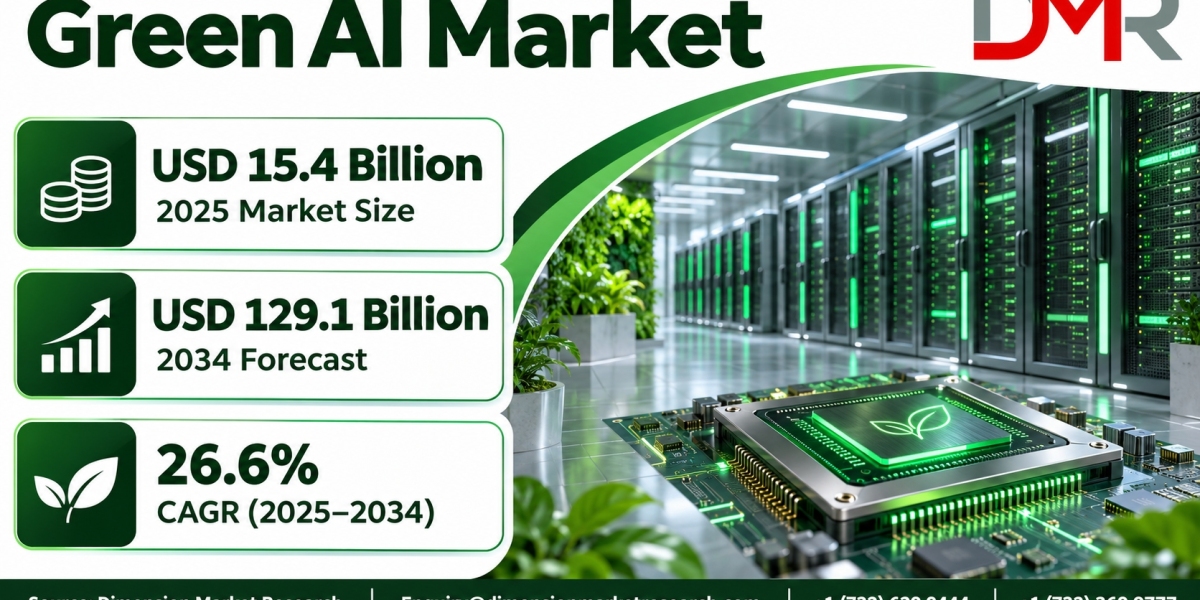

The Green AI Market is expanding as enterprises look for ways to train and run AI models with lower energy requirements. According to Dimension Market Research, the global market was estimated at USD 15.4 billion in 2025 and is projected to reach USD 129.1 billion by 2034, growing at a 26.6% CAGR from 2025 to 2034.
The forecast covers investment in areas such as low-power AI hardware, model optimization software, and cloud infrastructure that uses computing resources more efficiently. For buyers, the opportunity depends on the workload. A cloud provider may focus on how it allocates server capacity, while a manufacturer running predictive maintenance may focus on processing sensor data close to the equipment.
What Is the Green AI Market?
Green AI refers to the development and deployment of artificial intelligence systems with energy efficiency and environmental impact in mind. It includes techniques that reduce the computing resources needed to train or run a model, hardware designed for lower power consumption, and tools that manage workloads across cloud and edge infrastructure. The report covers hardware, software, and services used in industries including IT and telecom, manufacturing, healthcare, and transportation.
Get a Free Sample of the Green AI Market Report
Review how the report breaks down demand by component, technology, deployment mode, and industry. The sample can help you identify which sections are most relevant to an infrastructure investment, software roadmap, or market entry assessment.
https://dimensionmarketresearch.com/request-sample/green-ai-market/
Why Software Leads Green AI Spending
Software accounted for an estimated 40.0% of the Green AI Market by component in 2025. The report links software demand to model optimization, energy-aware workload management, and tools that help organizations use computing capacity more efficiently. Machine learning technologies led the technology breakdown with an estimated 30.0% share.
For a data center operator, software can help manage server loads and allocate resources as demand changes. For a team running an AI model, optimization may reduce the computing resources needed to deliver a result. These use cases give suppliers different ways to demonstrate value. An infrastructure team may look at power consumption across servers, while an application team may compare energy use per completed task alongside response time and model performance.
Cloud Leads Deployment as Edge AI Serves Local Workloads
Cloud-based deployment led with an estimated 50.0% share in 2025. Cloud platforms give organizations access to computing resources that can be adjusted as workloads change. The report also highlights hybrid cloud and edge deployments, which allow some processing to take place near the equipment or device generating the data.
A manufacturer using AI for predictive maintenance, for example, may need to analyze machine data quickly enough to flag an issue on the production floor. Local processing can support timely decisions, while cloud infrastructure can support analysis across facilities. For buyers, deployment choices depend on where the workload runs most effectively, how quickly results are needed, and what resources each configuration requires.
Where Demand Is Concentrated and What Could Slow Adoption
IT and telecom led the industry breakdown with an estimated 25.0% share in 2025, reflecting the relevance of energy efficiency to cloud infrastructure and data centers. North America accounted for an estimated 35.0% of global Green AI revenue in 2025, the largest regional share. DMR also identifies adoption in Europe and Japan across applications such as industrial automation, resource management, and energy-efficient computing.
Implementation costs remain a constraint, particularly for smaller organizations. Specialized hardware, optimized software, and hybrid infrastructure can require upfront investment and ongoing maintenance. The report covers NVIDIA, Microsoft, IBM, Amazon Web Services (AWS), Siemens, and Schneider Electric among the companies active in the market. For buyers comparing offerings, the upfront cost matters alongside the energy savings a deployment can deliver under typical operating conditions.
Explore the Complete Green AI Market Analysis
Compare demand across hardware, software, services, and deployment models to assess where your product, infrastructure, or partnership strategy fits.
https://dimensionmarketresearch.com/checkout/green-ai-market/
Frequently Asked Questions
What is the size of the Green AI Market?
The global market was estimated at USD 15.4 billion in 2025 and is projected to reach USD 129.1 billion by 2034.
What is the projected CAGR for the Green AI Market?
DMR projects a CAGR of 26.6% from 2025 to 2034.
Which component leads the Green AI Market?
Software led the component breakdown with an estimated 40.0% share in 2025.
Which region leads the global Green AI Market?
North America led with an estimated 35.0% of global Green AI revenue in 2025.
What is driving demand for Green AI?
Demand for energy-efficient data centers, lower-power AI hardware, and software that reduces the computing resources needed for AI workloads supports growth.
Conclusion
Through 2034, the Green AI Market outlook reflects a practical challenge for organizations expanding AI use. They need to manage the energy and computing resources required to run more workloads. Suppliers can address that challenge through model optimization, efficient hardware, and deployment tools that help buyers match computing resources to the task.








