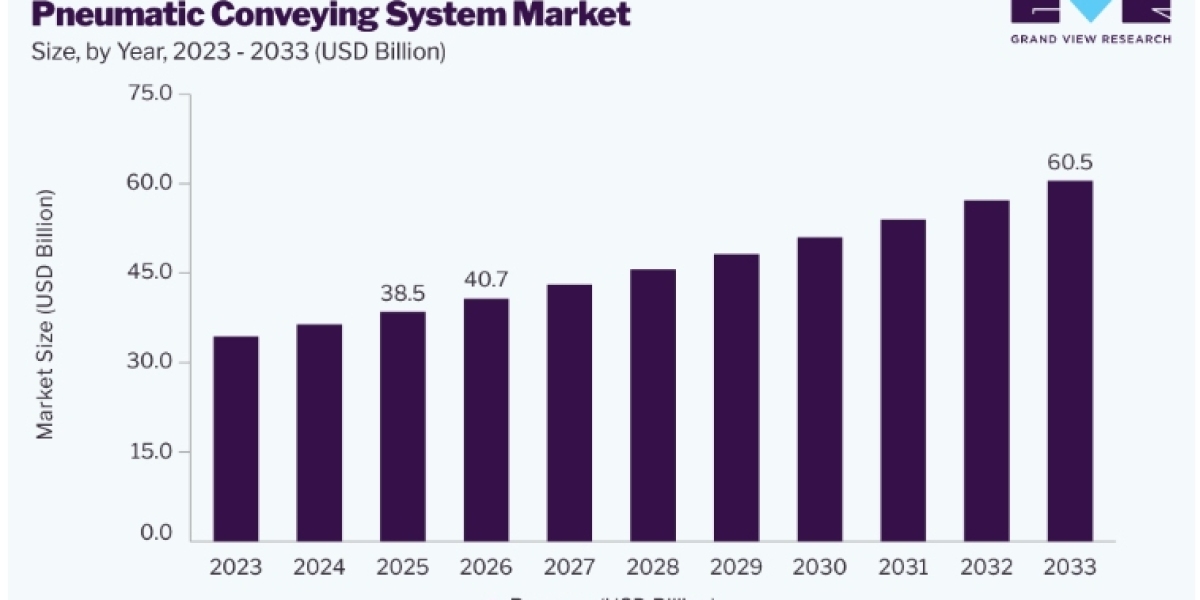

The global pneumatic conveying system market is gaining momentum as industries increasingly adopt automated, enclosed, and energy-efficient solutions for bulk material handling. These systems transport powders, granules, pellets, and other dry materials through pipelines using air or gas pressure, helping manufacturers improve operational efficiency and maintain product quality. Growing industrialization, expansion of recycling and waste treatment activities, and rising concerns about workplace safety and material contamination are supporting market demand. The global Pneumatic Conveying System Market was valued at USD 38.5 billion in 2025 and is projected to grow from USD 40.7 billion in 2026 to USD 60.5 billion by 2033, registering a CAGR of 5.8% from 2026 to 2033.
Market Snapshot: Key Figures and Industry Highlights
- 2025 market size: USD 38.5 billion
- 2026 estimated market size: USD 40.7 billion
- 2033 projected market size: USD 60.5 billion
- Forecast CAGR: 5.8% from 2026 to 2033
- Leading region: Europe, with over 30.0% revenue share in 2025
- Largest operating principle: Dilute-phase conveying, with over 70.0% share
- Leading technology: Positive pressure systems, accounting for over 50.0% of revenue
- Leading end-use industry: Food industry, with around 30.0% revenue share
Why Industries Are Moving Toward Pneumatic Conveying
Product hygiene, operational reliability, and material protection are becoming important considerations in industrial material handling. Conventional mechanical conveyors can allow dust and foreign particles to enter the conveying process, potentially affecting product quality and increasing material losses. Pneumatic conveying systems offer enclosed material transfer, helping reduce contamination risks and material spillage.
The technology is increasingly used in food processing, pharmaceuticals, ceramics, chemicals, rubber, and plastics manufacturing. These industries require reliable systems that can handle materials while maintaining quality and meeting operational safety requirements.
Automation is another important growth factor. Pneumatic conveyors can improve production output, reduce stoppages, and support cost savings across packaging, coating, and final-product processing operations. Advanced systems equipped with intelligent controls are also helping manufacturers improve conveying performance.
Want to Understand What’s Driving Market Growth? Ask Prism AI for research-backed insights into market size, evolving opportunities
How the Market Is Evolving: Four Important Developments
Enclosed and hygienic material handling: Food and pharmaceutical manufacturers are prioritizing conveying solutions that reduce contamination risks and support stringent hygiene requirements.
Smart monitoring and automation: IoT-enabled sensors and digital controls are increasingly used to monitor airflow and pressure in real time. These technologies can help operators identify system wear and reduce energy losses.
Energy-efficient system development: Manufacturers are focusing on equipment that delivers improved operational efficiency while consuming less electricity. This is important because energy consumption, maintenance, and repair costs can influence purchasing decisions.
Long-distance conveying capabilities: Industrial production networks are creating demand for flexible systems capable of transporting materials over longer distances while maintaining reliable performance.
Operating Principle: Dilute Phase Leads, Dense Phase Shows Strong Potential
Dilute-phase conveying accounted for more than 70.0% of overall market revenue in 2025. These systems are widely used for continuous transportation of low-density, non-fragile, and non-abrasive materials. Their cost-effectiveness, versatility, and relatively simple operating characteristics support adoption across industrial applications.
Dense-phase conveying, however, is anticipated to grow at a CAGR of more than 25.0% during the forecast period. These systems operate at lower conveying speeds and air volumes, making them suitable for fragile, abrasive, and sensitive materials. Their ability to reduce material degradation during transportation is increasing their relevance across industries that require careful handling of powders and mixtures.
Download a free sample report or claim your copy of this full market intelligence report
Technology Analysis: Positive Pressure Systems Retain the Lead
Positive pressure systems accounted for around 50.0% of market revenue in 2025. Their ability to operate at higher pressures makes them suitable for transporting heavy materials and large volumes of powders, pellets, grains, cement, chemicals, and minerals over long distances.
Increasing adoption of centralized bulk-solids handling systems in cement, chemical, and plastics manufacturing is supporting this segment. Integration with automated control units also helps improve pressure stability and energy efficiency in large-scale industrial operations.
Vacuum systems are expected to grow at a CAGR of about 6.0% through 2033. Their suitability for industries with strict hygiene requirements, particularly pharmaceuticals and food and beverages, supports adoption. Vacuum conveyors can transfer materials from multiple sources to a single destination and are used for handling pharmaceutical powders, active pharmaceutical ingredients, and excipients while maintaining product integrity.
End-Use Industry: Food Processing Drives Demand
The food industry accounted for over 30.0% of total market revenue in 2025. Pneumatic conveying systems are increasingly used in food processing facilities because they offer reliable material transfer, reduce spillage, and support hygienic production environments. Their enclosed design helps manufacturers maintain product quality while meeting food safety requirements.
The growing need for automated handling of powders and granulates is also encouraging the adoption of advanced systems. In April 2026, Gericke AG introduced an advanced pneumatic conveying solution for safe reactor filling, designed to enable dust-free and automated transfer of powders and granulates in food and chemical processing industries.
Beyond food processing, pharmaceutical and chemical manufacturers represent important application areas. These industries require conveying systems that can handle sensitive materials while meeting relevant safety and regulatory requirements.
Regional Performance: Europe Leads the Market
Europe: Europe held over 30.0% of total market revenue in 2025. Demand is supported by the increasing focus on hygienic material handling, food safety compliance, and modernization of food processing infrastructure. In March 2025, the European Committee for Standardization published an updated EN standard covering safety and hygiene requirements for food-processing equipment, including conveyors. This development is expected to support demand for enclosed and contamination-free conveying systems.
Asia Pacific: Asia Pacific is expected to register the fastest regional growth, with a CAGR of about 6.0% during the forecast period. Expanding pharmaceutical and vaccine manufacturing activities are creating demand for automated bulk material handling. Investments in healthcare infrastructure and production facilities across emerging economies are further supporting adoption.
In May 2025, Sanofi and Vietnam Vaccine JSC inaugurated a vaccine manufacturing facility in Vietnam with an initial investment of USD 77.1 million and annual production capacity of 100 million doses. Such investments reflect the expansion of pharmaceutical manufacturing infrastructure in the region.
Key companies profiled in the market include:
- Atlas Copco AB
- Coperion GmbH
- Cyclonaire Corporation
- Dongyang P & F
Future Outlook
The pneumatic conveying system market is expected to expand steadily through 2033 as manufacturers prioritize automation, product hygiene, and efficient bulk material transportation. Food processing, pharmaceuticals, chemicals, and other industrial sectors will continue to influence demand. Growing adoption of dense-phase systems, vacuum conveying, digital monitoring, and energy-efficient equipment will create opportunities for technology providers. However, controlling electricity consumption and maintenance costs will remain important for long-term market competitiveness.









