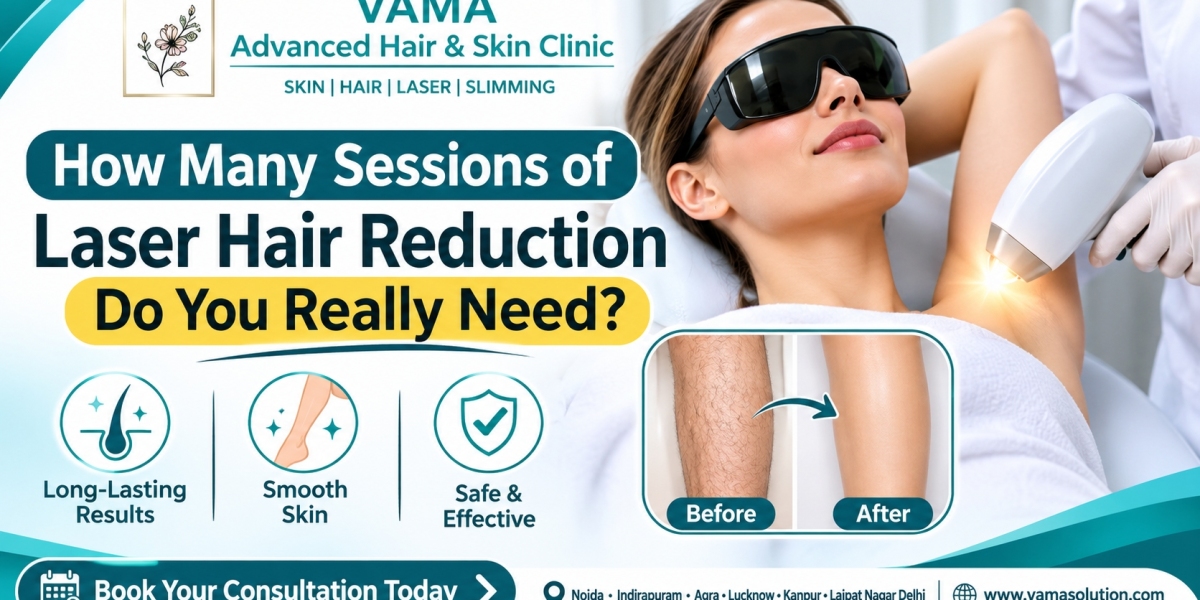

You have decided to say goodbye to shaving, waxing and threading, and now one practical question stands between you and smooth skin: how many appointments will it take? Anyone researching laser hair removal runs into wildly different answers online, from "just a few visits" to "a year of treatment." The truth sits in the middle, and it depends on you.
This guide gives you a clear, honest answer. You will learn why a single visit is never enough, how the count changes from one body area to another, what can add or remove sessions from your plan, and how to protect your results afterwards.
The Quick Answer: Plan for 6 to 8 Sessions
For most people, a course of 6 to 8 sessions delivers significant, long-lasting results. Some areas or hair types need a couple more, and a few people finish a little sooner. You will usually see a visible change after the second or third visit, with hair growing back slower, finer and patchier.
A typical laser hair reduction treatment session lasts anywhere from 15 to 60 minutes. A small area like the upper lip is done in minutes, while legs or the back take closer to an hour. Spread across a few months, the whole course fits comfortably into a busy schedule.
How the Laser Actually Works
The laser sends out a focused beam of light that is absorbed by melanin, the natural pigment in each hair. That light energy converts to heat, which damages the follicle underneath the skin and disrupts its ability to produce new hair. The device delivers this energy in rapid pulses as it moves across the treatment area.
Because the beam is drawn to pigment, contrast matters. Dark, coarse hair on lighter skin is the easiest scenario, but modern lasers can be calibrated for a wide range of skin tones. That calibration is exactly why you should always book a consultation first: your specialist chooses the settings that treat the hair effectively while keeping your skin safe.
Why One Session Is Never Enough
The reason behind multiple appointments is biology. Every hair follicle cycles through three stages:
- Anagen: the active growth stage, when the hair is firmly attached to the follicle and the laser is most effective.
- Catagen: a short transition stage when growth stops and the follicle shrinks.
- Telogen: the resting stage, when the old hair sheds and a new one prepares to grow.
At any moment, the hairs in a given area are at different stages. Only those in the growth stage respond properly, so each session treats one group while the others are still asleep. Weeks later, a fresh group has entered the growth stage and becomes treatable. Repeating the process on schedule is how the laser eventually reaches almost every follicle.
This is also why waxing and plucking between sessions are discouraged. Pulling the hair out removes the very target the laser needs.
Sessions Needed by Treatment Area
No two people are identical, but these general ranges help you plan. Your specialist will refine them after examining your skin and hair.
Facial Areas
The upper lip, chin, cheeks, sideburns, jawline and neck are among the most requested zones, and laser hair removal for face usually follows a course of 6 to 8 sessions, sometimes a few more. Facial hair tends to grow faster than body hair and is strongly influenced by hormones, so the schedule is a little tighter and the results need slightly more upkeep.
Because the skin on the face is thin and always on show, precision is essential. Treatment of these areas should only ever be done by trained professionals who adjust the settings for your skin type and hair density.
If you have noticed a sudden increase in facial hair, especially with irregular periods or acne, it is sensible to check for hormonal causes with a doctor. Conditions such as PCOS can keep stimulating new hair, which may mean extra sessions or occasional maintenance visits.
Body Areas
Underarms, arms, legs, chest, back, abdomen and the bikini line make up the other half of the menu, and laser hair removal for body typically needs around 6 to 8 sessions as well. Body hair grows more slowly, so the gaps between appointments are longer, and the results often feel dramatic because the areas are large.
Underarms are often the quickest to respond thanks to coarse, dark hair. Legs and arms usually do very well too. Finer or lighter hair anywhere on the body can take more visits, since there is less pigment for the laser to target.
What Can Change Your Session Count?
Two people treating the same area can finish at different times. These factors make the difference:
- Hair colour and thickness: dark, thick hair absorbs more energy and tends to clear faster than fine or light hair.
- Skin tone: your specialist tailors the energy level to your skin, which can influence how quickly the area can be treated.
- Hormones: thyroid conditions, PCOS and other hormonal changes can trigger fresh growth.
- Treatment area: face, underarms and legs each follow their own growth timelines.
- Consistency: missed or delayed appointments let follicles recover and grow back between visits.
- Tanning: recently tanned skin may force a delay, stretching your overall timeline.
Getting the Timing Right
The gap between sessions is planned around the growth cycle. As a general guide, facial areas are treated every 4 to 6 weeks and body areas every 6 to 8 weeks, adjusted according to how your hair responds. Your specialist will fine-tune the interval after your first couple of visits.
Rushing the process by booking sessions closer together does not speed up results. If the laser meets follicles that are still resting, the session does very little, and you simply spend more for the same outcome. Patience and regular, well-spaced appointments are the fastest route to a smooth finish.
Is It Truly Permanent?
Here is the honest answer. A permanent hair reduction treatment permanently damages many of the follicles it treats, which is why the drop in hair growth is so dramatic and long-lasting. It is not, however, a guarantee that every hair will stay away forever. Some fine hair may return over the years, particularly where hormones are involved.
Many people maintain their results with an occasional top-up, perhaps once a year, to tidy up stray regrowth. The realistic goal is hair that is far sparser, finer and lighter, and a routine that goes from daily shaving to rare maintenance.
What a Session Feels Like
Most people describe the sensation as a quick snap or a brief warmth against the skin, similar to a light rubber band flick. Sensitive spots such as the upper lip and bikini area can feel sharper than the legs or arms, but each pulse is over in a fraction of a second. As the hair thins out across your course, sessions generally become more comfortable.
Downtime is minimal. You can usually go straight back to work or your regular plans after your appointment.
Preparing for Your Appointment
A little preparation makes each session more effective:
- Stop waxing, plucking, threading and bleaching the area before treatment so the hair root stays in place.
- Limit sun exposure and avoid tanning beforehand.
- Shave the area if your specialist asks you to.
- Arrive with clean skin, free from creams, perfumes and deodorants.
- Mention any medication, skin condition or hormonal issue during your consultation.
Aftercare That Protects Your Results
What you do after the session matters just as much as the session itself:
- Apply sunscreen daily and keep the treated skin out of direct sun.
- Avoid hot showers, saunas and steam rooms for a short period.
- Skip intense workouts for a day or so.
- Shave if you need to, but do not wax or pluck between sessions.
- Moisturise gently and avoid scrubs or harsh products.
Possible Side Effects
When performed by trained medical professionals with suitable equipment, laser treatment is considered safe. A few side effects can occur, most of which settle quickly:
- Temporary redness and swelling
- Mild skin irritation
- Temporary darkening or lightening of the skin
- Scarring, which is rare
Following the aftercare advice and choosing an experienced clinic greatly lowers the chance of any problems.
Signs Your Treatment Is Working
Results build gradually, and these are the usual signs:
- Hair grows back more slowly.
- Regrowth feels softer, finer and lighter.
- The skin stays smooth for longer stretches.
- You shave or trim far less often.
If you notice little change after three or four visits, speak to your specialist. The settings may need adjusting, or a hormonal factor may need attention.
Is It Safe for Every Skin Type?
In most cases, yes. Modern laser technology can treat most skin types safely when the right equipment and settings are chosen by an experienced professional. This is why a proper assessment of your skin tone, hair colour and medical history comes before any treatment, and why a personalised plan beats a generic package every time.
What to Expect at Your First Visit?
Your first appointment is mostly about understanding you. A specialist examines the area, asks about your health history and hormonal factors, discusses your goals, and explains the number of sessions to expect. A laser hair removal treatment plan is then built around your skin and hair, rather than a one-size-fits-all package.
You will also get clear guidance on preparation and aftercare, so there are no surprises. Many clinics begin treatment on the same day when you are ready, while others prefer a patch test first for sensitive skin.
Why Choose Vama Solution
At Vama Advanced Hair & Skin Clinic in Indirapuram, Ghaziabad, the focus is on safe, effective and comfortable care. The clinic combines modern laser technology with experienced specialists and personalised treatment plans, so your session count is based on your skin, not a standard template.
If you would like a realistic estimate of your sessions, visit the clinic for a consultation. You can find it on Google Maps and book an appointment through the website.
Frequently Asked Questions
How many sessions will I need? Most people need 6 to 8 sessions for significant reduction, depending on the area, hair type, skin type and hormones.
Is the result permanent? It is long-term reduction rather than guaranteed permanent removal, and occasional touch-ups may help.
How long is each session? Between 15 and 60 minutes, depending on the size of the area.
Does it hurt? Most people feel mild discomfort, like a slight snap or warmth.
How far apart are sessions? Usually 4 to 6 weeks for the face and 6 to 8 weeks for the body.
Can I treat the face and body together? Often yes, depending on the areas and your skin type. Your specialist will advise you.
Final Thoughts
So, how many sessions do you really need? For most people, 6 to 8 well-spaced appointments, followed by occasional maintenance if required. That number is not a flaw in the treatment. It simply follows the way hair grows, and it is what makes the results last.
The most accurate answer will always come from a personal consultation. Book a visit, bring your questions, and walk away with a plan built around your goals.