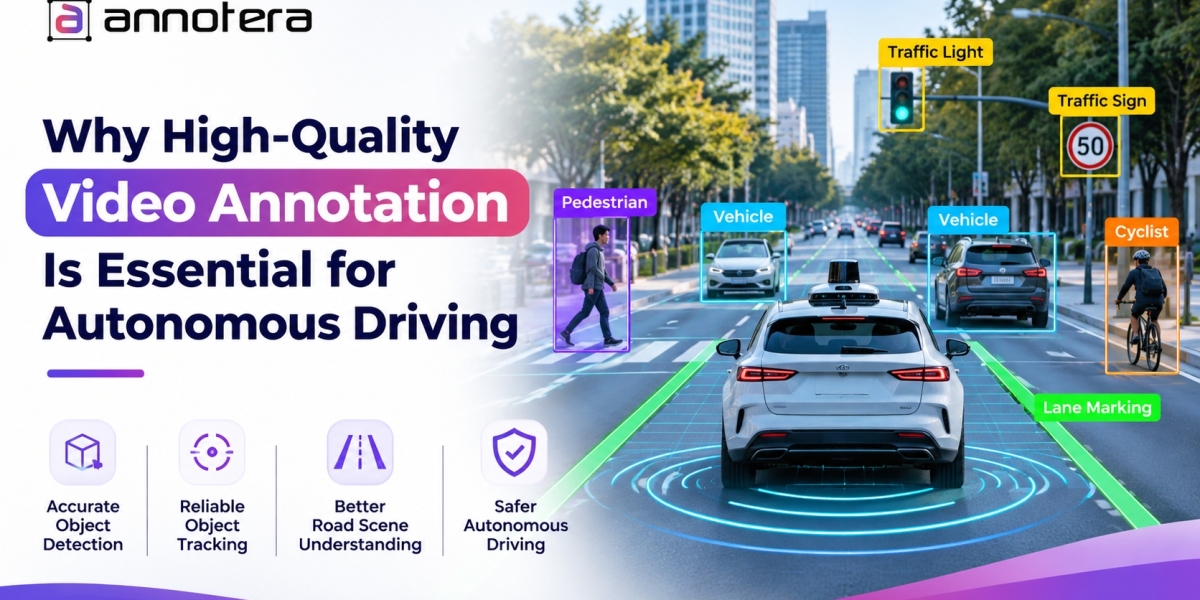

Autonomous driving technology is transforming the automotive industry by enabling vehicles to perceive their surroundings, interpret road conditions, and make intelligent driving decisions without continuous human intervention. However, the reliability of self-driving systems depends heavily on the quality of the data used to train their artificial intelligence (AI) and machine learning (ML) models. Among the essential data preparation processes, video annotation plays a critical role in helping autonomous vehicles understand complex driving environments.
Unlike traditional image annotation, which focuses on individual frames, video annotation captures objects, movements, interactions, and changes across consecutive frames. This temporal information helps AI models recognize moving vehicles, pedestrians, cyclists, traffic signals, and unexpected road events. High-quality annotations provide the foundation for developing safer, more accurate, and reliable autonomous driving systems.
Understanding Video Annotation in Autonomous Driving
Video annotation is the process of identifying, labeling, and tracking relevant objects and activities within video footage to create structured datasets for AI training. Autonomous vehicles use cameras and other sensors to continuously collect information about their surroundings. Annotated video datasets help machine learning models interpret this information and respond appropriately.
For example, an autonomous vehicle must distinguish between a stationary parked car and a moving vehicle, identify pedestrians crossing the road, recognize traffic signs, and predict the movement of nearby objects.
Common video annotation techniques used in autonomous driving include:
Bounding Box Annotation: Identifies and tracks objects such as cars, pedestrians, bicycles, and trucks across video frames.
Polygon Annotation: Outlines irregularly shaped objects, including road boundaries, vehicles, and roadside structures, with greater precision.
Semantic Segmentation: Classifies individual pixels into categories such as roads, sidewalks, buildings, vegetation, and vehicles.
Instance Segmentation: Separates individual objects belonging to the same category, helping autonomous systems distinguish between multiple vehicles or pedestrians.
Object Tracking: Maintains consistent object identities across consecutive frames to understand movement and trajectories.
Keypoint Annotation: Identifies important object landmarks, such as vehicle corners, wheel positions, and pedestrian joints.
These annotation techniques collectively help autonomous driving systems develop a more comprehensive understanding of real-world environments.
1. Improving Object Detection and Recognition
Accurate object detection is one of the most important requirements for autonomous vehicles. Self-driving cars must continuously identify surrounding vehicles, pedestrians, cyclists, traffic signs, road barriers, and other objects to make informed driving decisions.
High-quality video annotation provides accurately labeled examples that help AI models recognize objects under different conditions. For instance, a vehicle approaching from behind, a pedestrian entering a crosswalk, or a cyclist moving between parked cars must be correctly identified.
Consistent object labeling across multiple frames helps models learn visual patterns and recognize objects even when their appearance changes because of distance, lighting, or partial obstruction.
2. Understanding Object Movement and Trajectories
Recognizing an object is not enough for autonomous driving systems. Vehicles must also understand how objects move and anticipate their future positions.
Video annotation enables continuous object tracking across frames, allowing AI models to learn movement patterns and trajectories. This is particularly important when vehicles approach intersections, pedestrians cross busy roads, or cyclists move alongside cars.
For example, tracking a pedestrian across multiple frames helps autonomous systems estimate whether the person intends to cross the road or continue walking along the sidewalk.
Accurate temporal annotations improve motion prediction and support safer decision-making, including braking, accelerating, and changing lanes.
3. Enhancing Road Scene Understanding
Autonomous vehicles operate in dynamic environments containing multiple objects, road structures, and changing traffic conditions. Understanding the relationship between these elements is essential for safe navigation.
Video annotation supports road scene understanding by labeling important environmental components, including:
Road lanes and lane markings.
Traffic lights and road signs.
Pedestrian crossings and sidewalks.
Road intersections and junctions.
Vehicles, pedestrians, and cyclists.
Road obstacles and construction zones.
With accurately annotated video datasets, AI models can learn how different elements interact within a driving environment. This improves their ability to identify drivable areas, maintain lane positions, and navigate complex road networks.
4. Supporting AI Model Performance in Challenging Conditions
Autonomous driving systems must operate reliably across different weather, lighting, and environmental conditions. Rain, fog, snow, nighttime driving, glare, and low visibility can significantly affect camera-based perception.
High-quality video annotation helps developers build diverse training datasets that represent these challenging scenarios.
For example, annotators can label partially visible pedestrians, vehicles obscured by heavy rain, reflective road surfaces, and objects appearing in low-light environments. Including these scenarios helps AI models learn to interpret difficult visual information rather than relying exclusively on ideal driving conditions.
A reliable dataset should include diverse geographical locations, road types, traffic densities, and environmental conditions to improve model generalization.
5. Improving Pedestrian and Road Safety
Pedestrian safety is a major consideration in autonomous vehicle development. Self-driving cars must detect vulnerable road users, understand their movements, and respond appropriately to potentially dangerous situations.
Video annotation helps train AI models to identify pedestrians, cyclists, motorcyclists, and other vulnerable road users. Temporal labeling also helps models understand interactions, such as pedestrians stepping onto roads, cyclists changing direction, or children moving unpredictably near vehicles.
Accurate annotations of these scenarios strengthen the training process and help autonomous systems recognize potential collision risks earlier.
6. Enabling Consistent Training and Validation Datasets
The effectiveness of autonomous driving AI models depends not only on dataset volume but also on annotation accuracy and consistency.
Incorrect object classifications, missing labels, inconsistent tracking IDs, and inaccurate bounding boxes can introduce noise into training datasets. Such inconsistencies may affect model performance and reduce the reliability of perception systems.
A structured annotation quality assurance process should include:
Clearly defined annotation guidelines and labeling taxonomies.
Consistent object identification across video frames.
Automated validation and error detection.
Human review and quality control.
Inter-annotator agreement assessments.
Regular dataset audits and correction workflows.
Working with an experienced video annotation company helps automotive AI developers establish scalable annotation workflows while maintaining consistent labeling standards. Annotera focuses on structured data annotation and quality-driven workflows that support demanding AI training requirements.
7. Accelerating Autonomous Driving Innovation Through Scalable Annotation
Autonomous driving development requires enormous volumes of diverse, accurately labeled video data. As vehicle manufacturers and AI developers expand testing across different environments, annotation requirements continue to grow.
An experienced video annotation company can help organizations manage large-scale video datasets through trained annotation teams, standardized processes, and quality assurance mechanisms.
Outsourcing video annotation can also help automotive technology companies reduce operational complexity, accelerate dataset preparation, and allocate more resources to AI model development, testing, and optimization.
At Annotera, we understand the importance of reliable training data in developing advanced computer vision systems. Our data annotation capabilities support businesses working with complex visual datasets, helping them build structured resources for next-generation AI applications.
Conclusion
High-quality video annotation is a fundamental requirement for advancing autonomous driving technology. From object detection and motion tracking to road scene understanding and pedestrian safety, accurately labeled video datasets help AI models interpret dynamic driving environments and make more informed decisions.
As autonomous vehicles become increasingly sophisticated, the demand for diverse, consistent, and accurately annotated video data will continue to increase. Automotive manufacturers and AI developers must prioritize annotation quality, scalable workflows, and rigorous quality assurance to build more reliable perception systems.
Annotera supports organizations with structured data annotation solutions designed to meet the evolving requirements of computer vision and autonomous driving applications. By investing in high-quality video annotation, businesses can strengthen their AI training pipelines and contribute to the development of safer, smarter, and more intelligent mobility solutions.