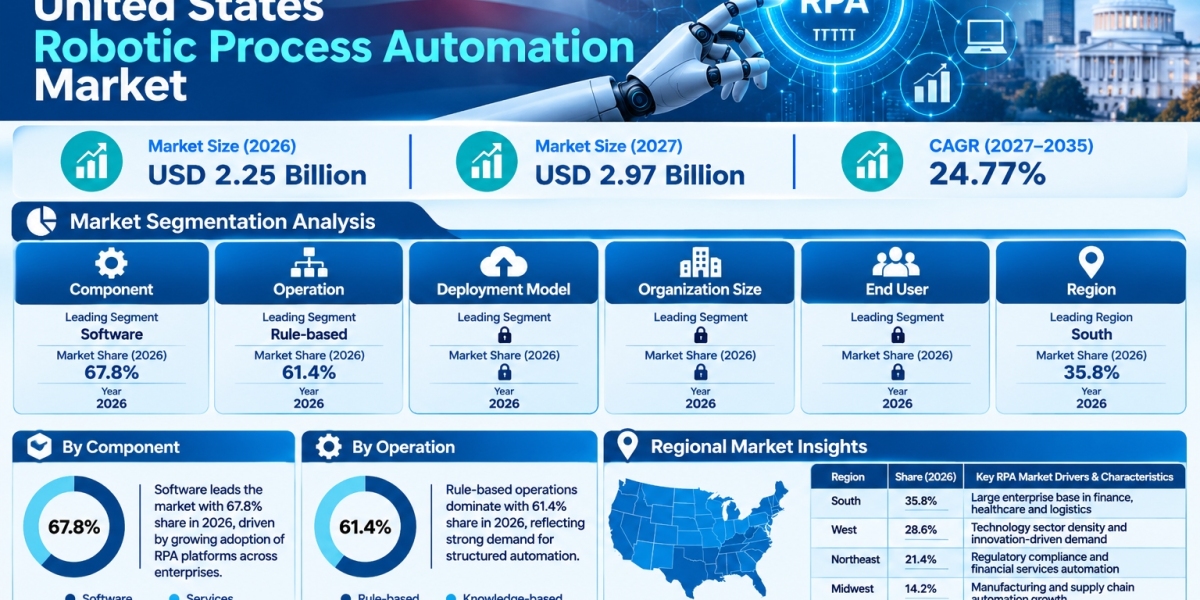

IMARC Group has recently released a new research study titled “United States Robotic Process Automation Market Report by Component, Operation, Deployment Model, Organization Size, End User, and Region, 2027-2035,” which offers a detailed analysis of the market drivers, segmentation, growth opportunities, trends and competitive landscape to understand the current and future market scenarios.
United States Robotic Process Automation Market Size, Growth, and Forecast (2027-2035)
The united states robotic process automation market size reached USD 2.25 Billion in 2026 and is projected to reach USD 17.44 Billion by 2035, growing at a CAGR of 24.77% during 2027-2035. The imperative to reduce operational costs, the integration of artificial intelligence with automation platforms, and accelerating digital transformation across industries are the primary factors driving the united states robotic process automation market.
Robotic process automation (RPA) uses software robots to mimic human interactions with digital systems, automating tasks such as data entry, document processing, and transaction handling without requiring major changes to existing IT infrastructure. It is widely used to improve speed, accuracy, and compliance in high-volume back-office processes.
The US is the largest country-level market for RPA globally, and the us robotic process automation market is evolving from rule-based task bots toward AI-augmented and agentic automation. Large organizations in financial services, healthcare, retail, and government are scaling automation programs, which is also shaping demand in the us enterprise robotic process automation market, where platform licensing, cloud deployment, and managed services are expanding together.
Explore Growth Opportunities in the United States Robotic Process Automation Market - Grab Your Sample Report for Evaluation: https://www.imarcgroup.com/united-states-robotic-process-automation-market
Key Trends Driving the United States Robotic Process Automation Market
• Operational efficiency and cost reduction: Organizations across BFSI, healthcare, and retail are placing RPA at the center of operational efficiency programs, with back-office cost reduction targets of 30% to 50% driving deployment. Automation also reduces errors in high-volume repetitive processes and frees employees for higher-value work.
• AI and machine learning integration: Intelligent automation combines RPA with AI, natural language processing, and machine learning to handle unstructured data and complex decision-making. Agentic AI and hyperautomation, which link RPA with process mining and analytics, are moving enterprises from isolated bots to end-to-end workflow automation.
• Digital transformation, compliance, and government adoption: Enterprises modernizing legacy processes and migrating to the cloud are adopting cloud-native and low-code RPA platforms. Regulatory requirements in healthcare, finance, and government favor audit-ready automation, and more than 30 US federal agencies have already adopted RPA to cut wait times and improve throughput.
United States Robotic Process Automation Market Report Segmentation:
The United States Robotic Process Automation Market report provides a detailed segmentation analysis to help businesses identify key growth segments and evolving industry dynamics. The market is categorized based on component, operation, deployment model, organization size, end user, and region, offering comprehensive insights across the united states robotic process automation market.
Component Insights:
• Software: Software leads with a 67.8% share in 2026, driven by platform licensing revenue from enterprise RPA suites, cloud-hosted orchestration hubs, and AI-enabled automation tools, and is growing at roughly 28.5% CAGR as vendors shift to subscription models.
• Services: Services account for 32.2% and cover bot development, system integration, change management, and managed automation operations, with demand rising as enterprises scale beyond pilot deployments.
Operation Insights:
• Rule-based: Rule-based operations dominate with a 61.4% share, supporting structured, high-volume processes such as accounts payable, claims processing, and data entry with the auditability that regulated industries need.
• Knowledge-based: Knowledge-based operations hold 38.6% and are the fastest-growing segment at roughly 31.1% CAGR, as AI-augmented bots handle unstructured data, natural language inputs, and exception-based decisions.
Deployment Model Insights:
• On-premises: On-premises deployment remains important for organizations with strict data control, security, and compliance requirements, particularly in regulated sectors.
• Cloud-based: Cloud-based deployment is gaining ground as enterprises seek faster rollout, elastic scalability, and consumption-based pricing without heavy infrastructure investment.
Organization Size Insights:
• Large Enterprises: Large enterprises drive a significant share of spending, deploying RPA across multiple departments through centers of excellence and enterprise-wide automation programs.
• Small and Medium-sized Enterprises: Small and medium-sized enterprises are adopting RPA as low-code and cloud-based tools lower the cost and technical barriers to automation.
End User Insights:
• BFSI, Healthcare and Pharmaceuticals: BFSI and healthcare organizations use RPA for regulatory reporting, claims adjudication, onboarding, reconciliation, and audit trail requirements, where accuracy and compliance are critical.
• Retail and Consumer Goods, IT and Telecommunication, and Government and Defense: Retail, IT and telecom, and government organizations automate order processing, service operations, and administrative workflows to improve throughput and reduce costs.
• Transportation and Logistics, Energy and Utilities, and Others: Logistics, energy, and other industries are applying RPA to supply chain, billing, and back-office processes as digitization programs expand.
Regional Insights:
• South: The South leads with a 35.8% share in 2026, supported by large financial services, healthcare, and logistics enterprises in Texas, Florida, North Carolina, and Georgia, along with strong digital transformation investment.
• West: The West holds 28.6%, reflecting a dense technology sector and software-native enterprises that build internal automation capabilities alongside vendor platforms.
• Northeast: The Northeast accounts for 21.4%, driven by financial services, healthcare systems, and insurers that require compliance-grade, audit-ready automation.
• Midwest: The Midwest represents 14.2%, with manufacturing and logistics enterprises automating supply chain, ERP, and back-office workflows as digitization accelerates.
United States Robotic Process Automation Market: Recent News and Developments
• January 2026: Automation Anywhere announced a new generation of AI-native agentic solutions developed in collaboration with OpenAI, combining its Process Reasoning Engine with OpenAI’s reasoning models to help enterprises reach more autonomous operations with faster time-to-value.
• February 2026: UiPath launched agentic AI solutions for healthcare, enabling medical records summarization and claim denial prevention at enterprise scale.
Challenges Impacting the United States Robotic Process Automation Market
High implementation and maintenance costs, including platform licenses, infrastructure, integration services, and ongoing bot upkeep, can delay returns for mid-market organizations. Integrating RPA with heterogeneous legacy systems that lack modern APIs also extends timelines and raises costs.
Bots with access to sensitive financial, healthcare, and personal data create cybersecurity and privacy risks that require strong governance. Scaling beyond initial deployments is difficult without a mature center of excellence, and a shortage of skilled automation developers limits deployment speed.
Investment Opportunities in the United States Robotic Process Automation Market
The united states robotic process automation market presents compelling investment opportunities supported by its projected growth from USD 2.25 Billion in 2026 to USD 17.44 Billion by 2035. Agentic AI and RPA platform development is the highest-value emerging area, as enterprises move from task-level automation to autonomous, multi-step workflow orchestration.
Healthcare revenue cycle and clinical documentation automation, BFSI intelligent automation, and compliance-certified government automation also offer strong growth potential. Low-code platforms for citizen developers are expanding the addressable user base beyond IT departments.
Outlook of the United States Robotic Process Automation Market (2027-2035)
The outlook for the united states robotic process automation market is highly positive, supported by digital transformation programs, the convergence of AI and RPA, and growing government adoption. The market is estimated at USD 2.97 Billion in 2027, is expected to reach about USD 5.29 Billion by 2030, and is projected to reach USD 17.44 Billion by 2035 at a CAGR of 24.77%.
Agentic automation, hyperautomation platforms, cloud-native deployment, and low-code tools will be the defining trends shaping the us robotic process automation market and the us enterprise robotic process automation market through 2035.
Key Players in the United States Robotic Process Automation Market
The united states robotic process automation market is moderately concentrated, with pure-play RPA leaders, enterprise software giants embedding automation in broader platforms, and compliance-focused vendors competing. Automation Anywhere, IBM, SAP, and Pegasystems also hold important positions.
• UiPath: A New York-based enterprise automation company and the world’s largest pure-play RPA vendor by revenue, UiPath offers the UiPath Platform, Studio, Orchestrator, and Document Understanding, and is expanding agentic AI orchestration and integrating RPA with large language models while deepening healthcare and financial services solutions.
• Microsoft: A strong challenger, Microsoft embeds RPA within its Microsoft 365 and Azure ecosystem through Power Automate, Azure Logic Apps, and Copilot Studio, and is expanding low-code and AI agent capabilities to reach citizen developers and mid-market organizations.
Frequently Asked Questions (FAQs): United States Robotic Process Automation Market
- What is the current United States robotic process automation market size?
The United States robotic process automation market size reached USD 2.25 Billion in 2026 and is projected to reach USD 17.44 Billion by 2035, growing at a CAGR of 24.77% during 2027-2035.
- What is robotic process automation?
Robotic process automation is the use of software robots to mimic human actions in digital systems, automating repetitive, rule-based tasks such as data entry, document processing, and transaction handling.
- What are the key drivers of the us robotic process automation market?
Key drivers include the need to reduce operational costs, integration of AI and machine learning with automation platforms, accelerating digital transformation, and regulatory compliance requirements.
- Which component and operation segments lead the us enterprise robotic process automation market?
Software leads the component segment with a 67.8% share, while rule-based operations lead with a 61.4% share in 2026.
- Who are the key players in the united states robotic process automation market?
Key players in the united states robotic process automation market include UiPath, Automation Anywhere Inc., Microsoft, IBM Corporation, SAP SE, and Pegasystems Inc.
- Author IMARC Group
IMARC Group is a global management consulting firm that helps the world's most ambitious changemakers to create a lasting impact. The company provide a comprehensive suite of market entry and expansion services. IMARC offerings include thorough market assessment, feasibility studies, company incorporation assistance, factory setup support, regulatory approvals and licensing navigation, branding, marketing and sales strategies, competitive landscape and benchmarking analyses, pricing and cost research, and procurement research.
Contact Us
IMARC Group,
134 N 4th St. Brooklyn, NY 11249, USA,
Email: sales@imarcgroup.com,
United States: +1-201971-6302