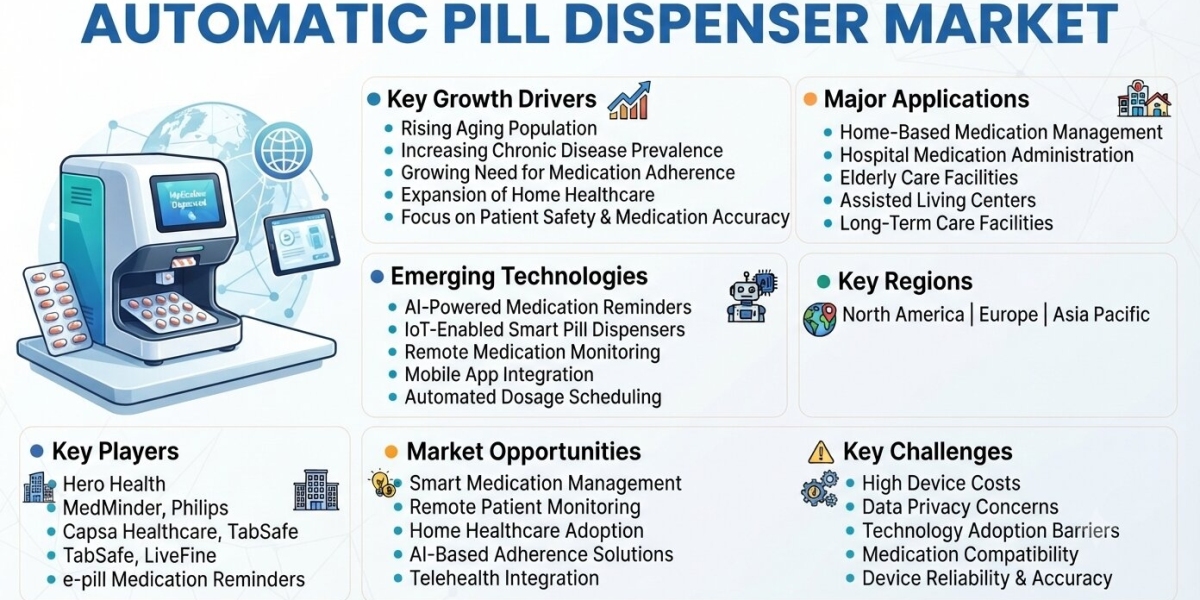

According to Transpire Insight, the Automatic Pill Dispenser Market size is estimated at USD 3.78 Billion in 2026 and is anticipated to reach USD 6.28 Billion by 2033, growing at a CAGR of 7.52 % from 2026 to 2033. The growth will be fueled by the rising elderly population, increasing prevalence of chronic diseases, and growing demand for accurate medication management and adherence.
The market is expected to benefit from increasing adoption of home healthcare, smart medication management solutions, and remote patient monitoring technologies. Improvements in automated dispensing systems, IoT connectivity, and AI-powered medication reminders are also creating new opportunities for manufacturers.
Why the Automatic Pill Dispenser Market Is Influencing the Healthcare Industry
The increasing focus on medication adherence is influencing the adoption of automatic pill dispensers across healthcare settings. Patients managing multiple prescriptions often face difficulties remembering dosage schedules and taking medicines at the correct time. Automatic pill dispensers address these challenges by organizing medications and providing scheduled dispensing, alerts, and reminders.
Furthermore, the growing preference for independent living and home-based healthcare is encouraging demand for user-friendly medication management solutions. These devices can support elderly individuals and patients with long-term health conditions while reducing the daily responsibilities of caregivers. Healthcare facilities and assisted living centers are also exploring automated solutions to improve medication management and patient safety.
Read more: https://www.transpireinsight.com/report/automatic-pill-dispenser-market
Key Factors Supporting Automatic Pill Dispenser Market Growth
Rising Elderly Population and Chronic Disease Burden
The increasing elderly population is creating greater demand for medication management solutions. Older adults frequently manage multiple prescriptions for conditions requiring regular treatment. Automatic pill dispensers help simplify medication schedules through organized storage, reminders, and controlled dispensing. The growing burden of chronic diseases is further supporting the need for consistent medication adherence.
Increasing Focus on Medication Safety and Adherence
Missed doses, incorrect medication timing, and accidental double dosing can create challenges in treatment management. Automatic pill dispensers help reduce these risks by providing reminders and releasing medication according to programmed schedules. Their use can improve medication routines for patients and provide caregivers with additional support.
Expansion of Home Healthcare and Independent Living
The growing adoption of home healthcare services is creating opportunities for automated medication management devices. Patients increasingly prefer receiving care at home rather than relying entirely on healthcare facilities. Automatic pill dispensers can support independent living by helping individuals follow prescribed medication schedules with less manual assistance.
Key Players in the Automatic Pill Dispenser Market
Hero Health
MedMinder
Philips
Omnicell
Capsa Healthcare
TabSafe
LiveFine
e-pill Medication Reminders
Accu-Chart Plus Healthcare Systems
Spencer Health Solutions
Segmentation of the Automatic Pill Dispenser Market
Product Type
Centralized Automatic Pill Dispensers
Decentralized Automatic Pill Dispensers
Technology
Electronic
Connected and Smart Devices
End User
Hospitals and Clinics
Home Healthcare
Assisted Living Facilities
Long-Term Care Facilities
Distribution Channel
Online Sales
Pharmacies
Medical Equipment Suppliers
Direct Sales
How Technological and Industry Developments Are Changing Demand
Smart Connectivity and Remote Monitoring
Integration of Wi-Fi, Bluetooth, mobile applications, and connected healthcare platforms is improving medication management capabilities. Some smart devices allow caregivers to monitor medication schedules and receive notifications when doses are missed. These features support remote supervision and improve communication between patients and caregivers.
Automation and User-Friendly Device Design
Advancements in dispensing mechanisms, programmable schedules, alarms, and simplified interfaces are making devices more accessible. Manufacturers are focusing on designs that improve ease of use, medication organization, and dispensing accuracy. These developments are expanding the potential applications of automatic pill dispensers in residential and healthcare environments.
Regional Patterns and Emerging Demand in the Automatic Pill Dispenser Market
North America represents an important market due to its established healthcare infrastructure, growing adoption of home healthcare technologies, and increasing focus on medication adherence. Europe also offers opportunities through its aging population and expanding use of digital healthcare solutions.
Meanwhile, Asia-Pacific is emerging as a potential growth region as healthcare infrastructure develops, the elderly population increases, and awareness of medication management technologies improves. Differences in healthcare spending, technology access, and reimbursement policies continue to influence adoption across regions.
Challenges Companies Need to Consider in the Automatic Pill Dispenser Industry
Despite promising opportunities, the industry faces challenges related to high device costs, limited technology awareness, and difficulties integrating products with existing healthcare systems. Some patients may also find advanced devices difficult to operate, particularly when interfaces are not designed with accessibility in mind.
Additionally, medication compatibility, device reliability, data privacy, and cybersecurity remain important considerations. Manufacturers must maintain dispensing accuracy and develop secure, easy-to-use products to build confidence among patients and healthcare providers.
Future Opportunities in the Automatic Pill Dispenser Market
The market presents opportunities through the development of connected devices, AI-supported medication reminders, remote monitoring, and personalized medication management solutions. Increasing demand for home healthcare and assisted living services may further encourage adoption.
Manufacturers can also explore affordable devices, improved accessibility features, and integration with telehealth platforms. Partnerships between healthcare providers, technology companies, and pharmacies may help expand distribution and improve patient access.
What This Means for the Automatic Pill Dispenser Industry
The expansion of the Automatic Pill Dispenser Market highlights the growing importance of medication adherence, patient safety, and technology-enabled healthcare. As chronic disease management and home-based care become increasingly important, automated dispensing solutions can offer valuable support to patients and caregivers. Companies investing in device reliability, smart connectivity, affordability, and user-friendly designs will be better positioned to address evolving healthcare needs. Going forward, technological innovation, patient awareness, and integration with healthcare services will play an important role in shaping the industry's development.
Latest Reports:
https://in.pinterest.com/pin/1083819466608251121/
https://in.pinterest.com/pin/1083819466608208476/
https://in.pinterest.com/pin/1083819466608124660/
https://in.pinterest.com/pin/1083819466608093791/
https://www.quora.com/What-is-the-difference-between-Nutanix-and-VMware/answer/Devashish-217
https://www.quora.com/What-are-the-benefits-brought-by-the-railways/answer/Devashish-217