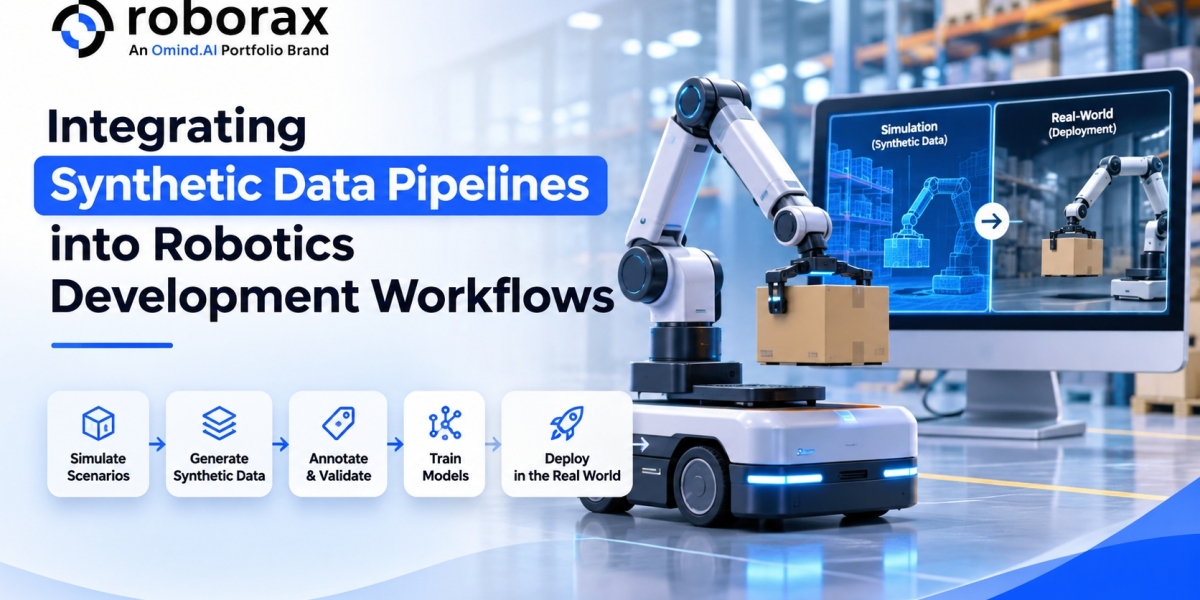

Robotics development is becoming increasingly dependent on high-quality, diverse, and scalable training datasets. As robots move beyond controlled environments into warehouses, manufacturing facilities, healthcare settings, and dynamic industrial operations, they must learn to handle unpredictable situations with greater accuracy. However, collecting and annotating real-world robotic data can be expensive, time-consuming, and difficult to scale.
Synthetic data offers a practical solution to these challenges. By generating artificial training scenarios through simulation environments, robotics teams can expose AI models to diverse conditions without depending entirely on physical data collection. When integrated into development workflows, synthetic data pipelines help streamline dataset generation, validation, model training, and deployment.
For organizations developing intelligent robotic systems, synthetic data & sim-to-real transfer are becoming essential components of modern AI development. Roborax supports robotics innovation through structured data operations, robotic data collection, and training data solutions designed to help robotics teams build more capable physical AI systems.
What Are Synthetic Data Pipelines in Robotics?
A synthetic data pipeline is a structured workflow that generates, processes, validates, and delivers artificially created datasets for training and evaluating robotic systems.
Unlike traditional datasets collected exclusively through physical robots and sensors, synthetic datasets are generated using simulation platforms and virtual environments. These environments can reproduce real-world conditions, including object interactions, environmental changes, lighting variations, obstacles, and different operational scenarios.
A typical synthetic data pipeline includes:
Scenario generation: Creating virtual environments that represent real-world robotic tasks.
Data generation: Producing simulated images, video sequences, sensor readings, and robot movement trajectories.
Annotation and labeling: Assigning meaningful labels to objects, actions, movements, and environmental elements.
Quality validation: Checking dataset consistency, accuracy, and coverage.
Model training: Integrating validated datasets into robotics AI training workflows.
Performance evaluation: Testing model behavior across simulated and real-world environments.
Integrating these stages creates a repeatable process that makes robotic training data generation more efficient and scalable.
Why Robotics Teams Need Integrated Synthetic Data Workflows
Developing reliable robotic systems requires exposure to a wide range of operational conditions. Relying exclusively on real-world data can limit the number of scenarios available for model training.
Synthetic data pipelines address several important development challenges.
1. Reducing Real-World Data Collection Costs
Collecting physical robotic data requires operational hardware, controlled testing environments, human operators, and repeated experiments. These activities can increase development costs, particularly when testing complex robotic movements.
Synthetic environments allow developers to generate thousands of variations of a scenario without repeatedly conducting physical experiments. Teams can simulate object manipulation, navigation, obstacle avoidance, and other tasks before deploying robots in actual environments.
2. Improving Dataset Diversity
Robots must operate under changing conditions. A warehouse robot, for example, may encounter different package sizes, unexpected obstacles, changing lighting, and varying floor conditions.
Synthetic pipelines can generate these variations systematically. This helps developers create more diverse datasets and reduce dependence on limited real-world examples.
3. Accelerating Development Cycles
Manual data collection and annotation can slow down robotics development. Automated synthetic data generation allows teams to create datasets more quickly and integrate them into model training pipelines.
Developers can also modify simulation parameters to generate additional scenarios whenever model evaluations reveal performance gaps.
Key Stages of Integrating Synthetic Data into Robotics Development
Successfully implementing synthetic data requires more than generating virtual images or simulated movements. It involves connecting data generation with the broader robotics development lifecycle.
1. Define Robotic Tasks and Data Requirements
The first step is identifying the specific tasks the robot must perform. These may include object detection, grasping, navigation, manipulation, or autonomous decision-making.
Developers should define the required sensor modalities, annotation formats, environmental conditions, and performance objectives.
For example, a robotic picking system may require labeled images of objects from different viewing angles, grasping trajectories, object dimensions, and interaction data.
2. Build Realistic Simulation Environments
The next stage involves creating virtual environments that closely represent the robot's intended operating conditions.
Simulation platforms can reproduce physical properties such as gravity, friction, collisions, object weight, and joint movement. Environmental variables such as lighting, surface textures, and object positioning can also be modified.
Realistic simulation is particularly important for humanoid robots and mobile manipulation systems that interact with complex physical environments.
3. Generate and Annotate Synthetic Datasets
Once simulation environments are established, developers can generate training datasets using different scenarios and configurations.
Depending on the application, these datasets may include:
RGB and depth images.
LiDAR point clouds.
Object detection and segmentation labels.
Robot joint positions and movement trajectories.
Force and torque measurements.
Multimodal sensor recordings.
Accurate annotation ensures that generated data contains meaningful information for training robotic perception and decision-making models.
4. Validate Dataset Quality
Synthetic datasets must undergo systematic quality checks before entering production training workflows.
Teams should evaluate annotation accuracy, class distribution, scenario coverage, sensor synchronization, and physical consistency.
It is also important to identify unrealistic simulation artifacts that may introduce misleading patterns into training datasets.
Combining synthetic data with carefully selected real-world examples can improve dataset reliability.
5. Integrate Data into Model Training Pipelines
Validated datasets should be organized into standardized formats and connected to existing machine learning workflows.
Dataset versioning, metadata management, and reproducible processing pipelines help teams track changes and compare model performance across training iterations.
This integration allows robotics developers to update datasets continuously as new operational requirements emerge.
The Role of Sim-to-Real Transfer in Robotics Development
One of the biggest challenges in simulation-based robotics training is ensuring that models trained in virtual environments perform reliably in the physical world.
This challenge is known as the sim-to-real gap.
Differences between simulated and real environments may include lighting behavior, sensor noise, material properties, object friction, and unexpected physical interactions.
Synthetic data & sim-to-real transfer strategies help address these differences through techniques such as:
Domain randomization: Varying environmental parameters during simulation to improve model adaptability.
Physics-based simulation: Reproducing realistic physical interactions and movement constraints.
Real-world fine-tuning: Combining synthetic datasets with physical robot data to improve deployment performance.
Sensor calibration: Aligning simulated sensor outputs with real-world sensor characteristics.
These approaches help robotics teams develop models that are more resilient to environmental variations and real-world uncertainty.
How Roborax Supports Synthetic Data-Driven Robotics Development
Building effective robotics training pipelines requires coordination between simulation, data engineering, annotation, and validation.
Roborax focuses on supporting robotics and physical AI development through specialized data operations and robotics-focused workforce capabilities.
Its approach brings together robotics expertise, structured data workflows, and scalable operational support to help organizations prepare training datasets for intelligent robotic systems.
Roborax supports key requirements such as:
Robotic training data preparation: Organizing structured datasets for robotic perception, manipulation, and navigation tasks.
Multimodal sensor data operations: Supporting workflows involving camera, LiDAR, and other sensor modalities.
Data annotation and validation: Improving consistency across object labels, movements, and robotic interaction datasets.
Simulation-driven development support: Helping teams prepare and validate datasets generated through virtual environments.
Scalable data operations: Supporting evolving dataset requirements as robotics projects expand.
By connecting data operations with robotics development requirements, Roborax helps organizations establish more structured and scalable training workflows.
Best Practices for Building Scalable Synthetic Data Pipelines
To maximize the value of synthetic datasets, robotics teams should follow a few important practices:
Start with real-world requirements: Design simulation scenarios around actual robotic tasks rather than generating random datasets.
Maintain dataset diversity: Include different environments, object configurations, lighting conditions, and physical interactions.
Combine synthetic and real data: Use physical-world observations to identify and correct simulation limitations.
Establish quality benchmarks: Evaluate annotation consistency, sensor accuracy, and scenario coverage.
Implement dataset versioning: Track changes to simulation configurations, labels, and training datasets.
Continuously evaluate performance: Use model testing results to identify missing scenarios and improve subsequent data generation cycles.
These practices help transform synthetic data generation from an isolated activity into a continuous part of robotics engineering.
Conclusion
Integrating synthetic data pipelines into robotics development workflows is an important step toward building intelligent, adaptable, and reliable robotic systems. From scenario generation and dataset annotation to quality validation and model training, structured pipelines enable robotics teams to manage complex data requirements more efficiently.
As physical AI applications continue to expand, combining high-quality robotic training data with effective simulation strategies will become increasingly important. A well-designed approach to synthetic data & sim-to-real transfer can help bridge the gap between virtual training environments and real-world robotic performance.
With its focus on robotics data operations, multimodal workflows, and scalable workforce capabilities, Roborax aims to support organizations developing the next generation of intelligent robotic systems.
Building the next generation of intelligent robots requires more than advanced algorithms. It requires reliable, diverse, and well-structured training datasets. Partner with Roborax to strengthen your robotics data workflows and accelerate your physical AI development journey.