
Science education creates opportunities for students interested in research, technology, mathematics, healthcare-related fields, and scientific developments. However, attending a regular college may not always fit everyone's circumstances. Students managing employment, family responsibilities, or other commitments may prefer a more flexible approach to higher education.
BSc Distance Education offers an alternative learning pathway for students who want to pursue an undergraduate science qualification. The program introduces scientific concepts, theoretical knowledge, and subject-specific learning while providing flexibility in accessing academic resources and completing coursework.
For students interested in continuing their education without following a conventional classroom schedule, distance learning can be an option worth exploring.
What Is BSc Distance Education?
Bachelor of Science (BSc) is an undergraduate degree that focuses on scientific disciplines, mathematical concepts, and technical subjects. Through distance education, students study using university-provided learning materials, digital resources, assignments, and other academic support.
The standard duration of a BSc program is generally three years, although some universities offer four-year undergraduate structures under applicable academic frameworks.
The course structure depends on the selected specialization and university. Certain science disciplines also require laboratory sessions, practical examinations, or other supervised activities.
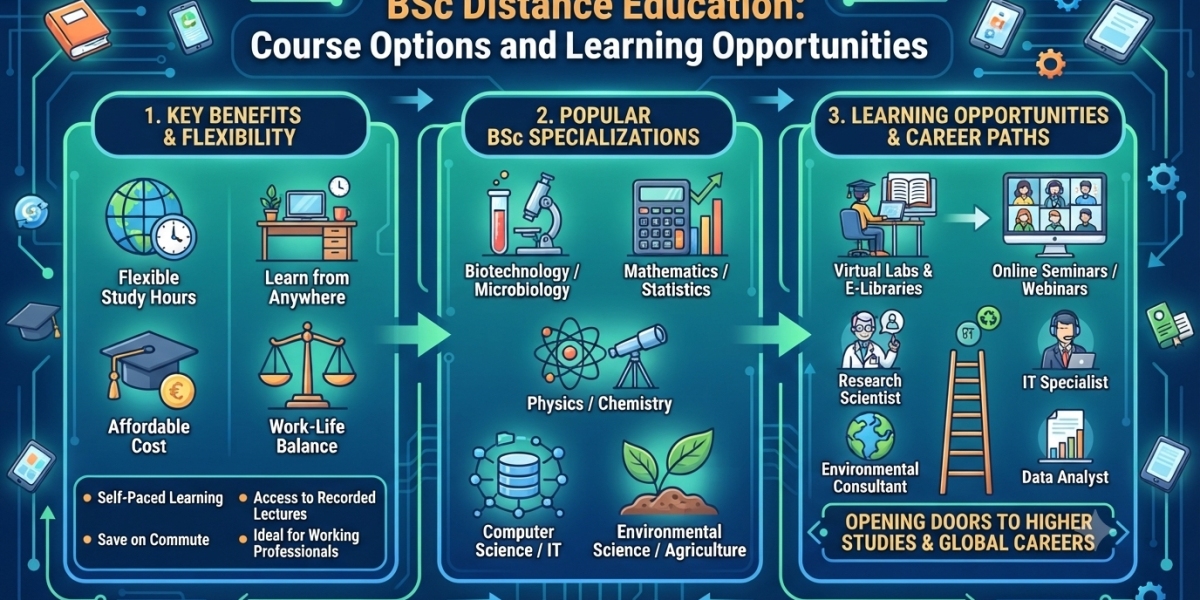
Popular BSc Specializations Available
Students can explore different science-related disciplines according to their academic interests and eligibility.
1. BSc Mathematics
This specialization covers algebra, calculus, statistics, geometry, and mathematical reasoning. It can be relevant for students interested in analytics, teaching, and further mathematical studies.
2. BSc Physics
Students learn about mechanics, electricity, magnetism, optics, and modern physics. The program provides a foundation for advanced studies in physical sciences.
3. BSc Chemistry
This discipline introduces organic, inorganic, and physical chemistry, along with chemical reactions and scientific principles.
4. BSc Computer Science
Students explore programming, computer systems, algorithms, and fundamental computing concepts. Practical requirements depend on the university's delivery model.
5. BSc Information Technology
This specialization focuses on information systems, computer applications, networking, and digital technologies.
6. BSc Biology
Students study living organisms, genetics, ecology, cell biology, and biological processes.
Not every specialization is available through distance education. Students must check whether their chosen program is approved for the relevant academic session.
Eligibility Criteria for BSc Distance Education
Admission requirements vary depending on the subject combination and university.
Generally, applicants may need:
Completion of Class 12 from a recognized board.
Relevant science subjects for the selected specialization, where required.
Fulfilment of minimum qualifying marks prescribed by the university.
Class 10 and Class 12 academic documents.
Identity proof and other admission-related information.
Completion of the university application process.
For example, mathematics or physics may be required for certain specializations, while biology may be necessary for particular life-science programs.
Advantages of Studying BSc Through Distance Education
Distance learning can provide several benefits for students looking for alternatives to regular college education.
Flexible Study Planning: Students can organize their learning hours according to their personal and professional commitments.
Access to Academic Resources: Universities may provide printed materials, digital lectures, online libraries, and academic guidance.
Opportunity for Continued Education: Learners who cannot attend regular classes can explore eligible science degree programs.
Subject-Based Learning: Students can choose from available science disciplines according to their interests and qualifications.
Independent Learning Skills: Distance education encourages discipline, time management, and independent study habits.
However, science students should carefully examine laboratory and practical requirements before selecting a distance learning program.
Career Opportunities After BSc Distance Education
Career options depend on the selected specialization, practical skills, additional qualifications, and employer requirements.
Career option | Relevant specialization |
Mathematics Tutor | Mathematics |
Laboratory Assistant | Chemistry or Biology |
Data Analyst Trainee | Mathematics or Computer Science |
IT Support Associate | Computer Science or IT |
Research Assistant | Relevant science discipline |
Quality Control Assistant | Chemistry |
Technical Support Executive | Information Technology |
Some positions require additional certifications, practical experience, or postgraduate qualifications.
Higher Education Options After BSc
Graduates can explore several postgraduate pathways to develop specialized knowledge.
MSc: Advanced education in mathematics, physics, chemistry, biology, or computer science.
MCA: An option for eligible graduates interested in computer applications.
MBA: Suitable for graduates interested in business and management.
BEd: An option for eligible graduates interested in teaching, subject to applicable admission requirements.
Professional Certifications: Specialized training in analytics, computing, laboratory skills, and other technical areas.
Students should select higher education programs based on their undergraduate subjects and career interests.
How to Choose the Right Distance BSc University
Before applying, students should examine the following factors:
Verify the university's recognition and degree-awarding authority.
Check UGC-DEB entitlement for the specific BSc program and academic session.
Confirm whether the chosen specialization is available through distance education.
Review laboratory and practical examination requirements.
Compare course fees and additional expenses.
Examine the syllabus and student support facilities.
Practical components are particularly important in science education, so students should not select a course based only on convenience or advertising claims.
Conclusion
BSc Distance Education can provide an alternative opportunity for students interested in scientific and technical education. With different subject options and flexible learning arrangements, the program can support individuals who want to continue their academic development while managing other responsibilities.
Choosing a properly recognized university, understanding practical requirements, and selecting an appropriate specialization are essential steps toward a successful learning experience.
https://justpaste.it/distance-bca-course