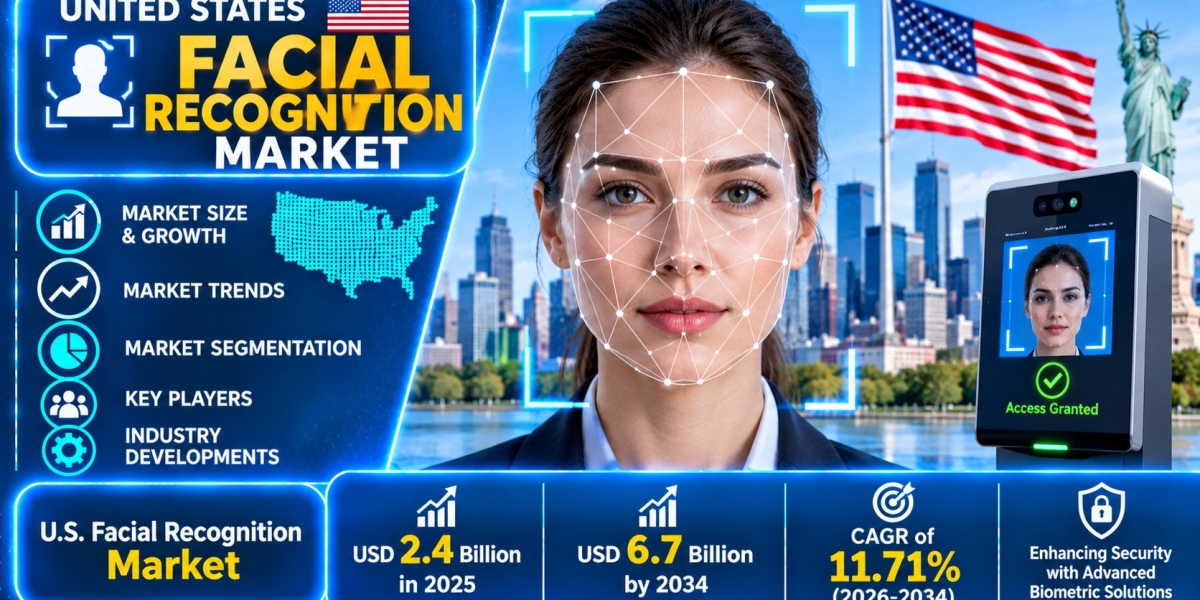

IMARC Group has recently released a new research study titled “United States Facial Recognition Market Report by Component, Technology, Application, End Use Industry, and Region, 2026-2034,” which offers a detailed analysis of the market drivers, segmentation, growth opportunities, trends and competitive landscape to understand the current and future market scenarios.
United States Facial Recognition Market Size, Growth, and Forecast (2026-2034)
The united states facial recognition market size reached USD 2.4 Billion in 2025 and is projected to reach USD 6.7 Billion by 2034, growing at a CAGR of 11.71% during 2026-2034. Growing use of enhanced security solutions for identity verification, rising focus on hygiene and contactless interactions, and the increasing need to enhance public safety are the primary factors driving the united states facial recognition market and the broader us facial recognition market.
Facial recognition is an advanced technology used to identify and verify individuals by analyzing unique facial features such as the shape of the face, eyes, nose, and mouth, along with facial landmarks and skin texture. It offers a quick and accurate means of authentication, helps identify suspects captured on surveillance cameras, locates missing persons, and reduces the risk of unauthorized access to secure areas or devices.
Organizations also use it to personalize marketing, streamline payment processes, and prevent identity theft and fraud. In digital onboarding and identity verification, facial recognition is increasingly paired with optical character recognition (OCR) that reads data from identity documents, so the us facial recognition market and the us optical character recognition market are becoming closely connected through shared verification workflows.
Explore Growth Opportunities in the United States Facial Recognition Market - Grab Your Sample Report for Evaluation: https://www.imarcgroup.com/united-states-facial-recognition-market
Key Trends Driving the United States Facial Recognition Market
- Identity verification and fraud prevention: Rising use of facial recognition on smartphones and tablets to unlock devices, access apps, and make secure transactions is influencing the market positively. E-commerce platforms are applying it for identity verification during online transactions, reducing fraud and improving online security, often alongside OCR-based document checks that support the us optical character recognition market.
- Advancements in AI and machine learning: Advancements in artificial intelligence (AI) and machine learning (ML) algorithms are improving the accuracy and performance of facial recognition systems. Integration with other biometric technologies such as fingerprint scanning and iris recognition is strengthening overall security, while organizations adopt the technology to comply with industry-specific regulations and security standards.
- Public safety, access control, and contactless interactions: The need to enhance public safety and the growing use of facial recognition in access control systems to grant or deny entry to secure areas are supporting a positive market outlook. Healthcare providers are also using it for patient identification and access control, and the rising focus on hygiene and contactless interactions is creating lucrative growth opportunities for investors.
United States Facial Recognition Market Report Segmentation:
The United States Facial Recognition Market report provides a detailed segmentation analysis to help businesses identify key growth segments and evolving industry dynamics. The market is categorized based on component, technology, application, end use industry, and region, offering comprehensive insights across the us facial recognition market.
Component Insights:
- Software: Software includes the algorithms, matching engines, and analytics platforms that detect, compare, and verify faces, and it benefits directly from continuous improvements in AI and machine learning.
- Services: Services such as integration, deployment, maintenance, and managed support help organizations implement and operate facial recognition systems across security, access control, and identity verification use cases.
Technology Insights:
- 2D Facial Recognition: 2D facial recognition analyzes flat images and is widely deployed in smartphones, surveillance, and attendance systems because it works with standard cameras.
- 3D Facial Recognition: 3D facial recognition maps the depth and contours of the face, offering higher accuracy and stronger resistance to spoofing in secure authentication settings.
- Facial Analytics: Facial analytics interprets facial attributes and expressions to support use cases such as audience measurement, personalization, and emotion detection.
Application Insights:
- Emotion Recognition and Attendance Tracking and Monitoring: Emotion recognition supports customer experience and behavioral insights, while attendance tracking and monitoring automates workforce and campus check-ins without physical contact.
- Access Control and Security and Surveillance: Access control grants or denies entry to secure areas, and security and surveillance applications help identify suspects and locate missing persons, supporting public safety.
- Others: Other applications include payment authentication, device unlocking, and identity verification during online onboarding.
End Use Industry Insights:
- Retail and E-commerce, and BFSI: Retailers and banking, financial services, and insurance firms use facial recognition for secure payments, identity verification, and fraud reduction during online transactions.
- Government and Defense, and Automotive and Transportation: Government and defense agencies rely on it for public safety and secure access, while transportation operators use it to streamline traveler identity checks and secure facilities.
- Media and Entertainment, Healthcare, Telecom and IT, and Others: Media companies use it for audience analytics, healthcare providers for patient identification and access control, and telecom and IT firms for secure authentication of users and devices.
Regional Insights:
- Northeast: The Northeast is supported by its concentration of financial institutions, government agencies, and dense urban transit hubs adopting biometric identity verification.
- Midwest: The Midwest sees growing adoption across healthcare systems, manufacturing sites, and regional commercial facilities seeking secure access control.
- South: The South reflects expanding demand from large airports, growing metropolitan areas, and rising investment in public safety and commercial security.
- West: The West benefits from its technology-driven ecosystem, where AI developers, device makers, and digital services companies drive early adoption of advanced facial recognition.
United States Facial Recognition Market: Recent News and Developments
- August 2026: Incode launched GovFaceMatch, a solution that verifies identity by matching biometrics directly against U.S. government records, with Georgia DDS among the partners, as businesses face growing pressure to detect synthetic and stolen identity fraud.
- January 2026: The Transportation Security Administration announced plans to expand its TSA PreCheck Touchless ID program to 65 U.S. airports by spring 2026, allowing eligible travelers to verify their identity with facial matching instead of presenting a physical ID at participating checkpoints.
Challenges Impacting the United States Facial Recognition Market
Privacy and civil liberties concerns remain a significant challenge, as the collection and storage of biometric data raise questions about consent, data security, and misuse. Evolving federal and state policy discussions create uncertainty for vendors and organizations planning large-scale deployments.
Concerns about accuracy and bias across different demographic groups, along with the cost and complexity of integrating systems with existing infrastructure, can also slow adoption. Providers must continually improve algorithm performance and transparency to build public and regulatory trust.
Investment Opportunities in the United States Facial Recognition Market
The united states facial recognition market presents compelling investment opportunities supported by its projected growth from USD 2.4 Billion in 2025 to USD 6.7 Billion by 2034. AI and machine learning improvements, 3D facial recognition, and multimodal biometrics that combine face with fingerprint or iris offer strong potential for higher accuracy and security.
Identity verification for online transactions, healthcare patient identification, and contactless access control are high-value areas. Solutions that combine facial recognition with OCR-based document verification can address fraud prevention end to end, linking the us facial recognition market with the us optical character recognition market.
Outlook of the United States Facial Recognition Market (2026-2034)
The outlook for the united states facial recognition market is positive, supported by rising demand for secure identity verification, public safety needs, and continuous advances in AI. The market is projected to grow from USD 2.4 Billion in 2025 to USD 6.7 Billion by 2034 at a CAGR of 11.71%.
Contactless authentication, multimodal biometrics, AI-driven accuracy improvements, and tighter integration with document verification such as OCR will be the defining trends shaping the us facial recognition market through 2034.
Key Players in the United States Facial Recognition Market
The united states facial recognition market is served by biometric identity verification providers and security technology companies competing on the basis of algorithm accuracy, fraud detection capabilities, and integration with government and enterprise systems.
- Incode: A digital identity verification company, Incode launched GovFaceMatch in August 2026 to verify users by matching biometrics against U.S. government records, and states that its platform has processed over four billion identity checks globally.
- CLEAR: An identity verification company, CLEAR partnered with the Transportation Security Administration to deploy biometric eGates at three U.S. airports, using real-time facial verification that matches a traveler’s facial image with their identity document and boarding pass.
Frequently Asked Questions (FAQs): United States Facial Recognition Market
- What is the current United States facial recognition market size?
The United States facial recognition market size reached USD 2.4 Billion in 2025 and is projected to reach USD 6.7 Billion by 2034, growing at a CAGR of 11.71% during 2026-2034.
- What is facial recognition?
Facial recognition is a technology that identifies and verifies individuals by analyzing unique facial features, and it is often paired with optical character recognition (OCR) to match a person’s face with the data on an identity document.
- What are the key drivers of the us facial recognition market?
Key drivers include enhanced security solutions for identity verification and fraud reduction, rising focus on hygiene and contactless interactions, the need to enhance public safety, and advancements in AI and machine learning algorithms.
- Which segments are covered in the United States facial recognition market report?
The report covers component (software and services), technology (2D facial recognition, 3D facial recognition, and facial analytics), application, end use industry, and region (Northeast, Midwest, South, and West).
- Who are the key players in the united states facial recognition market?
Key players in the united states facial recognition market include Incode and CLEAR, alongside other biometric identity verification providers and security technology companies.
Author IMARC Group
IMARC Group is a global management consulting firm that helps the world's most ambitious changemakers to create a lasting impact. The company provide a comprehensive suite of market entry and expansion services. IMARC offerings include thorough market assessment, feasibility studies, company incorporation assistance, factory setup support, regulatory approvals and licensing navigation, branding, marketing and sales strategies, competitive landscape and benchmarking analyses, pricing and cost research, and procurement research.
Contact Us
IMARC Group,
134 N 4th St. Brooklyn, NY 11249, USA,
Email: sales@imarcgroup.com,
United States: +1-201971-6302