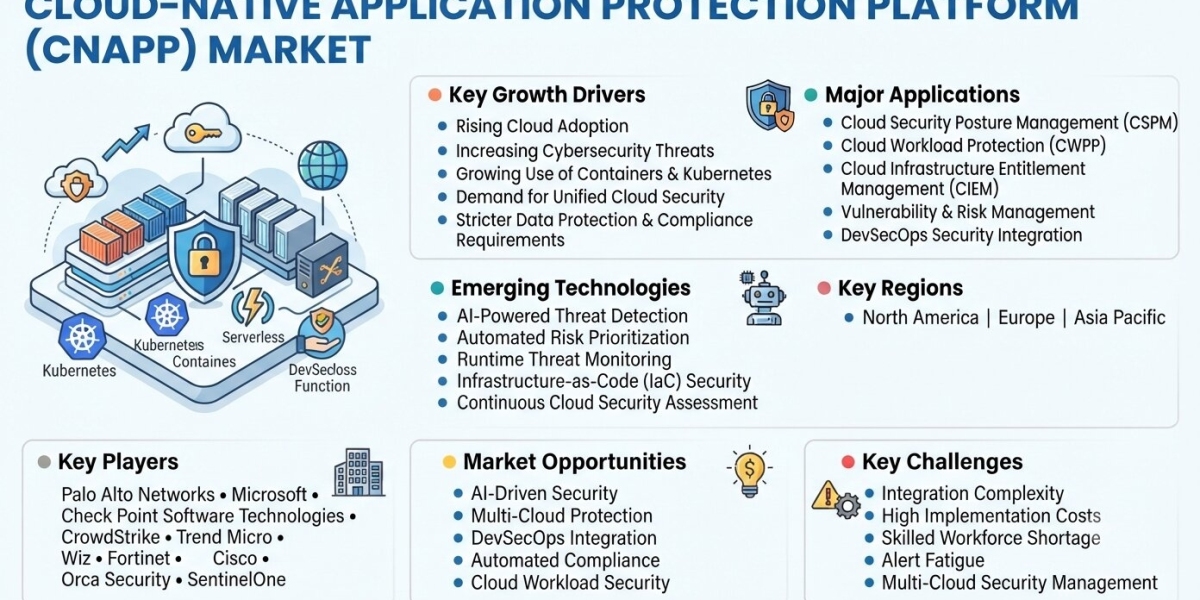

According to Transpire Insight, the Cloud-Native Application Protection Platform (CNAPP) Market size is estimated at USD 12.60 Billion in 2026 and is anticipated to reach USD 52.01 Billion by 2033, growing at a CAGR of 22.45% from 2026 to 2033. The growth will be fueled by increasing cloud adoption, rising cybersecurity threats, growing use of containers and microservices, and demand for unified cloud security solutions.
The market is expected to benefit from increasing investments in cloud infrastructure, DevSecOps practices, and multi-cloud security management. Advancements in AI-powered threat detection, automated risk assessment, and continuous security monitoring are also creating new opportunities for manufacturers and technology providers.
Why the CNAPP Market Is Influencing the Cybersecurity Industry
The growing complexity of cloud environments is changing how organizations approach cybersecurity. Traditional security tools often operate separately, creating visibility gaps and making it difficult to identify risks across applications, workloads, identities, and infrastructure. CNAPP platforms address these challenges by providing centralized visibility and security management.
Additionally, the increasing use of DevOps and continuous integration and continuous delivery (CI/CD) practices has created demand for security solutions that can be integrated directly into development workflows. By identifying vulnerabilities earlier, CNAPP platforms support a shift toward a proactive security approach while helping organizations maintain operational efficiency.
Read more: https://www.transpireinsight.com/report/cloud-native-application-protection-platform-market
Key Factors Supporting CNAPP Market Growth
Increasing Adoption of Cloud-Native Technologies
The growing use of containers, Kubernetes, serverless computing, and microservices is increasing the need for specialized cloud security solutions. These technologies create dynamic environments where workloads and configurations change frequently. CNAPP platforms help organizations continuously monitor cloud assets, detect misconfigurations, and protect workloads across different cloud environments.
Rising Cybersecurity Threats and Compliance Requirements
The growing frequency of cloud-based attacks, data breaches, identity-related threats, and software supply chain vulnerabilities is encouraging organizations to strengthen security investments. CNAPP solutions provide capabilities for vulnerability assessment, threat detection, risk prioritization, and compliance monitoring. These features help businesses address security risks while supporting regulatory and industry-specific requirements.
Demand for Unified Cloud Security Management
Organizations increasingly prefer integrated security platforms instead of managing multiple disconnected tools. CNAPP combines different cloud security functions within a centralized environment, reducing operational complexity and improving collaboration between development, security, and operations teams. This consolidated approach supports faster risk identification and more consistent security management.
Key Players in the Cloud-Native Application Protection Platform (CNAPP) Market
Palo Alto Networks
Microsoft
Check Point Software Technologies
CrowdStrike
Trend Micro
Wiz
Fortinet
Cisco
Orca Security
SentinelOne
Segmentation of the Cloud-Native Application Protection Platform (CNAPP) Market
Component
Software / Platforms
Services
Security Capability
Cloud Security Posture Management (CSPM)
Cloud Workload Protection Platform (CWPP)
Cloud Infrastructure Entitlement Management (CIEM)
Infrastructure as Code (IaC) Security
Vulnerability Management
Cloud Detection and Response
Deployment Model
Public Cloud
Private Cloud
Hybrid Cloud
Organization Size
Small and Medium-Sized Enterprises
Large Enterprises
End User
Banking, Financial Services, and Insurance
IT and Telecommunications
Healthcare
Retail and E-commerce
Manufacturing
Government and Public Sector
How Technological and Industry Developments Are Changing Demand
AI-Powered Threat Detection and Risk Prioritization
Artificial intelligence and machine learning are improving how CNAPP platforms identify suspicious activities, analyze security signals, and prioritize vulnerabilities. These capabilities help security teams focus on critical risks instead of manually reviewing large volumes of alerts. Automated threat detection can also support faster incident investigation and response.
Integration with DevSecOps and Development Workflows
The integration of CNAPP tools into CI/CD pipelines is encouraging organizations to adopt security practices throughout the software development lifecycle. Developers can identify vulnerabilities, insecure configurations, and exposed credentials before applications reach production. This approach helps reduce remediation costs and supports more secure software delivery.
Regional Patterns and Emerging Demand in the CNAPP Market
North America remains an important market due to widespread cloud adoption, advanced cybersecurity infrastructure, and the presence of major technology providers. Europe is experiencing demand supported by data protection requirements and growing investments in cloud security. Asia-Pacific offers significant opportunities as businesses in India, China, Japan, and other economies accelerate digital transformation and cloud migration. Growing enterprise adoption of hybrid and multi-cloud environments is also supporting demand across emerging markets.
Challenges Companies Need to Consider in the CNAPP Industry
Despite strong growth opportunities, the CNAPP market faces challenges such as integration complexity, high implementation costs, shortage of skilled cybersecurity professionals, and difficulties managing security across multi-cloud environments. Organizations may also experience alert fatigue when security platforms generate large volumes of findings. Data privacy requirements, vendor selection, and compatibility with existing security tools can further influence adoption decisions.
Future Opportunities in the CNAPP Market
The CNAPP market is expected to benefit from continued cloud migration, increasing DevSecOps adoption, and growing demand for automated security management. Opportunities are emerging through AI-driven security analytics, advanced identity protection, software supply chain security, and improved runtime threat detection. Vendors that simplify deployment, improve risk prioritization, and provide comprehensive multi-cloud visibility may strengthen their competitive position.
What This Means for the CNAPP Industry
The expansion of the Cloud-Native Application Protection Platform market highlights the growing importance of integrated security in modern cloud environments. As organizations adopt increasingly complex application architectures, unified platforms that connect development, infrastructure, and runtime protection will become more valuable. Companies investing in automation, AI-powered threat detection, and comprehensive cloud security capabilities will be better positioned to address evolving risks and support secure digital transformation.
Latest Reports:
https://in.pinterest.com/pin/1083819466608251121/
https://in.pinterest.com/pin/1083819466608208476/
https://in.pinterest.com/pin/1083819466608124660/
https://in.pinterest.com/pin/1083819466608093791/
https://www.quora.com/What-is-the-difference-between-Nutanix-and-VMware/answer/Devashish-217
https://www.quora.com/What-are-the-benefits-brought-by-the-railways/answer/Devashish-217