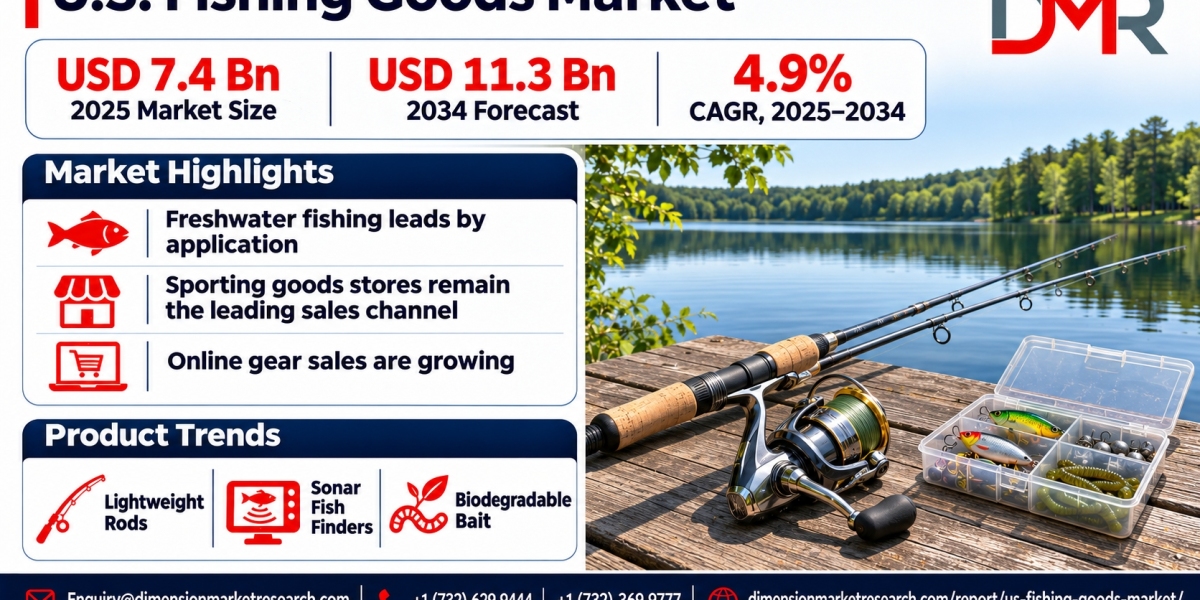

According to Dimension Market Research, the U.S. Fishing Goods Market Size was estimated at USD 7.4 billion in 2025 and is projected to reach USD 11.3 billion by 2034, growing at a compound annual growth rate (CAGR) of 4.9%. Recreational anglers drive demand across rods, reels, lures, and other tackle, while freshwater fishing gives many consumers an accessible way to take up the activity.
The opportunity spans different stages of an angler’s life. A family planning its first fishing trip may want a rod-and-reel combo that is easy to set up. An experienced angler may upgrade to a lighter, more sensitive rod or buy equipment for a different technique. Those purchase decisions help explain why manufacturers and retailers serve both entry-level and specialized demand.
What Is the U.S. Fishing Goods Market?
The market covers fishing rods, reels and components, hooks, lines, lures, baits, and other gear sold in the United States. The report examines demand by product type, fishing application, distribution channel, and end user. These categories help businesses assess which products anglers buy, where they shop, and how their needs vary by fishing method.
Get a Free Sample of the U.S. Fishing Goods Market Report
https://dimensionmarketresearch.com/request-sample/us-fishing-goods-market/
Why Do Fishing Rods and Freshwater Gear Lead Demand?
Fishing rods are projected to lead the market by product type. A rod is typically one of a beginner’s first purchases, and experienced anglers often upgrade when they want to improve casting, detect subtler bites, or try a new technique. Manufacturers use materials such as carbon fiber, graphite, and composites to offer different combinations of weight, sensitivity, and strength. Rod-and-reel combos also give retailers a way to sell a matched setup.
Freshwater fishing is expected to lead by application. Lakes, rivers, ponds, and reservoirs offer fishing opportunities across much of the country, with relatively low barriers to getting started. The report highlights states such as Michigan, Minnesota, and Texas, where freshwater fishing communities support demand for spinning rods, reels, and bait. For retailers, local fishing conditions can help determine which products to stock and when to promote them.
Why Do Sporting Goods Retailers Remain the Leading Channel?
Sporting goods retailers are projected to lead distribution. Shoppers can handle a rod, compare its weight and flex, and ask staff which reel or line would suit it. Those advantages matter for beginners assembling a first setup and for experienced buyers choosing specialized gear. Stores can also tailor seasonal assortments, such as stocking ice fishing equipment in northern markets or saltwater reels near the coast.
Online tutorials, product reviews, and angler communities also influence purchase decisions. For fishing brands, the product page and the store shelf can serve different parts of the same purchase. A shopper might learn which setup suits a particular species online, then compare rods in person before buying. Clear guidance on intended use can help shoppers make that comparison.
Where Are the Growth Opportunities for Fishing Brands?
Recreational anglers are expected to remain the largest end-user group. The report identifies women and younger anglers as fast-growing participant groups and points to beginner-friendly gear as a product opportunity. Family fishing events and youth programs can introduce new anglers to the sport, creating demand for equipment that is comfortable to handle and straightforward to assemble.
The competitive landscape includes Shimano, Pure Fishing, Daiwa, St. Croix Rods, and Eagle Claw. Brands can serve different needs through starter combos, equipment designed for specific fishing techniques, and upgrades built around lighter or more sensitive materials. The report also identifies pressure on fish stocks as a constraint. Where fishing opportunities decline or seasons are restricted, fewer outings can weaken demand for gear.
Explore the Complete U.S. Fishing Goods Market Analysis
https://dimensionmarketresearch.com/checkout/us-fishing-goods-market/
Frequently Asked Questions
How large is the U.S. Fishing Goods Market?
It was estimated at USD 7.4 billion in 2025 and is projected to reach USD 11.3 billion by 2034.
What is the projected CAGR of the U.S. Fishing Goods Market?
The report projects a CAGR of 4.9% from 2025 to 2034.
Which product category leads the U.S. Fishing Goods Market?
Fishing rods are projected to lead, supported by purchases from beginners and upgrades by experienced anglers.
Which fishing application leads demand?
Freshwater fishing is expected to lead because lakes, rivers, ponds, and reservoirs make it accessible to anglers across the country.
Which distribution channel leads U.S. fishing goods sales?
Sporting goods retailers are projected to lead, supported by hands-on product comparisons, staff advice, and assortments tailored to local fishing conditions.
Conclusion
Recreational participation and demand for gear upgrades support the U.S. market outlook through 2034. For manufacturers and retailers, one opportunity is to make the first purchase easier with well-matched setups, then offer specialized gear as anglers develop new skills and try different fishing methods.
Related Fishing Equipment Market Insights
The Recreational Fishing Equipment Market Size report estimates the global market at USD 14.8 billion in 2025 and projects USD 24.4 billion by 2034, at a CAGR of 5.7%. It covers rods, reels, lines, hooks, lures, and baits used in recreational fishing.
The Fishing Rods Market Share report identifies spinning rods as the leading product type, with a projected 36.0% global share in 2025. Carbon fiber was expected to lead by raw material with a 51.0% share that year.