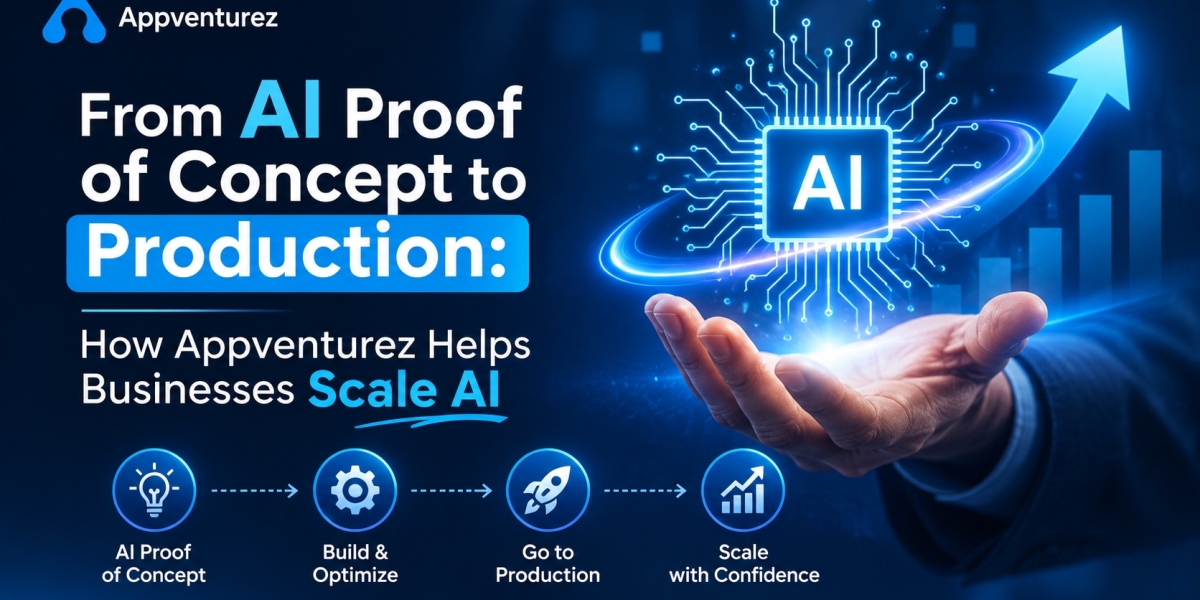

It is easy to be impressed by an AI demo. A few weeks of work, a clean dataset, and a clever prompt can produce a proof of concept that dazzles a boardroom. Then comes the harder question: can it run every day, on real data, for real users, safely, at a sensible cost, inside the systems the business already depends on?
For many organizations, the answer is not yet. Industry surveys regularly report that a large share of AI pilots never make it into production. They sit in what practitioners call pilot purgatory: promising, admired, and unused.
This guide explains why proofs of concept stall, what it actually takes to scale AI, and how Appventurez helps businesses move from experiment to dependable, production-grade AI. It also covers how scaled AI reaches users through mobile channels, including wearable and cross-platform apps.
Note: Company details and service descriptions should be confirmed on Appventurez’s official website before you rely on them for a purchasing decision.
What Is an AI Proof of Concept?
An AI proof of concept (POC) is a small, time-boxed project designed to answer one question: can AI solve this problem well enough to be worth pursuing? It typically uses a limited dataset, a narrow scope, and a simplified environment, and it aims to demonstrate feasibility rather than deliver a finished product.
A good POC does three things:
Tests technical feasibility with real, representative data
Estimates potential business value
Reveals the main risks, data gaps, and integration challenges
A POC is not a product. Treating it as one is the first step toward disappointment.
Why Most AI Proofs of Concept Never Reach Production
The gap between a successful POC and a running system is wider than most teams expect. Common reasons include:
The demo data was too clean. POCs often use curated samples. Real data is messy, incomplete, inconsistent, and constantly changing.
No clear business owner or metric. If nobody is accountable for the outcome, the project drifts once the novelty fades.
Integration was ignored. A model that works in a notebook cannot create value until it connects to CRM, ERP, data platforms, and user interfaces.
Security and compliance came too late. Privacy, access control, and regulatory reviews can stop a project cold when raised at the end.
Costs were not modeled. Inference, infrastructure, monitoring, and support costs at full scale can far exceed the pilot budget.
No plan for monitoring and drift. Models degrade as data and behavior change. Without monitoring, quality silently falls.
Evaluation was informal. Impressive examples are not evidence. Without systematic testing, nobody can say whether the system is good enough.
Skills gap. Data scientists who built the POC may not have the engineering, DevOps, and security experience needed for production.
Change management was missing. Users were not trained, processes did not change, and adoption stayed low.
Scope crept or shrank. Either the project tried to do everything, or it was so narrow that the return did not justify the investment.
Scaling AI means addressing each of these deliberately, not hoping they resolve themselves.
About Appventurez
Appventurez is a technology company based in Noida, India, that helps startups, SMEs, and enterprises build intelligent applications and AI-powered digital products. Its AI development offering highlights 100+ AI-driven products, 50+ certified AI engineers, work across 30+ industries, coverage in 38+ countries, and a 97% client satisfaction rate, as stated on the company’s own page.
Its capabilities span AI strategy, machine learning, Generative AI, LLM applications, AI agents, computer vision, NLP, intelligent automation, AI analytics, and AI integration. Solutions can be connected to existing enterprise ecosystems through APIs, cloud platforms, data systems, and modern AI infrastructure, and the company describes an approach that covers use-case discovery, data strategy, model and architecture selection, development, system integration, testing, deployment, monitoring, and continuous optimization.
That lifecycle view, from first idea through ongoing optimization, is exactly what moving from POC to production requires.
The Journey from POC to Production: An Overview
Scaling AI is a staged journey, not a single leap. A practical path looks like this:
Validate the POC honestly. Decide whether it deserves to continue.
Define production requirements. Turn a demo into a specification.
Prepare production-grade data. Build reliable pipelines and governance.
Re-architect for scale and reliability. Move from notebook to system.
Build evaluation and guardrails. Make quality measurable and safe.
Integrate with business systems and channels. Put AI where work happens.
Run a controlled pilot. Prove value with real users.
Deploy in stages with MLOps. Release safely and repeatedly.
Monitor, optimize, and govern. Keep it good, fast, safe, and affordable.
Scale to new use cases. Reuse the foundation.
The sections below explain each stage and how Appventurez approaches it.
Stage 1: Validate the POC Honestly
Not every POC deserves production. Before investing further, run a candid review.
Questions to answer
Did the POC meet its success criteria on realistic data, not only on curated samples?
Is the business value still compelling once real costs are estimated?
Who owns the outcome, and are they committed?
What were the failure cases, and how serious are they?
Are the required data and system access truly available?
Are there legal, privacy, or ethical barriers?
A strong partner will tell you when to stop, pivot, or simplify. Appventurez-style discovery work includes reviewing the POC, identifying gaps, and recommending whether to proceed, rework, or retire it. Ending a weak idea early is a success, not a failure.
Stage 2: Define Production Requirements
A demo has no obligations. A production system has many. Convert the POC into a clear specification covering:
Functional requirements. What the system must do, for whom, and in which situations.
Quality targets. Accuracy, precision, recall, groundedness, and acceptable error rates, including what happens when the AI is unsure.
Performance. Latency, throughput, and peak load.
Availability and reliability. Uptime targets, failover, and disaster recovery.
Security and privacy. Authentication, authorization, encryption, data residency, and retention.
Compliance. Regulations and internal policies such as GDPR, India’s DPDP Act, HIPAA, PCI DSS, or industry rules.
Cost envelope. Acceptable cost per transaction or per user, and total budget at scale.
Operational needs. Support model, monitoring, incident response, and ownership.
Success metrics. Business outcomes tied to the project, such as handling time saved, revenue influenced, or losses prevented.
These requirements shape every later decision, and agreeing them early avoids expensive surprises.
Stage 3: Build Production-Grade Data Foundations
POCs run on extracts. Production runs on pipelines.
Reliable ingestion. Automated, monitored pipelines from source systems, with retries and alerting.
Data quality checks. Validation for completeness, freshness, schema changes, and anomalies.
Standard definitions. A shared meaning for key terms and metrics.
Feature management. Consistent features for training and serving, where machine learning models are used.
Knowledge management for RAG. Document ingestion, chunking, embedding, indexing, versioning, and refresh schedules.
Access control. Permissions-aware data access so users see only what they should.
Privacy protection. Masking, anonymization, and consent handling.
Lineage and cataloging. Clear records of where data came from and how it changed.
Most production failures trace back to data issues, not model issues, so this stage deserves serious investment.
Stage 4: Re-Architect for Scale and Reliability
Code written to prove an idea is rarely suitable for production. Re-architecture typically includes:
Modular design. Separate components for data, models, retrieval, orchestration, business logic, and interfaces, so each can be tested and improved independently.
Scalable serving. Containerized services on cloud platforms such as AWS, Microsoft Azure, or Google Cloud, with orchestration through Kubernetes and autoscaling for variable demand.
API-first integration. Clean, versioned APIs that web, mobile, and enterprise systems can use.
Model strategy. Choose appropriate models for quality, cost, and latency, potentially routing simple tasks to smaller models and complex tasks to stronger ones, with fallbacks if a provider fails.
Caching and optimization. Reduce repeated computation and cost through caching, batching, and efficient prompts.
Resilience. Timeouts, retries, circuit breakers, graceful degradation, and clear fallbacks to human handling.
Environment separation. Development, staging, and production with controlled promotion.
Infrastructure as code. Repeatable, auditable environments.
Portability. Avoid unnecessary lock-in to a single model vendor or cloud service where it matters.
The aim is a system that is understandable, testable, and maintainable by people other than the original builders.
Stage 5: Build Evaluation, Guardrails, and Security
Trust is engineered, not assumed.
Systematic Evaluation
Build evaluation sets from real cases, including edge cases, ambiguous inputs, and adversarial attempts
Measure accuracy, groundedness, tool-use correctness, safety, latency, and cost
Use automated tests and human review together
Run regression tests whenever prompts, models, data, or code change
Define a quality gate that must pass before each release
Guardrails
Input checks for prompt injection and abuse
Output validation for policy, privacy, and tone
Citations and source grounding for knowledge answers
Limits on what actions an AI agent may take, with human approval for high-impact steps
Confidence thresholds and clear escalation paths
Security
Least-privilege access for AI components and tools
Secure secrets management and encryption
Protection against data leakage between users and tenants
Vulnerability scanning and penetration testing
Audit logs for requests, retrievals, and actions
Governance
Named owners for each AI system
Documentation of data sources, models, prompts, and known limitations
Review of risk, bias, and fairness where decisions affect people
Records of versions and changes
Stage 6: Integrate with Business Systems and Channels
Value appears only when AI is part of daily work.
Systems integration. Connect to CRM, ERP, ticketing, HR, finance, data warehouses, and internal applications through APIs and cloud platforms, with robust error handling and idempotent operations.
User channels. Deliver AI through web apps, internal portals, chat and messaging tools, email, voice, and mobile apps.
Workflow embedding. Place recommendations and actions inside the tools people already use, not in a separate destination they must remember to visit.
Human handoff. Pass full context to people when the AI escalates, so users never repeat themselves.
Notifications and approvals. Keep stakeholders informed and enable quick decisions.
Taking Production AI to Mobile: Wearable and Smartwatch Apps
Once an AI capability is stable, mobile delivery often multiplies its impact. Wearables in particular suit time-critical, hands-free, and sensor-rich scenarios.
Where wearables add value
Healthcare and wellness: remote monitoring, medication reminders, and early-warning alerts from vital-sign trends
Workforce safety: fall, fatigue, and hazard alerts in industrial and field settings
Field service and logistics: glanceable task prompts, route changes, and one-tap approvals
Fitness and coaching: personalized recommendations from activity and recovery data
Hospitality and retail: staff alerts for service requests and stock needs
Insurance and corporate wellness: consent-based, privacy-respecting programs
What building them involves
Watch apps and companion phone apps for watchOS and Wear OS
Sensor data collection and battery-aware syncing
Bluetooth Low Energy connectivity
On-device and cloud analytics, including anomaly detection and trend models
Concise, glanceable interface design with haptic and voice feedback
Strong privacy, explicit consent, and secure handling of health data
Regulatory awareness for health and medical claims
Choosing a wearable development partner
Wearable projects combine tiny screens, tight battery limits, sensors, mobile apps, and cloud AI, so choose a team with real experience across these areas.
A credible Wearable App Development Company can show live watch apps, not only phone apps.
When comparing a Wearable App Development Company in India with other options, check experience with watchOS, Wear OS, Bluetooth Low Energy, and health data frameworks.
Wearable App Development Services and Wearable Application Development Services should cover discovery, UX for small screens, development, testing on real devices, release, and maintenance.
Custom Wearable App Development Services matter when your use case needs tailored sensors, algorithms, or enterprise integration instead of a generic template.
A Wearable Mobile App Development Company should deliver the companion app and cloud back end alongside the watch experience, and Wearable Mobile App Development Services should include secure sync and analytics.
A Smartwatch App Development Company or Smartwatch App Development Services provider should understand battery, screen, and background-execution limits on each platform.
A Wearable App Development Agency with agile sprints and transparent reporting reduces risk, and many global businesses choose a Wearable App Development Agency in India for engineering depth and cost efficiency.
If you need sustained capacity, you can hire wearable app developers as a dedicated team working to your roadmap.
Start with a pilot on a small group of devices to validate battery impact, data accuracy, user acceptance, and privacy practices.
Taking Production AI to Mobile: Cross-Platform Apps
Most businesses need their AI experience on both Android and iPhone. Building two separate native apps doubles effort and cost. Cross-platform development uses frameworks such as Flutter and React Native to build a single codebase that runs on both platforms with near-native performance in most cases.
Why cross-platform suits scaled AI
Lower cost. One team and one codebase instead of two
Faster releases. New AI features reach both platforms together
Consistent experience. Matching behavior and design across devices
Easier maintenance. Fixes and improvements apply once
Shared backend. The same AI services and APIs serve every client
Fast iteration. Ideal for testing AI features with real users
Trade-offs to weigh
Very graphics-intensive or deeply platform-specific features may favor native development
Heavy on-device AI may need native modules
Framework and plugin updates need active management
Choosing a cross-platform partner
A strong cross-platform app development company should show Flutter or React Native apps in production, experience integrating AI and APIs, rigorous testing, and a plan for performance and updates. When you search for a cross-platform app development company in India, cross-platform app development services, a top cross-platform app development company, the best cross-platform app development company, or the top cross-platform app development companies, use those results to build a shortlist, then verify with live apps, references, and a pilot.
You can engage a cross-platform app development agency for end-to-end delivery, or hire cross-platform app developers to extend your own team. Reputable cross-platform mobile app development services cover discovery, design, development, QA, store release for both platforms, and post-launch support. India is a popular source of Flutter and React Native talent, which is why many companies compare a cross-platform app development company in India with local options.
Security note: mobile and wearable apps should never hold privileged credentials for AI or business systems. They authenticate the user, and the backend enforces permissions and logs actions.
Stage 7: Run a Controlled Pilot
Before full rollout, prove the system with real users in real conditions.
Pick a limited group representing the intended users, such as one team, region, or customer segment.
Define success criteria in advance, using business and quality metrics.
Compare against a baseline or control group where possible.
Keep humans in the loop, reviewing outputs and actions at first.
Collect feedback through usage data, surveys, and interviews.
Track failures and convert each into a test case.
Monitor cost per transaction against the model.
Decide with evidence: expand, adjust, or stop.
The pilot is also when change management begins: training users, explaining what the AI can and cannot do, and building trust.
Stage 8: Deploy in Stages with MLOps
MLOps (and its generative counterpart, LLMOps) brings software engineering discipline to AI.
Core practices
CI/CD for AI. Automated tests, evaluation gates, and repeatable deployments for code, prompts, and models
Versioning. Track datasets, models, prompts, and configurations so any result can be reproduced
Experiment tracking and model registry, using tools such as MLflow
Staged rollouts. Release to internal users, then a small percentage of traffic, then wider, with automatic rollback if metrics degrade
Feature flags and kill switches for instant control
Shadow and A/B testing to compare new versions safely
Infrastructure automation with containers, Kubernetes, and infrastructure as code
Operational readiness
On-call responsibilities and incident procedures
Support channels and escalation paths
Runbooks for common failure modes
Training for support and operations teams
Stage 9: Monitor, Optimize, and Govern
Production is where the real work of AI begins.
Monitor quality
Accuracy, groundedness, and task success rates
Escalation and override rates
User feedback and satisfaction
Drift in input data and predictions
Monitor operations
Latency, throughput, error rates, and uptime
Tool and integration failures
Dependency health, including model providers
Monitor cost
Token usage, model calls, and infrastructure spend per task
Cost trends against business value
Monitor safety and security
Policy violations, prompt injection attempts, and unusual access patterns
Data leakage indicators
Optimize continuously
Tune prompts, retrieval, and tools based on failure analysis
Refresh knowledge and retrain models when drift appears
Route traffic to cheaper models where quality allows
Use caching, batching, and distillation to cut cost
Evaluate new models as they appear
Govern
Regular risk and compliance reviews
Audit trails and documentation
Clear accountability and escalation
Periodic review of whether each AI system still delivers value
Stage 10: Scale to New Use Cases
The first production system should leave behind a reusable foundation.
Shared data platform and pipelines
Common AI services, such as retrieval, evaluation, guardrails, and monitoring
Reusable components and templates for new agents and applications
Platform standards for security, logging, and deployment
A prioritized backlog of use cases ranked by value and feasibility
Skills and process so internal teams can contribute and maintain
Businesses that build a platform mindset find each new AI use case faster and cheaper than the last.
How Appventurez Helps at Each Stage
Based on the company’s stated capabilities, a partner like Appventurez can support the journey as follows.
Strategy and discovery. AI strategy, use-case assessment, POC review, and a clear roadmap from pilot to production.
Data and architecture. Data strategy, model and architecture selection, and design for scale, using cloud platforms and modern AI infrastructure.
Engineering. Development of machine learning, Generative AI, LLM applications, RAG solutions, AI agents, computer vision, NLP, and intelligent automation, using technologies such as Python, TensorFlow, PyTorch, Scikit-learn, XGBoost, OpenAI, Claude, LLaMA, Hugging Face, LangChain, LlamaIndex, AutoGen, CrewAI, OpenCV, and YOLO.
Integration. Connecting AI with existing enterprise ecosystems through APIs, cloud platforms, and data systems.
Deployment and MLOps. Testing, deployment, monitoring, and continuous optimization, using tools such as MLflow, Kubernetes, and major cloud platforms including AWS, Microsoft Azure, and Google Cloud.
Delivery channels. Web, mobile, and related applications that put AI in front of users. Confirm current wearable and cross-platform mobile capabilities directly with the company.
Optimization. Model optimization, cost control, and ongoing improvement after launch.
With a stated minimum project size of $10,000+ and hourly rates under $25, the company positions itself as accessible to startups and SMEs while supporting larger programs. Always request a written estimate with assumptions.
Illustrative Scenarios
The following are hypothetical examples, not client case studies.
Scenario 1: A support assistant that outgrew its demo. A POC chatbot impressed leadership but failed on real tickets. The team rebuilt retrieval with cleaned, permission-aware knowledge, added evaluation sets and guardrails, integrated with the ticketing system, piloted with one team, and rolled out in stages. Resolution time dropped and escalations carried full context.
Scenario 2: A forecasting model stuck in a notebook. A demand model performed well in testing but required manual data pulls. Engineers automated pipelines, containerized the model, added monitoring for drift, and delivered forecasts to planners inside their existing tools and a mobile app.
Scenario 3: A health monitoring pilot. A POC analyzed wearable data for early-warning signs. Moving to production required consent flows, secure sync, a watch and companion app, clinician dashboards, and rigorous privacy controls before pilot expansion.
Scenario 4: A retail AI app on two platforms. A recommendation engine proved valuable on web. The company delivered it through a cross-platform mobile app so Android and iPhone customers received the same experience from one codebase, powered by shared AI services.
Estimated Timeline and Cost
Figures are planning guides only. Actual costs vary with scope, integration, compliance, and team location, so request detailed estimates.
POC review and production discovery: about 2 to 4 weeks, often $5,000 to $20,000
Production hardening of a focused use case: about 2 to 4 months, often $40,000 to $150,000
Enterprise-scale deployment with integrations and MLOps: about 4 to 9 months, often $100,000 to $400,000 or more
Mobile, wearable, or cross-platform delivery layer: typically adds weeks to months and tens of thousands of dollars
Ongoing operations: model usage, infrastructure, monitoring, and improvement, commonly a meaningful share of build cost each year
Budget for operations from the start. Many AI projects fail not because they cost too much to build but because nobody planned to run them.
Common Mistakes When Scaling AI
Treating the POC as the product
Starting without a business owner or success metric
Ignoring data pipelines and relying on one-off extracts
Leaving security and compliance until the end
Skipping systematic evaluation and relying on impressive examples
Underestimating integration work
Forgetting cost at scale
Launching everywhere at once instead of staging the rollout
Neglecting monitoring and drift
Overlooking change management and training
Locking into a single vendor without an exit plan
Declaring victory at launch and underinvesting in improvement
How to Choose a Partner to Scale Your AI
Production track record, not just demos
Full-lifecycle capability from strategy to monitoring
Engineering depth in integration, cloud, security, and MLOps
Evaluation discipline with clear quality measures
Domain knowledge relevant to your industry
Delivery breadth, including web, mobile, wearable, and cross-platform where needed
Transparent process and pricing, with phased milestones
Security and compliance practices
References and case studies with measured outcomes
Clear ownership of code, data, prompts, and models
Post-launch support and a plan for continuous improvement
Begin with a paid discovery or POC review so you can judge how the team thinks before committing to a larger build.
Trends in Scaling AI for 2026
From pilots to platforms. Organizations are consolidating scattered experiments into shared AI platforms.
Agentic AI in production. As agents take actions, permissions, evaluation, and oversight become central.
LLMOps maturity. Evaluation, prompt versioning, tracing, and cost control are becoming standard practice.
Cost-aware architectures. Model routing, smaller models, and caching reduce spend at scale.
Governance by default. Auditability, access control, and policy enforcement are expected from the start.
Edge and on-device AI. More inference runs on phones, wearables, and devices for latency and privacy.
Mobile-first delivery. AI is increasingly delivered through polished mobile, wearable, and cross-platform apps.
Frequently Asked Questions
Why do most AI proofs of concept fail to reach production?
Common causes include unrealistic demo data, no clear owner or metric, poor integration planning, late security reviews, unmodeled costs, missing monitoring, informal evaluation, and a skills gap between data science and production engineering.
How long does it take to move an AI POC to production?
A focused use case often takes two to four months of production engineering after a short review. Enterprise-scale deployments with integrations and compliance can take four to nine months or more.
What is MLOps and why does it matter?
MLOps applies engineering practices such as version control, automated testing, staged deployment, and monitoring to AI systems. It keeps models reliable, reproducible, and improvable after launch.
How can Appventurez help scale my AI project?
Appventurez can support POC review, strategy, data and architecture design, development of ML and Generative AI solutions, enterprise integration, deployment, monitoring, and ongoing optimization, based on its stated end-to-end AI capabilities.
How much does it cost to take AI to production?
Costs range from tens of thousands of dollars for a focused use case to several hundred thousand or more for enterprise deployments, plus ongoing operating costs. The company lists a minimum project size of $10,000+ and rates under $25 per hour, but you should request a detailed estimate.
How do you keep AI accurate after launch?
Through continuous monitoring, evaluation sets, user feedback, drift detection, knowledge refreshes, retraining, and regression testing before every change.
How do you control AI costs at scale?
By measuring cost per task, routing work to appropriately sized models, caching and batching, optimizing prompts and retrieval, and reviewing cost against business value regularly.
Do I need a wearable app for my AI solution?
Only when your use case benefits from glanceable, hands-free, or sensor-driven interaction, such as health monitoring, safety alerts, or field operations. A Wearable App Development Company can build watch and companion apps with the right privacy and battery considerations.
Should I choose cross-platform or native mobile development?
Choose cross-platform when you need Android and iPhone quickly on one codebase and mostly use cloud-based AI. Choose native when you need maximum performance, heavy on-device AI, or deep platform-specific features.
How do I choose the best cross-platform or wearable development partner?
Review live apps and ratings, check technical skills and AI integration experience, speak to past clients, confirm testing and security practices, compare transparent pricing, and start with a pilot.
Conclusion
The distance between an impressive AI demo and a dependable business system is real, but it is predictable. Teams that cross it do so by treating production as a discipline: define requirements, build solid data foundations, re-architect for reliability, evaluate systematically, add guardrails and security, integrate with real workflows, pilot with real users, deploy in stages with MLOps, and monitor and improve continuously.
Appventurez brings AI specialization and engineering together across strategy, machine learning, Generative AI, LLM applications, RAG, AI agents, computer vision, NLP, intelligent automation, and enterprise integration. Combined with delivery through web, mobile, wearable, and cross-platform channels, that lifecycle approach helps businesses move from proof of concept to production and from one use case to many.
If you have a promising POC gathering dust, start by reviewing it honestly. Define what production requires, invest in data and architecture, measure quality, and plan for operations. Done well, scaling AI turns a clever experiment into a lasting business capability.