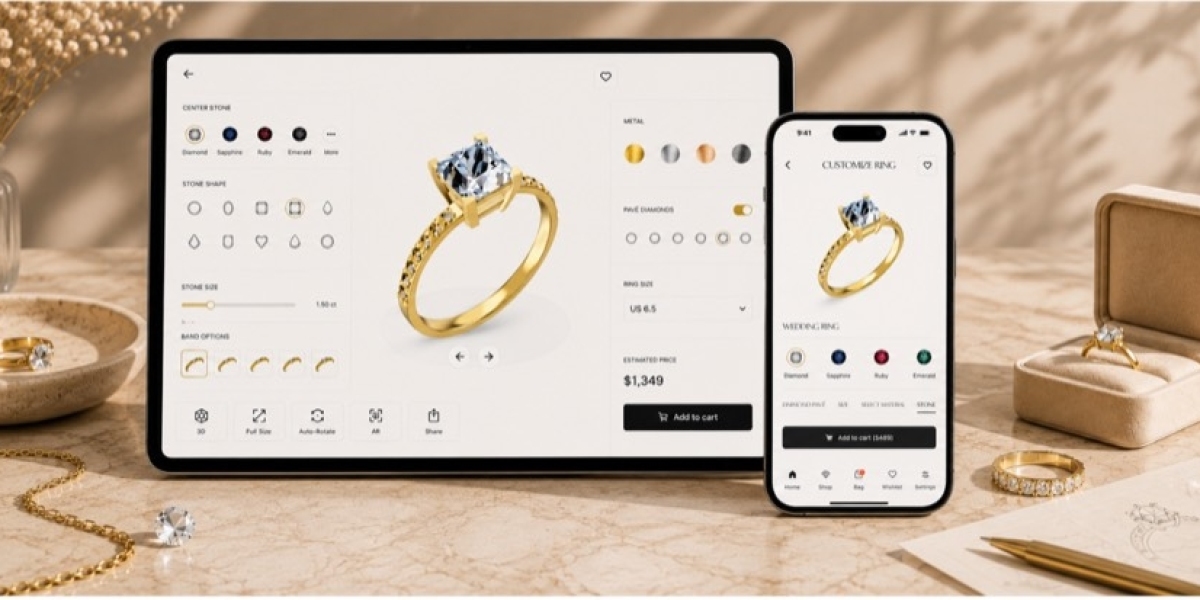

A Los Angeles jeweler who wants to sell custom rings online has three routes: commission a configurator built around its own models, license a SaaS platform, or keep CAD work local and add 3D on top. Of the seven options below, a custom build from Todor3D in Culver City covers the most of the ring-buying flow, with stone, metal, setting, engraving, live price and AR try-on in one browser tool. Threekit and Zakeke follow as off-the-shelf platforms, and iQ Design Studio is the local CAD shop in the Jewelry District.
| # | Option | Type | AR try-on | Live price | Reviews |
|---|---|---|---|---|---|
| 1 | Todor3D | Custom build studio, Culver City | Yes, on the shopper's hand | Yes | Clutch 5.0 · 25 |
| 2 | Threekit | Platform with a packaged ring configurator | Not listed; model hand and turntable views | Price module tied to price books | — |
| 3 | Zakeke | Self-serve SaaS with store plug-ins | AI virtual try-on for jewelry | Not listed on jewelry page | — |
| 4 | iQ Design Studio | Jewelry CAD studio, Jewelry District | AR try-on linked on site | No | Google 5.0 · 23 |
| 5 | Salsita | Configurator platform for complex products | Not on jewelry page | Yes, instant | — |
| 6 | Expivi | 3D configurator platform | Web AR | Yes, real time | — |
| 7 | Emersya | 3D and AR viewer and configurator platform | Web AR | Not listed | — |
How We Ranked
We opened each company's website and kept only those that show jewelry or ring work, then checked which parts of a custom ring order each one handles: stone and metal choice, setting, engraving, live pricing and AR try-on. Public case studies with live demos counted more than feature lists, and so did a stated tech stack.
Independent reviews on Clutch or Google, a California presence and published budget ranges broke ties. Platforms rank by how much of the ring flow they show on their own jewelry pages, not by company size.
Seven Ways to Put a Ring Builder on Your Store
Todor3D, Culver City, Los Angeles
Todor3D is a 3D web studio founded in 2020, with its US office at 6101 W Centinela Ave #110 in Culver City and a team of 40+ people working across time zones. It builds configurators on Three.js, React Three Fiber and WebGL, uses 8th Wall for AR, and holds a 5.0 rating across 25 Clutch reviews.
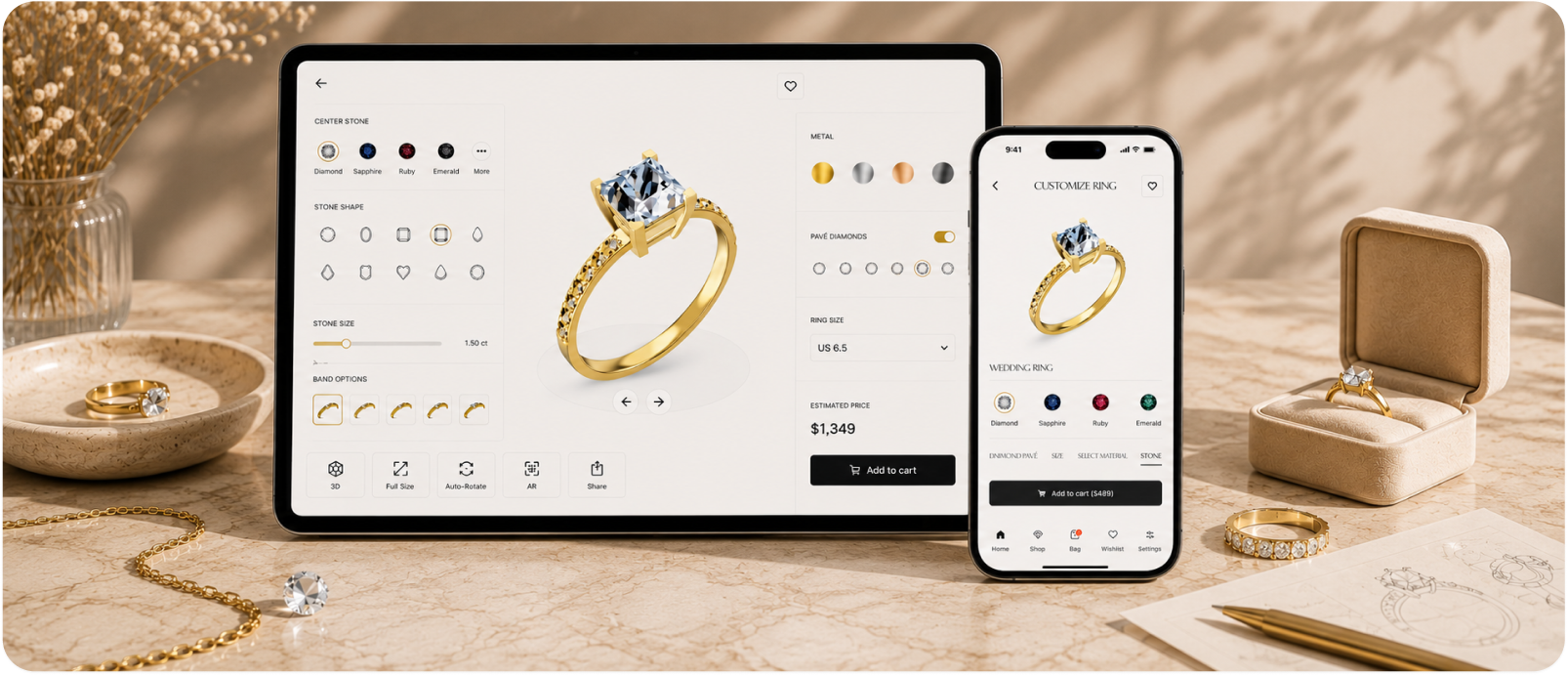
The Todor3D jewelry configurator lets a shopper change the stone, metal, setting and engraving while price and specs update in WebGL, then try the ring on their own hand in AR. A finished design can be saved or shared as a view-only link, so a custom inquiry arrives as a pre-approved order. Budget range on the case: $10,000–50,000.
Setup work is where the build pays off for a jeweler with a large catalog. Stones snap into the setting automatically, and new models are analyzed to detect stones by name and geometry, which shortens setup for every SKU added. The shared view can be interacted with, but the underlying 3D model cannot be downloaded or exported.
The same build doubles as a content tool. Premium scenes place a single ring on a marble pedestal or in a box, and the platform can generate marketing photos and video from any configured model without a new photo shoot for each combination.
Threekit
Threekit, a visual commerce platform, sells an engagement ring configurator as a packaged offering. Shoppers pick gem shapes, metals, setting styles, band styles and finishes and view the ring from every angle, on a turntable or on a model hand.
The jeweler sends CAD files, and Threekit turns them into photorealistic models, with gems rendered in V-Ray. A separate Price module applies the retailer's own price books and rules.
Zakeke
Zakeke is a self-serve customization platform with a dedicated jewelry and accessories section that promises lifelike 3D models, live customization and an app-free AI virtual try-on. It suits a jeweler who wants to start without a development team.
Its clearest strength is integration: native connectors for Shopify, WooCommerce, Wix, BigCommerce, Adobe Commerce and PrestaShop, which Zakeke describes as plug and play with no code.
iQ Design Studio
iQ Design Studio sits at 606 S Hill St in the Jewelry District and works upstream of the storefront. It produces stone-ready, cast-ready CAD models, prints castable wax on industry-standard MJP printers, and renders stills, turntables and video.
Its site also links to an AR try-on and a design visualizer for stores. The standout is speed: most models are finished the next business day, and most wax prints the same day if approved by 3:00 PM.
Salsita
Salsita builds 3D configurators for complex products from offices in Prague, Ostrava and Atlanta, and runs a jewelry and luxury line. Shoppers choose gemstones, settings and metal finishes, add engraving text and get an instant price in one session.
The wider platform is built around manufacturing: finished configurations can generate outputs such as CAD files and bills of materials for the production team.
Expivi
Expivi is a 3D configurator platform that lists jewelry among its industries and mentions a wedding ring configurator. Its jewelry page focuses on real-time pricing, so shoppers see how each choice moves the number, and on production-ready files at the end of the order.
The platform connects to SAP, Oracle NetSuite, Microsoft Dynamics, Salesforce, Shopify and Magento, which matters to a jeweler running inventory in an ERP.
Emersya
Emersya offers 3D configurators, 3D viewers, web AR and rendering automation. Its jewelry-adjacent work leans toward presentation: Gemmyo uses Emersya's 3D viewer on a diamond ring page, and Vacheron Constantin lets buyers customize strap material, color, stitching and engraving.
One useful trait for a catalog with many finishes is variant building, where several colorways come from a single 3D model.
A Configurator Turns CAD Revisions Into a Self-Serve Order
The traditional custom ring order runs through a consultation, a CAD design the client cannot see in context, three to six rounds of revisions and only then production. Each round means an email, a render and a wait, and buyers lose interest along the way.
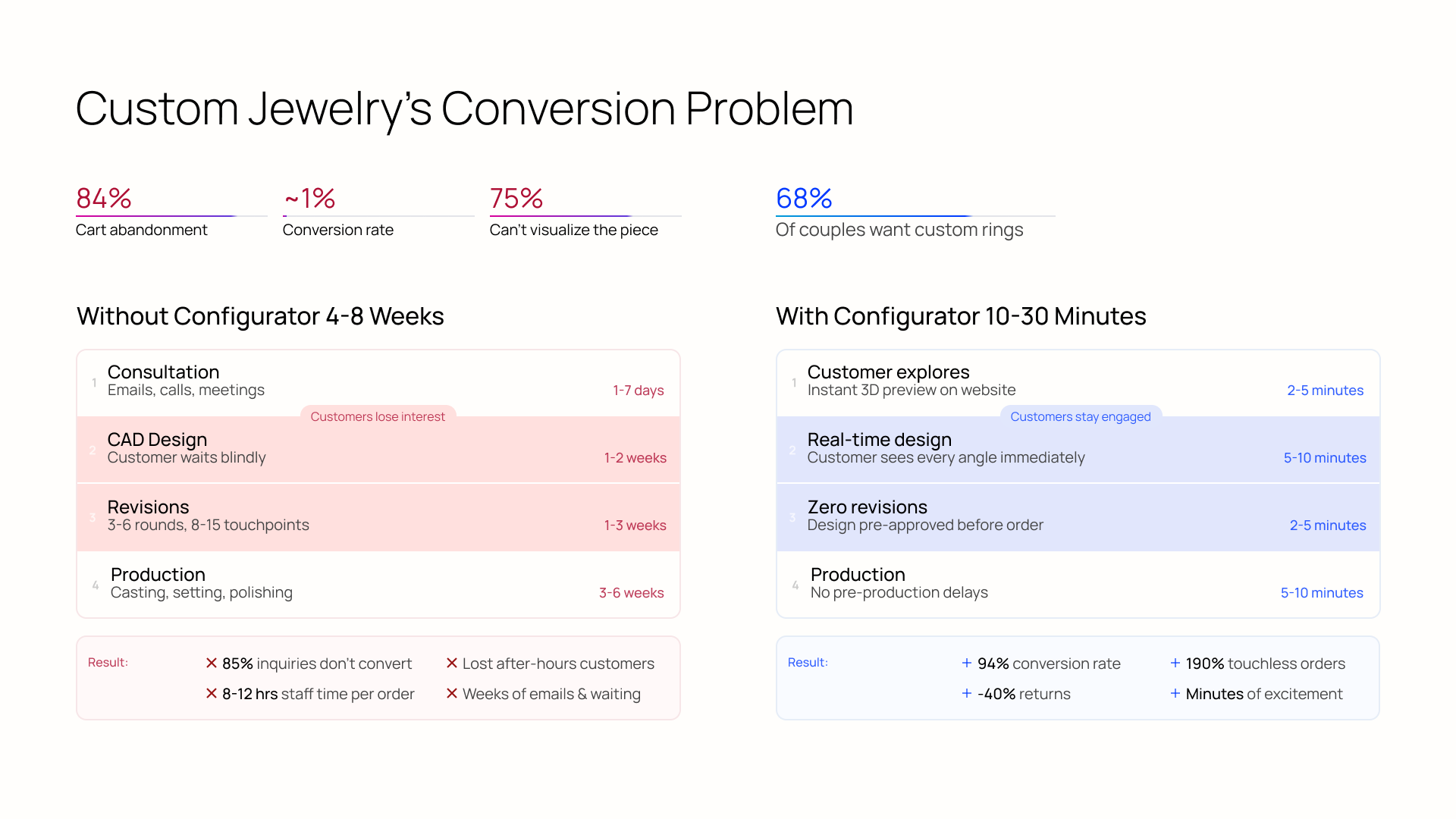
A configurator moves most of that work to the shopper. The buyer picks a cut, a center stone, a metal and a shank style, types the engraving and sees the result at their own size before anyone talks about money.
| Step | Without a configurator | With a configurator |
|---|---|---|
| First idea | Consultation by phone, email or in store | Shopper builds the ring online |
| Design | CAD drafted from notes | Options limited to what the jeweler can make |
| Revisions | Three to six rounds of renders | Changes made live by the shopper |
| Price | Quoted after the design settles | Updates with every change |
| Hand-off | Notes collected from emails | A saved design with full specs |
Upsells also happen during configuration rather than in a sales call. A shopper who sees a sapphire next to a diamond, or rose gold next to platinum, makes that comparison alone, and the jeweler sees which combinations people actually build.
The jeweler's job shifts to rules. Someone has to decide which stones fit which settings, how metal and stone choices map to price, and which engraving fonts the workshop can produce, and those rules are what a developer or platform turns into options.
FAQ
How much does a 3D ring configurator cost?
The jewelry configurator case above is listed at $10,000–50,000, and the studio's site says most e-commerce configurator projects start around $10,000–25,000. Cost depends on the number of ring models, the stone and metal combinations, AR try-on and how pricing connects to the store. SaaS platforms charge subscriptions, so ask each vendor for a quote based on your catalog.
How long does it take to launch?
The Culver City studio's site puts a typical 3D configurator or AR feature at 4–10 weeks. Pre-built templates for rings, pendants and earrings shorten setup, while a large catalog of unique models adds time for modeling and stone placement.
Should a jeweler build custom or use a SaaS platform?
A SaaS platform is faster to start if your store runs on Shopify or WooCommerce and your options fit its templates. A custom build makes sense when you need your own pricing logic, AR try-on on the hand, protected models or a viewer that matches your brand.
What should we prepare before starting?
Gather CAD files for the rings you want to sell, a list of stones, metals and settings per model, and the rules that set price. Photos of finished pieces help the 3D team match metal and stone materials to what customers will receive.









