
Setting up a payments bank in India requires substantial financial resources, regulatory preparation and a clear business strategy. The Reserve Bank of India (RBI) has established specific capital requirements to ensure that payments banks have sufficient financial strength to operate responsibly and protect customer interests.
One of the most important conditions for establishing this type of bank is the payment bank minimum capital requirement of ₹100 crore in paid-up equity capital. However, meeting this initial requirement alone is not sufficient. Promoters must also consider ongoing capital adequacy, leverage requirements, ownership conditions and other regulatory obligations.
For startups, fintech companies, NBFCs and established businesses exploring the banking sector, understanding these requirements is essential before preparing a licensing application.
What Is the Minimum Capital Required to Start a Payments Bank in India?
According to the RBI's Guidelines for Licensing of Payments Banks dated November 27, 2014, the minimum paid-up equity capital required to establish a payments bank in India is ₹100 crore.
This requirement ensures that the proposed bank has an adequate financial foundation to develop its technology infrastructure, establish operational systems, manage regulatory responsibilities and provide banking services.
The ₹100 crore requirement refers to paid-up equity capital, not simply the total value of assets or an estimated business investment.
Promoters planning to establish a payments bank should therefore arrange the required equity funding and maintain a financial structure that supports the bank's long-term operations.
The initial capital requirement should also be considered separately from the ongoing capital adequacy requirements prescribed by the RBI.
RBI Capital Requirements for Payments Banks
The RBI has introduced capital-related conditions to maintain the financial stability of payments banks. These requirements cover initial capital, regulatory capital and leverage.
The important requirements include:
Capital requirement | Regulatory requirement |
Minimum paid-up equity capital | ₹100 crore |
Minimum promoter contribution | 40% for the first five years |
Minimum total capital adequacy ratio | 15% of risk-weighted assets |
Minimum CET1 capital | 6% of risk-weighted assets |
Minimum Tier 1 capital | 7.5% of risk-weighted assets |
Minimum leverage ratio | 3% |
The capital adequacy figures are prescribed under the RBI's Payments Banks – Prudential Norms on Capital Adequacy Directions, 2025, as updated on October 7, 2026.
These are different regulatory tests. Businesses should not confuse the initial paid-up capital requirement with the capital that must be maintained continuously during banking operations.
Understanding the ₹100 Crore Paid-Up Capital Requirement
Paid-up equity capital represents the amount of share capital actually paid by shareholders against the shares issued by a company.
For a proposed payments bank, the RBI requires a minimum of ₹100 crore in paid-up equity capital.
For example, if promoters and eligible investors establish a proposed payments bank with ₹100 crore in paid-up equity capital, the entity meets the stated minimum capital threshold. However, this does not automatically guarantee RBI approval.
The RBI will also assess the promoter group's financial strength, ownership structure, business plan, management capabilities and compliance arrangements.
Why Does RBI Require ₹100 Crore?
The capital requirement serves several purposes:
1. Financial stability: Adequate capital provides a financial foundation for the bank and supports its ability to meet regulatory obligations.
2. Technology infrastructure: Payments banks depend heavily on digital platforms, secure transaction systems, banking software and cybersecurity arrangements.
3. Operational preparedness: Establishing branches, customer support facilities, transaction-processing systems and compliance functions requires financial resources.
4. Customer protection: A well-capitalised institution is better positioned to manage operational challenges and maintain customer confidence.
5. Long-term sustainability: Sufficient initial capital helps the bank establish operations without depending entirely on immediate business revenues.
What Is the Promoter's Contribution to Payments Bank Capital?
The promoter's contribution is another important aspect of payments bank licensing.
Under the RBI's 2014 licensing guidelines, promoters must contribute at least 40% of the paid-up equity capital of the payments bank. This contribution must be maintained for the first five years from the commencement of business.
For example, consider a proposed payments bank with paid-up equity capital of ₹100 crore.
Total paid-up equity capital: ₹100 crore
Minimum promoter contribution: ₹40 crore
Remaining capital: ₹60 crore
The remaining capital may be arranged through eligible investors, subject to applicable RBI ownership and shareholding requirements.
The promoter's contribution demonstrates financial commitment and ensures that the promoters have a meaningful stake in the institution.
Promoters should also review the applicable RBI requirements concerning changes in ownership, share transfers and foreign investment before finalising the capital structure.
Capital Adequacy Ratio for Payments Banks
Apart from the initial capital requirement, payments banks must maintain a prescribed Capital to Risk-Weighted Assets Ratio (CRAR).
Under the RBI's Payments Banks – Prudential Norms on Capital Adequacy Directions, 2025, the minimum total capital requirement is 15% of total risk-weighted assets on an ongoing basis.
The prescribed capital components are:
1. Common Equity Tier 1 (CET1)
Payments banks must maintain CET1 capital of at least 6% of their risk-weighted assets.
CET1 primarily includes qualifying common equity instruments and eligible reserves, after applicable regulatory adjustments.
2. Tier 1 Capital
The minimum Tier 1 capital requirement is 7.5% of risk-weighted assets.
Tier 1 capital includes CET1 and eligible Additional Tier 1 (AT1) instruments, subject to RBI conditions. AT1 capital can contribute up to 1.5% within the minimum Tier 1 requirement.
3. Total Regulatory Capital
The total regulatory capital requirement is 15% of risk-weighted assets.
It includes Tier 1 and eligible Tier 2 capital, subject to the prescribed limits.
These requirements must be maintained continuously rather than being treated as a one-time condition at the time of incorporation or licensing.
Leverage Ratio Requirement for Payments Banks
The leverage ratio is another important financial safeguard.
Under the RBI's updated Payments Banks – Prudential Norms on Capital Adequacy Directions, 2025, payments banks must maintain a leverage ratio of at least 3%.
The directions also specify that outside liabilities should not exceed 33.33 times the bank's net worth, comprising paid-up capital and reserves.
This requirement helps restrict excessive leverage and ensures that the bank maintains an adequate capital base in relation to its liabilities.
Promoters should consider this requirement while preparing financial projections and estimating the bank's future funding requirements.
Who Can Apply to Establish a Payments Bank in India?
The RBI's payments bank licensing framework identifies eligible categories of promoters.
These include:
Existing non-bank prepaid payment instrument (PPI) issuers.
Non-Banking Financial Companies (NBFCs).
Corporate Business Correspondents.
Mobile telephone companies.
Supermarket chains.
Companies and real-sector cooperatives owned and controlled by residents.
Public sector entities.
Other eligible entities covered under the RBI licensing framework.
A promoter or promoter group may also establish a joint venture with an existing scheduled commercial bank, subject to applicable regulatory conditions.
Eligibility is not determined by capital availability alone. The RBI also considers the promoter's financial soundness, professional experience, business track record and fit-and-proper status.
Important Business Activities of Payments Banks
Understanding the permitted business activities is essential before investing ₹100 crore in a proposed payments bank.
Payments banks operate under a differentiated banking model. Their activities are primarily focused on deposits, payments and remittance services.
Their permitted activities include:
Accepting demand deposits, subject to applicable limits.
Providing domestic payments and remittance services.
Issuing ATM and debit cards.
Providing internet and mobile banking facilities.
Acting as a Business Correspondent for other banks, subject to applicable conditions.
Distributing non-risk-sharing financial products, such as insurance and mutual funds, subject to regulatory requirements.
An important restriction: Payments banks cannot undertake lending activities on their own account. They must also comply with RBI requirements governing the deployment of customer deposits and other funds.
Therefore, promoters should prepare a business model based on transaction services, digital banking, payments and financial inclusion rather than traditional lending operations.
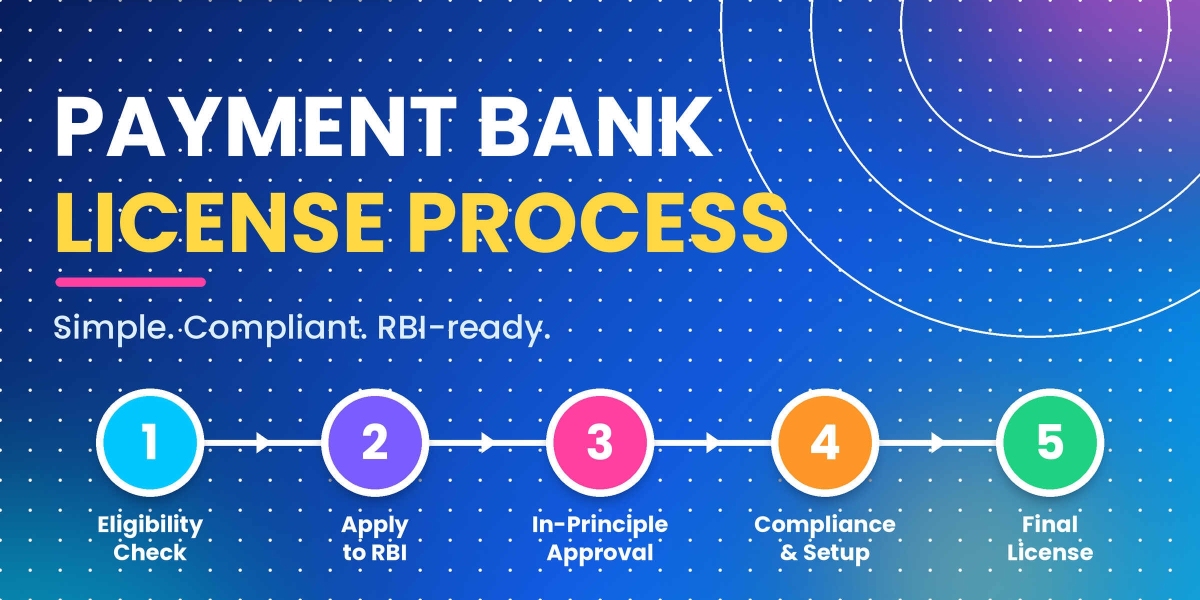
Steps to Establish a Payments Bank in India
Establishing a payments bank involves several regulatory and business preparations.
Step 1: Assess Promoter Eligibility
The proposed promoters should examine whether they fall within the eligible categories under RBI's licensing framework.
Their financial position, professional experience and business track record should be assessed before proceeding.
Step 2: Arrange the Required Capital
The promoters must plan for the minimum ₹100 crore paid-up equity capital and ensure that the required promoter contribution is available.
The proposed shareholding structure should also comply with applicable ownership conditions.
Step 3: Prepare a Detailed Business Plan
The business plan should explain the proposed banking model, target customers, technology infrastructure, revenue sources, operational strategy and financial projections.
It should also demonstrate how the proposed bank will comply with RBI's operating and prudential requirements.
Step 4: Establish Technology and Compliance Infrastructure
Payments banks depend on secure and reliable technology systems.
Promoters should plan for transaction monitoring, cybersecurity, data protection, customer grievance management, internal controls and regulatory reporting.
Step 5: Submit the Application to RBI
The licensing application must follow the applicable RBI process and prescribed documentation requirements.
The RBI evaluates the applicant's eligibility, financial strength, ownership, management and proposed business model before taking a licensing decision.
Step 6: Obtain Regulatory Approval and Commence Operations
An applicant must obtain the required RBI approval and fulfil the applicable conditions before commencing banking operations.
The bank must continue to comply with the licensing conditions and ongoing regulatory requirements after starting its business.
Common Mistakes to Avoid When Planning Payments Bank Capital
Promoters should pay attention to several issues before committing funds.
Confusing paid-up capital with net worth: These are different financial concepts. Meeting the initial paid-up equity capital requirement does not automatically establish compliance with every ongoing capital requirement.
Ignoring promoter contribution: The minimum 40% promoter contribution must be considered while planning the ownership structure.
Underestimating technology expenditure: Digital banking infrastructure, cybersecurity and transaction management require substantial planning and investment.
Overlooking capital adequacy: Maintaining the required CRAR and leverage ratio is an ongoing responsibility.
Preparing an unrealistic business plan: Financial projections should reflect the restrictions applicable to payments banks, particularly the prohibition on undertaking lending activities.
Addressing these issues at the planning stage can help promoters avoid unnecessary regulatory and financial complications.
Conclusion
The payment bank minimum capital requirement in India is ₹100 crore in paid-up equity capital under the RBI's licensing framework. However, establishing a payments bank involves much more than arranging the initial investment.
Promoters must also satisfy ownership requirements, maintain the prescribed capital adequacy ratio and leverage ratio, establish secure technology infrastructure and comply with RBI licensing conditions.
Businesses considering this opportunity should carefully evaluate their eligibility, financial capacity and proposed operating model before initiating the licensing process.
Most popular services :
Financial intelligence unit india